Our contention is that, if we fail to think through and delimit the role of AI in our lives, we risk undermining the intelligibility of our own guiding cultural concepts, and thus initiating a period in our own society of which it may someday be possible to say that “nothing happened.”
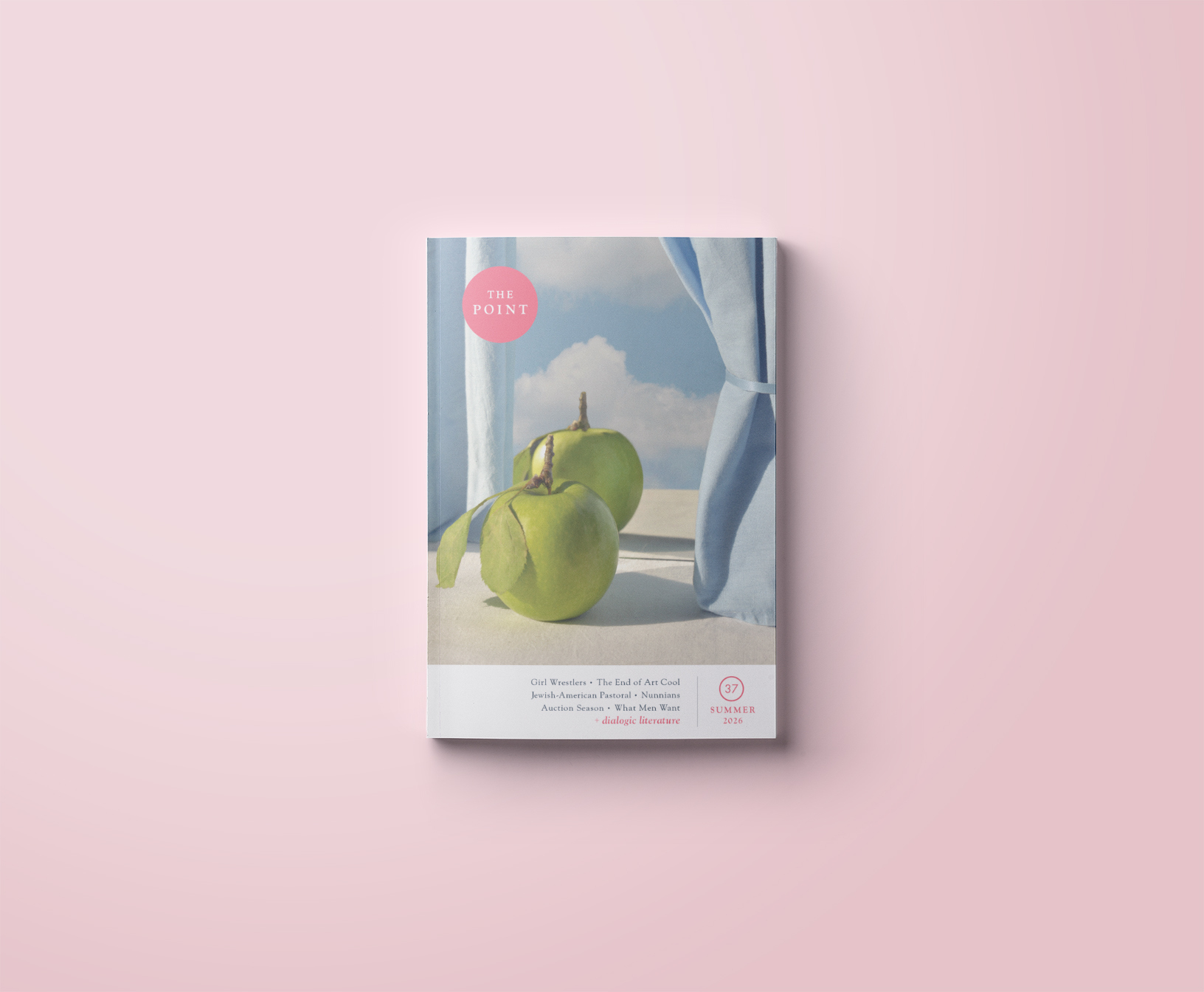
My daughter joined her school’s newly formed girls’ wrestling team in the seventh grade. Her first tournament was at a high school in Oak Harbor, Ohio.
When the art market can get by with flashy and ineffectual figurative paintings that are easy to sell on Instagram, it no longer has any reason to care about what’s going on in artistic subcultures. Indeed, those subcultures no longer have any reason to care about themselves.
It’s one thing to think abstractly about what men want, as a literary or philosophical question, or even to decry sexism as a social phenomenon; it’s another to be a single woman in New York City seeking love and partnership, and to worry that what you have to offer is not especially desired by those you are attracted to.
As the global tides have continued to shift rightward, I’ve found myself going back to those initial days of Occupy, looking for clues. What was it about the movement that captured the imagination of an entire generation?
On November 13, 2024, about fifty people gathered on a corner in West Orange, New Jersey, a quiet suburb an hour’s drive from Manhattan. The plan was to march down the block to protest in front of Moshe Glick’s home.
This past January, I traveled to a small town in Wisconsin’s Driftless region, the southwest corner of the state the glaciers missed, to join a summit of representatives from the far-flung universe of “microcolleges.”
Before I even knew what teaching was, I loved to teach. When I was a child, as soon as I left the crib—and oh, believe me, I wanted to leave that crib! ha ha—my mother would join me in my puny bed, the one that felt so vast at the time, and she would read aloud to me.
Hope being an exotic commodity these days, I try to take it wherever I can get it. One of the few recent times I’ve felt optimistic about the future was last fall—November 18th, to be exact, at 7 p.m. EST.
It can seem, then, that to try to say something about the essence of Fosse’s work is to go against the wisdom of the author as well as his most sensitive readers—and so perhaps to violate the spirit of the work itself.