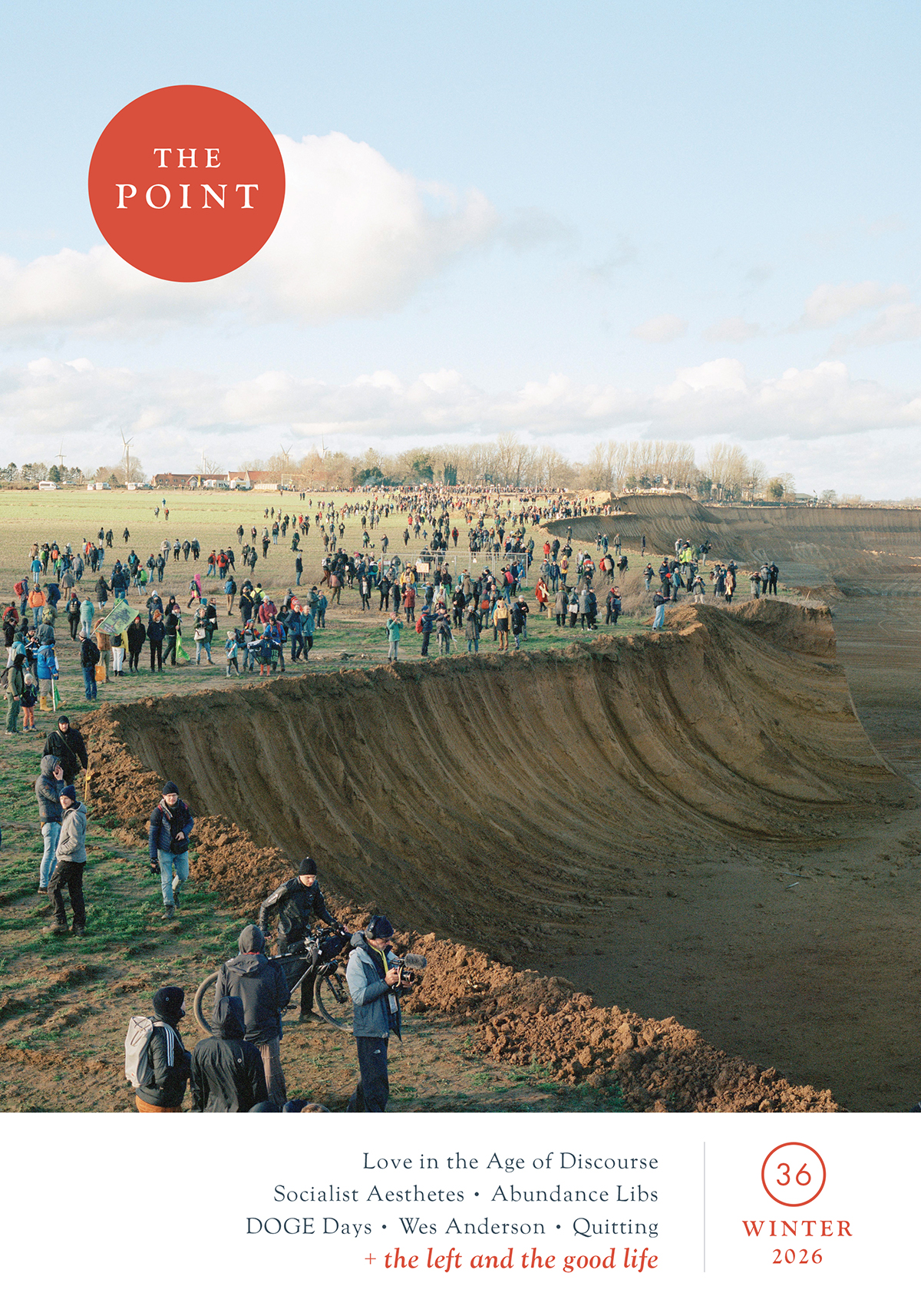
There are understandable reasons why liberal and leftist intellectuals are cautious about discussing the good life.
Another fed worker tells me he spends his days pacing the marble corridors of his office like an absolute madman. The Lana del Rey lyric “I don’t wanna do this anymore” plays on loops in his head in Lana’s exact fey, languid voice.
Yes, your fantasies aren’t real, but you’re not stupid to have had them.
Heterosexuality has been deemed dangerous for as long as I can remember.
What I’m about to say is going to seem like a bad joke: the trouble with the left is its egalitarianism.
I once found the spirit of democracy at a church that met in a movie theater.
Discovering class consciousness is itself a social practice, where people form communities through a constant feedback loop of desire, self-inquiry and action.
The choice is not between growth and degrowth but capital growth and rational growth.
With one misstep, one slip off balance, the invitation to think becomes instead a theater of gesture, a drama of recognition and vengeance playing out in a space that appears to be free but reveals itself to be cryptically or tacitly authoritarian.
A great-books model at the undergraduate level is, in fact, so consonant with Freire’s radical critique that it represents a far better path forward for a left-wing vision of education than virtually anything else currently on offer in the United States.
In the name of progress, public education is now pressed into the service of agendas that align with corporate profit, workforce readiness, ideological reproduction and demand for quantifiable results.
Writing off the average American worker as either a naïve dupe or an embattled burnout is reductive, an easy intellectual out. It skirts the messier question: Even if the contemporary economy is inherently exploitative, does the left have anything constructive to say about finding meaningful work within it anyway?
For us who follow in the wake of the twentieth-century avant-gardes, Morris’s challenge remains our challenge, his dream our dream.
“The intellectuals who want to ‘do what Marx did’ are the ones who decide to spend some years reading Marx. We have this great guide—they don’t need to write it again. We’re still in the same epic saga where the analysis takes us.”
The questions surrounding this small museum can be extended to the country at large: What value does Soviet heritage have in Ukraine now?
Where is liberalism’s “Fascinating Fascism”? Who is its Riefenstahl?
None of us—Camus, the peddlers of multicultural ephemera, the internet Nazis or me—is immune to the self-forgetting that follows the transformation of genuine cultural memory into kitsch.