Justin E. H. Smith is a professor of history and philosophy of science at the University of Paris. In addition to his recent book, Irrationality: A History of the Dark Side of Reason, Smith is the author of the blog post “It’s All Over,” republished by The Point in January, which sparked weeks of debate across the internet and remains the magazine’s most popular article of 2019. He is currently in New York on a Cullman Fellowship, researching a book on Leibniz, the St. Petersburg Academy of Sciences, and the Second Kamchatka Expedition of 1731-41. In September, we met at Bryant Park for a casual conversation about postmodernism, comedy in the age of the algorithm, and what it means to be an aging cultural critic during a period of accelerated generational upheaval. What follows is an edited transcript of that discussion.
—Jon Baskin
●
Jon Baskin: When we were going back and forth over email about this conversation, you mentioned that one thing you’ve been worrying about lately is “the challenge of how to avoid ending up like Adorno in ’68.” Can you say more about what you meant by that and why it’s been on your mind?
Justin E. H. Smith: In 1968, student activists had occupied the facilities of the Institute for Social Research in Frankfurt. Theodor Adorno was corresponding about this with his colleague Herbert Marcuse, who was in sunkissed Californian exile, and Marcuse was saying, Come on! Let the kids express their political will, it’s good to have this sort of turnover. And Adorno was like, What are you talking about? I spent my life building this Institute up, it means everything to me, and these kids don’t value it, they think I’m just some old man. And how can you, my old friend, tell me that that’s something I should just bow to, as if all of our work meant nothing.
It’s so poignant, and what I found shocking when this correspondence between Adorno and Marcuse was circulating recently—it was before I left Facebook so it must have been three years ago now—was that all of my academic colleagues who were roughly my age were at least publicly saying “yeah, Marcuse!” To a person, the Facebook crowd at least pretended to gather under the banner of Marcuse and to disdain Adorno’s stance and in general his whole old-man vibe.
One doesn’t want to share in that old-man vibe and die of a heart attack after a student protester shows us her breasts, or whatever the contemporary equivalent would be, but one also doesn’t want to abandon years of work and a whole critical-theoretical framework just because it’s fallen out of fashion. So, how to navigate between those two hazards?
JB: It’s interesting to think about the ’68 generation: their perspective on aging, and on youth culture, is something that has survived today, not only in popular or consumer culture but also in intellectual life.
JS: The ’68 generation thought their parents were old but they thought they could escape ever being old in the same way—that is, outdated. I’m generalizing here, obviously, but they thought they could escape it for their whole lives. Now I think we’re facing a moment where the invisible but nonetheless clearly present wall that prevents me from engaging with twentysomethings on Twitter, for example, is a new form of the “don’t trust anyone over thirty” mantra of the ’68 generation. We’re back to this moment where there’s a huge generational gap.
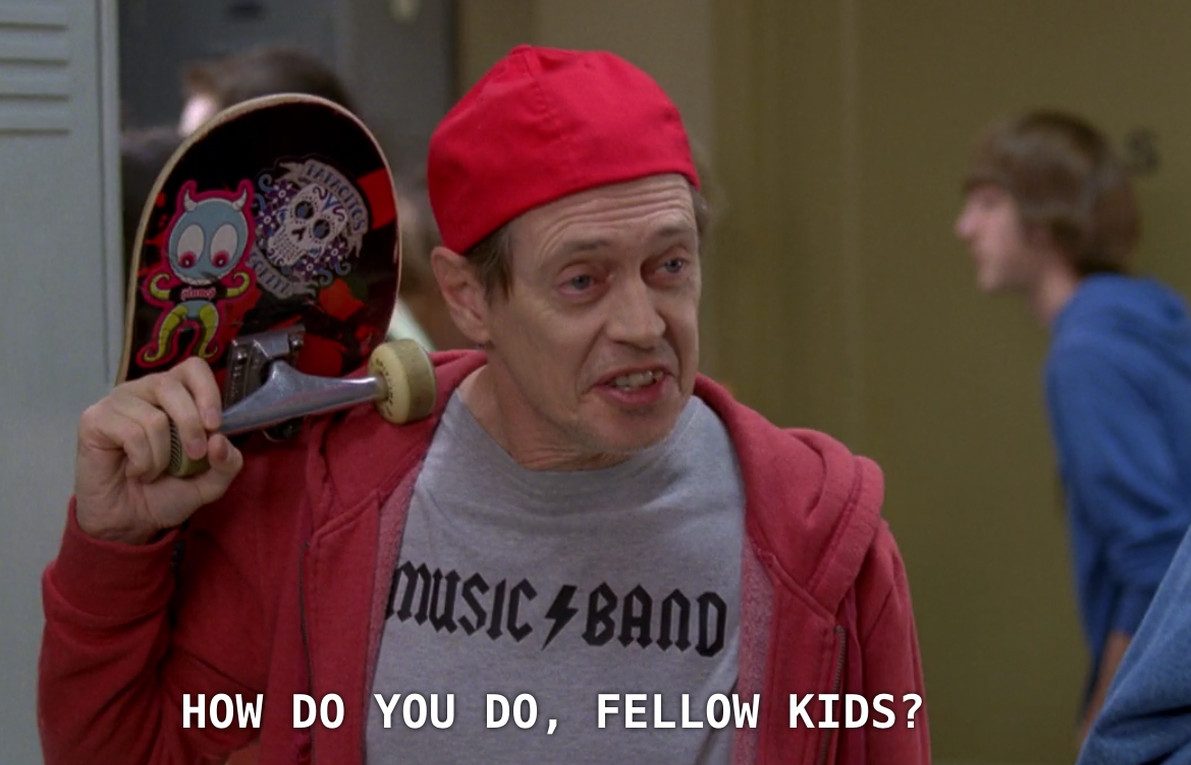
Of course there’s a funny, comical or tragicomical, exception, and that is the thirty- and fortysomething academics who are basically doing—have you seen the Steve Buscemi gif of him walking down a high-school hallway where there are lockers and he’s holding a skateboard and he has a baseball cap on backwards and he says, “How do you do, fellow kids”? That’s basically how many of my peers in academia are behaving, many of them are doing a real-life version of that. And it’s painful to watch.
JB: As you get older I think you become more and more aware that your generation has a sensibility: there are certain things you’re good at, and certain things you’re less good at. But you can’t just pretend you don’t have that sensibility. As a critic, the one ultimate responsibility you have is to your voice and what you believe, and that’s why it’s so painful to watch people from our generation do and say things that feel as if they’ve been borrowed from people younger than them. I hate using the term bad faith but when I see that act, the act for the cool kids, it’s so dispiriting to me.
JS: Again, the problem for me right now is how to avoid meeting Adorno’s fate, how to avoid that really tragic end without just taking the other horn of the dilemma and becoming a ridiculous figure who refuses to acknowledge that generational differences or life experience are, again, simply the stages on life’s way, and that different ages open up different insights to us.
JB: To make some of these issues more concrete, another impetus for this discussion was the piece you wrote for the Chronicle of Higher Education’s symposium on the “birth, death and rebirth” of postmodernism, called “Playtime Is Over.” That was a reflection on the changes in intellectual culture—and especially in youth culture—that you’ve witnessed yourself since the 1990s, when you were in graduate school. Can you say a little about how postmodernism—and the “playtime” sensibility—affected you as a student?
JS: I was in a Ph.D. program in analytic philosophy in the Nineties. So we had these almost subterranean reading groups on Deleuze and Guattari and other French theory, but we read these things with a cautious, somewhat detached perspective on the currents of thought that were much more popular in English departments. So as graduate students in analytic philosophy we were attuned to all of this and not necessarily hostile to it. Analytic philosophers remained committed, broadly speaking, to the law of the excluded middle; that is, that everything is either true or false and there is nothing in between. Postmodernism, again speaking in broad strokes, never took any purported determination of truth or falsity as the last word, but always sought to expose or undermine the conceits of self-serious and haughty truth-mongers. The clearest signs today of the death of postmodernism are coming from, for example, the young people who are simply not buying [the NYU professor] Avital Ronell’s self-defense, that she was just plumbing the infinite depths of campy play or whatever with her grad student. They want to know: Was she harassing him or wasn’t she? (Answer: She was.) The law of the excluded middle is back, baby.
JB: I studied English as an undergraduate, around the turn of the century, and when I read that phrase, “Playtime Is Over,” it called to mind for me the “new sincerity.” That was one response I remember being recommended by some of the artists and thinkers I admired back then, to what were perceived to be the excesses of postmodernism—especially to postmodernism as a style of thinking and writing. But at the same time those artists (David Foster Wallace, Radiohead, etc.) were also still products of postmodern “play,” so they seemed unable to fully be sincere even when they said that was what they wanted. Now we get to a generation later and, to expand on what you just said, in the piece you gave the example of Andrea Long Chu’s castigation of Ronell, which was directed not only at the professor’s behavior but also at the way other “postmodern” professors from Ronell’s generation had tried to defend her with all this jargon about theatricality, play, etc. Do you think this next generation has fully turned against postmodernism in the way the earlier one said they wanted to?
JS: I have to say I’ve been teaching in Paris for the past six years and gaining new insight into what this historical phenomenon that we call postmodernism has been. And one thing that strikes me, in France, and that I had not understood previously, is the power of French institutions to uptake, and to institutionalize or to domesticate everything that happens in French culture. This precedes postmodernism—you can certainly see this happening already in the 1940s and Fifties with Surrealism. I’m thinking for example of Ferdinand Alquié’s work on the philosophy of surrealism that in a sense makes it something that is both recognized and acknowledged and valued by the culture as a whole but also, at the same time, defanged. So this is a familiar process. It’s simply that I think the French are particularly adept at it. They have the power to take the most transgressive things—Bataille raving about sticking an eyeball in his rectum and so on—and turn them into boring university lectures. And I think that this adeptness is part of what explains the difficulty of understanding what French philosophers were up to in the late twentieth century.
Certainly when I was in graduate school in analytic philosophy in the 1990s I generally bought into the line, which was common in Anglo-American philosophy departments at the time, that people like Lyotard or Baudrillard were simply bad philosophers. That is to say, trying to do the same thing that John Searle or whoever was trying to do, but failing. Obviously that’s not an adequate understanding of what this was all about. What it was really all about was the institutional uptake of a certain kind of cagey form of discourse. A form of discourse in which, as I put it in the Chronicle piece, the rule of the game is to be unforthcoming, to stay away or stand back from firm commitment to positions that have been argued for.
This playfulness was something that in my own work I always wanted to engage in, but never knew how, because the boundaries of philosophy as they were drawn by the tradition I was brought up in didn’t permit it. But at some point in the 2000s I realized that if I hadn’t been brought up in this particular tradition I could have been having so much more fun! And not just having more fun but being myself, which included a playful side. And it was around the time of this realization that I was so to speak coming into my own intellectually, that we started feeling this shift that the piece is about, where the generation coming up after my own was now wary of playfulness.
JB: Besides the criticism of Ronell, are there other examples you could give briefly to illustrate the “playtime is over” sensibility?
JS: There was another recent forum I participated in in the Chronicle about hoaxes. And I was surprised to see that almost without exception, all the younger academics I know take it for granted that all scholarly hoaxing is a breach of our academic contract with one another, and that it should be investigated by ethics boards and so on. Whatever the political aims of the hoaxers may be—now, maybe these academics were taking it for granted that the hoaxers would always be like the “Sokal Squared” people and therefore political enemies—my younger academic colleagues all seem to take for granted that the institutional rules are kind of the divine law. And this, as much as the response to the Ronell saga, clued me in to the vastness of this transformation of the past decade, which I think goes beyond postmodernism and has a lot to do with the transformation of academic careers into something much further from any notion of what we had earlier considered the life of the intellectual.
At the same time, there are also some things that complicate my claim that playtime is over—and I’m not sure it’s totally correct. Because some of the people who are pushing for, let’s say, more administrative rules governing behavior at academic conferences, are also extremely funny and playful in some of their manifestations. Now this is a closed community of playfulness, and if some aging normie were to jump in and try to play they would be immediately expelled. But I think we as, let’s say, outside analysts and critics, have to be careful about our declaration of the death of playfulness just because we’ve been shut out.
JB: In fact, Andrea for instance is a writer most people would describe as playful.
JS: Exactly, she’s hilarious. So it’s more complicated than I was able to bring across in the piece.
JB: This is a good opening perhaps to talk more about playfulness under another name, which is comedy. You’ve written about comedy both in your book, Irrationality, and for The Point in our issue 14 comedy symposium, and you also did a New York Times op-ed about your own attitudes toward satire changing since the Charlie Hebdo attacks. Maybe we could talk about comedy as a way of getting more concrete about the way you see attitudes changing in the culture.
JS: A prefatory remark: I don’t watch a lot of stand-up comedy. I have only the faintest idea of who is who. I really like to look at ancient comedy, like the Philogelos, and I’m a big fan of Soviet-era samizdat joke-books. That said, I am able to talk a little bit about, let’s say, the Chappelle vs. Gadsby bifurcation of the current moment.
First a few words about the new Chappelle. The clips I saw I thought were really funny. I thought they were well-timed, I thought they were masterful, etc. At the same time, I am so dispirited to see these same clips within a few days of the special on Netflix being retweeted by Donald Trump, Jr. And seeing the way again that we don’t have the freedom in the present moment to appreciate—and I mean that in the etymological sense of the word, like acknowledge the value of—a given fragment of cultural production without, in that same gesture, being algorithmically associated with people we might genuinely not want to be associated with.
The way social media formalizes relationships in the contemporary moment creates dilemmas—as for example between Gadsby and Chappelle. And I confess I like Hannah Gadsby too! Watching her I thought, this is someone who’s telling interesting stories about her life, and she’s pulled me in. It’s not to say I think it’s supremely successful as comedy, or the direction I would want comedy to go in; it’s just to say that she hit the spot for me in that particular moment. And yet I find that my general inclination right now is simply to withdraw from talking about our culture and its output at all, because I don’t want to be funneled into either horn of a given dilemma.
JB: People often talk about the problem with social media being that you get into these bubbles that limit what you see, but what you’re pointing to is an opposite issue, which is that anything you put on there can immediately be repurposed or used by someone from a different side of the political spectrum, possibly someone you loathe and want nothing to do with. And the fact that everyone is aware of this can give rise to the demand that you as a writer or artist or comedian must avoid saying anything that could even potentially be used by a political enemy. And from this comes the imperative to be crystal-clear about where you stand on everything, which can itself be a rationale for avoiding saying anything ironic or playful—much less taking risks as a stand-up comic.
JS: I think people have become attuned to how important this issue is especially in the past year or two. It was about a year ago I started hearing the term “adjacent,” usually after a hyphen. As in “alt-right-adjacent.” And now adjacency is everywhere; people are so concerned about what’s adjacent to what. Or the related notion of “follow-policing,” where you see who’s followed by someone you follow on social media. And then what I wrote about in “It’s All Over”: our awareness that everything can be plotted and visualized in terms of adjacency, which almost relieves people of the duty to listen to what anyone is saying. And so here we are, just trying to say stuff, to the extent possible in blissful ignorance of where this will be plotted, and the frustrating result, one sometimes feels, is that the only uptake of what one says is for it to be plotted.
JB: You sound like you’re saying it has affected your desire to connect yourself to certain things that will be taken up in this way.
JS: I’m writing a book right now about the Great Kamchatka Expedition of the 1730s, if that gives you some sense of my stance vis à vis our contemporary discourse.
JB: I worry that what’s happening is having the effect of making people withdraw who I also want to hear from. Or it is degrading the kind of conversations we can have with each other in public. That’s what I think is so dangerous about thinking, “Well, Trump’s son is going to tweet it so we can’t say it.” I do find that that’s particularly a thing the left does. Maybe it’s just what I’m more familiar with, but I don’t see right-intellectuals doing this kind of thing in the same way: “Oh, this was tweeted by someone on the left so it must be bad.”
JS: The people this really pinches are people who are genuinely committed to a self-understanding as not on the right, but who want to take up a critical position in response to many of the current tendencies on the left. Those are the ones who get pinched. And then of course you have this almost absurd result of the so-called “radical centrists,” who are again produced algorithmically as a tertium quid, but who rather obviously have nothing at all to offer.
JB: But they serve a purpose. People can map them and then when someone tries to take a position that’s critical of the left but not on the right, then they can be identified; you’re the radical centrist, or the dark web.
JS: I’ve mentioned in writing to you that some people I know have tried to smear me—in my understanding of what they’re doing—as a conservative. A fellow philosopher has claimed that I am the up-and-coming, next generation’s Roger Scruton. Now Roger Scruton is, in my opinion, an atrocious human being. He has for a long time flirted with antisemitism, he’s friendly with Viktor Orban and the authoritarian regime in Hungary; I despise him. And when I think about the politics of my own country, I lean most toward supporting Elizabeth Warren in the upcoming presidential elections. So when on occasion people have attempted to associate me with something called conservatism I think, What kind of strange historical moment are we living in when I, a supporter of the same candidate supported by much of the bien-pensant New York, am nevertheless being labeled a conservative?
So I challenged the friend who had compared me to Scruton and I said Look, I’m only being called a conservative because the world has gone crazy in the past few years and I haven’t gone crazy with it. And he said: That’s what conservatives always say! That’s what it is to be a conservative! (He graciously added: And there might be nothing wrong with that!)
JB: What you’re speaking to in some sense is the pulling apart of politics—in the narrow sense of electoral politics—and culture. And this is one of the legacies, I think, of postmodernist theory on today’s left. Many left intellectuals and academics don’t care that much who you support for president, that’s a side issue. The important question is: How do you feel about Spider-man?
JS: Just for the record I’m going to double down: I would also say about The Joker, I think anything born of the superhero universe is tainted by its origins and is a total waste of time. I’ve been called a conservative for publicly declaring my contempt for the Spider-man franchise. But Spider-man is a vigilante crime-fighter, essentially a variation on the Charles Bronson Death Wish franchise. Who’s the conservative? What is even happening here?
JB: We now know how this interview is going to be plotted! But I wonder about that word “conservative.” I attended a graduate program at the University of Chicago called the Committee on Social Thought, which believes in studying the great books tradition, and many people believe that our program produces “conservatives.” But the person who runs the program, and my advisor, is Robert Pippin, a Hegelian, modern liberal. Many of the students I knew there would call themselves socialists in terms of what they believe would be the best economic or social system. So in a way it’s silly to say the program is conservative. At the same time, compared to the atmosphere of other academic departments, and to the atmosphere in general on the left, I don’t know. There are certain things most people in Social Thought do want to conserve.
JS: Lenin wanted to conserve the tsarist railways, so there’s always something one wants to hold on to from before everything changed, right? I think you might be right that we’re living in a moment where culture has been so intermeshed with politics that preserving not just say the railways from before the revolution but also books and movies from before the revolution, and stand-up comedy, is almost by definition conservative. And I suppose the friend of mine who called me a conservative was being gracious; he was trying to say, Look, there might be a connotation of this term that is not as noxious as we ordinarily think.
Nonetheless, I feel like maybe my revulsion, or my hesitance, to accept this, points to a pre-existing concern to keep culture and politics separate to some extent. And to allow politics to concern itself with, say, fighting income inequality and abolishing student debt, and things like that. And to let us keep on listening to our old Richard Pryor albums.
JB: But is that itself a conservative position—to want to separate those two things?
JS: I don’t know. And because I spend way too much time reading the cultural output of extremely online people twenty years younger than I am, I’m very attuned to the way in which we are generationally determined—and how, like it or not, different artifacts of culture come to have different significances in different eras, and it’s perfectly possible that the radical comedy of, say, Richard Pryor, or the music of Nick Cave and the Bad Seeds, might come to be dorky and conservative, even though we have a lived memory of it being cool. But I would insist that it should be conservative in the way that, say, being a dad, for example, is just innately kind of a dorky conservative thing no matter what, likely for ingrained evolutionary reasons, rather than conservative in the sense of being actually political reactionary.
JB: After the 2016 election there was an article going around—one of those pieces that everyone said had “predicted Trump”—which had been published in the London Review of Booksin the early Nineties, by Edward Luttwak. The article was about how the paceat which the economy was changing was affecting people. Tectonic shifts that used to take whole lifetimes to occur, Luttwak argued, were now happening within a single person’s lifetime, often more than once. So it was no longer uncommon for someone who was 45 or fifty to find that all the skills they’d learned were suddenly irrelevant for the job market. And I wonder if something like that is happening culturally too, where things are changing so fast that there are people in their late twenties and early thirties—men, women, white, non-white, etc.—who feel that “it’s all over” for them. Relatedly, many of the thinkers I assumed a decade ago were going to be major voices in the culture for the next few decades seem almost to be in hiding. Meanwhile the New Yorker website is filled with articles by 24- and 25-year-olds.
JS: I wrote “It’s All Over” as I was driving up from San Diego, where I had just met an older poet friend of mine named Jerome Rothenberg. And I was thinking about his career in avant-garde circles in the 1950s and Sixties, being the first English translator of Paul Celan, and just what an amazing human being he is—you know, he had these posters on his walls of his various performances in the coolest venues dating back several decades—and how indifferent the world is to the value these venues once held. It was so poignant and painful to me that somehow driving back up the California Coast I was reflecting in a way that I never had before on the way the world forgets about us, inevitably. And what this means when it hits you, or when it starts to hit you, when you feel like you’re still at full strength.
I think until about 2014 I was working in a mode of both scholarly and creative output in which I felt like I was just on top of the zeitgeist; I was part of it; I was moving along with it the way one rides a wave. Circa 2015 that wave crashed. I’ve been reconstituting myself ever since then, and “It’s All Over” was both my most pessimistic and most lucid statement of these reflections since 2015.
JB: The reception to that article, though, suggested there are probably a lot of people thinking about out how to reckon with that feeling. And one thing I wonder is what are the positives of feeling like you’re “off the wave.” I mean there’s a way in which it can be a relief, right?
JS: That’s why I’m attracted to this possibility—we’re mixing metaphors here—of retreat. Of course it’s curious to me that this historical moment just happens to coincide with my hair turning gray, with a drop in testosterone levels: it’s funny that my own personal life course already had built into it a crash of sorts, no matter what history had been like. But the two happened to coincide for me, the personal and the historical. And in my own reflections on this I spend a lot of time thinking about how much I’m projecting from the personal to the historical. Or maybe, in the other direction as well, how much I’m allowing the contemporary historical moment to taint or to shadow my understanding of my own personal development. These are very complicated questions, and I don’t have clear answers to them. I do think that people in every historical moment obviously get older. Some historical moments have been very good at processing what that involves. Some historical moments have been much better than ours.
Maybe the good to get out of being so swiftly superannuated is that it might be an opportunity to do away with this ideology of the ’68 generation and to allow ourselves to think, to speak, with Kierkegaard, of the stages on life’s way. And the way in which moving into a different period of life opens up new perspectives, you might even say affords new revelations.
JB: Ideally you’d have a situation where each generation is able to acknowledge the next generation has their ideas and you have yours and there could be a conversation between them. Because I don’t think any of us benefit from a generation’s ideas just sinking out of view. But there seem to be fewer and fewer of those kinds of forums.
JS: Since I wrote “It’s All Over” I’m doing two things. The first is I’m retreating into subjects that are close to my heart, mostly things that are far away from contemporary culture (this discussion notwithstanding). The other thing I’m doing is trying to be more sincere in finding common ground with people it’s easy to read, especially at a distance, especially on social media, as being on the other side of a divide. So finding common ground with them but not doing that by putting on the backwards baseball cap and carrying a skateboard and saying “hey, fellow kids!”
JB: And where do you see opportunities for that common ground?
JS: First of all, face-to-face conversation. And second of all, again, finding whatever it is that we have in common, whatever shared interest. In my heart I’m a kind of encyclopedist Leibnizian who really likes big collaborative knowledge projects. And in that respect I’m conscious of the fact that if we could resuscitate Leibniz he would be thrilled about the internet and in particular about Wikipedia—I think Wikipedia is the best corner of the internet; it’s the most remarkable success story. The article on Aristotle’s marine biology for example, on Wikipedia, is better I would dare say than any scholarly publication on the subject from before 1890. So if you were behind the veil of ignorance, and you had a choice between either the scholarship on Aristotle’s marine biology published before 1890 or the Wikipedia article, you would be better off with the Wikipedia article.
I bring that up because it’s not as if we’re losing the past, which is something we (scare quotes) “conservatives” care about. The past is going to be preserved and in fact with new methods and new technologies that are allowing us a kind of granular understanding of what the past was like in a way that was just not at all on offer to previous generations. So we’re not going to lose the past. But if we really care about the past, I think we should be engaging with people we think are on the other side of the dividing line from us, who also care about the past but might not share exactly the same sensibility. One thing I’m often struck by when I do interact with people twenty years younger is that often they’re remarkably well informed about, say, historical periods that interest me, about antiquity, about the early modern period, about Walt Whitman… I’m often surprised. And I’m jolted pleasingly. They’re better informed about these historical periods which we share an interest in than they are about the immediate past, the one they’re just a little too young to remember. Not the Eighties or the Nineties or 2016—but the real historical past, as a potential neutral territory to meet for negotiations. That’s my hope.

Justin E. H. Smith is a professor of history and philosophy of science at the University of Paris. In addition to his recent book, Irrationality: A History of the Dark Side of Reason, Smith is the author of the blog post “It’s All Over,” republished by The Point in January, which sparked weeks of debate across the internet and remains the magazine’s most popular article of 2019. He is currently in New York on a Cullman Fellowship, researching a book on Leibniz, the St. Petersburg Academy of Sciences, and the Second Kamchatka Expedition of 1731-41. In September, we met at Bryant Park for a casual conversation about postmodernism, comedy in the age of the algorithm, and what it means to be an aging cultural critic during a period of accelerated generational upheaval. What follows is an edited transcript of that discussion.
—Jon Baskin
●
Jon Baskin: When we were going back and forth over email about this conversation, you mentioned that one thing you’ve been worrying about lately is “the challenge of how to avoid ending up like Adorno in ’68.” Can you say more about what you meant by that and why it’s been on your mind?
Justin E. H. Smith: In 1968, student activists had occupied the facilities of the Institute for Social Research in Frankfurt. Theodor Adorno was corresponding about this with his colleague Herbert Marcuse, who was in sunkissed Californian exile, and Marcuse was saying, Come on! Let the kids express their political will, it’s good to have this sort of turnover. And Adorno was like, What are you talking about? I spent my life building this Institute up, it means everything to me, and these kids don’t value it, they think I’m just some old man. And how can you, my old friend, tell me that that’s something I should just bow to, as if all of our work meant nothing.
It’s so poignant, and what I found shocking when this correspondence between Adorno and Marcuse was circulating recently—it was before I left Facebook so it must have been three years ago now—was that all of my academic colleagues who were roughly my age were at least publicly saying “yeah, Marcuse!” To a person, the Facebook crowd at least pretended to gather under the banner of Marcuse and to disdain Adorno’s stance and in general his whole old-man vibe.
One doesn’t want to share in that old-man vibe and die of a heart attack after a student protester shows us her breasts, or whatever the contemporary equivalent would be, but one also doesn’t want to abandon years of work and a whole critical-theoretical framework just because it’s fallen out of fashion. So, how to navigate between those two hazards?
JB: It’s interesting to think about the ’68 generation: their perspective on aging, and on youth culture, is something that has survived today, not only in popular or consumer culture but also in intellectual life.
JS: The ’68 generation thought their parents were old but they thought they could escape ever being old in the same way—that is, outdated. I’m generalizing here, obviously, but they thought they could escape it for their whole lives. Now I think we’re facing a moment where the invisible but nonetheless clearly present wall that prevents me from engaging with twentysomethings on Twitter, for example, is a new form of the “don’t trust anyone over thirty” mantra of the ’68 generation. We’re back to this moment where there’s a huge generational gap.
Of course there’s a funny, comical or tragicomical, exception, and that is the thirty- and fortysomething academics who are basically doing—have you seen the Steve Buscemi gif of him walking down a high-school hallway where there are lockers and he’s holding a skateboard and he has a baseball cap on backwards and he says, “How do you do, fellow kids”? That’s basically how many of my peers in academia are behaving, many of them are doing a real-life version of that. And it’s painful to watch.
JB: As you get older I think you become more and more aware that your generation has a sensibility: there are certain things you’re good at, and certain things you’re less good at. But you can’t just pretend you don’t have that sensibility. As a critic, the one ultimate responsibility you have is to your voice and what you believe, and that’s why it’s so painful to watch people from our generation do and say things that feel as if they’ve been borrowed from people younger than them. I hate using the term bad faith but when I see that act, the act for the cool kids, it’s so dispiriting to me.
JS: Again, the problem for me right now is how to avoid meeting Adorno’s fate, how to avoid that really tragic end without just taking the other horn of the dilemma and becoming a ridiculous figure who refuses to acknowledge that generational differences or life experience are, again, simply the stages on life’s way, and that different ages open up different insights to us.
JB: To make some of these issues more concrete, another impetus for this discussion was the piece you wrote for the Chronicle of Higher Education’s symposium on the “birth, death and rebirth” of postmodernism, called “Playtime Is Over.” That was a reflection on the changes in intellectual culture—and especially in youth culture—that you’ve witnessed yourself since the 1990s, when you were in graduate school. Can you say a little about how postmodernism—and the “playtime” sensibility—affected you as a student?
JS: I was in a Ph.D. program in analytic philosophy in the Nineties. So we had these almost subterranean reading groups on Deleuze and Guattari and other French theory, but we read these things with a cautious, somewhat detached perspective on the currents of thought that were much more popular in English departments. So as graduate students in analytic philosophy we were attuned to all of this and not necessarily hostile to it. Analytic philosophers remained committed, broadly speaking, to the law of the excluded middle; that is, that everything is either true or false and there is nothing in between. Postmodernism, again speaking in broad strokes, never took any purported determination of truth or falsity as the last word, but always sought to expose or undermine the conceits of self-serious and haughty truth-mongers. The clearest signs today of the death of postmodernism are coming from, for example, the young people who are simply not buying [the NYU professor] Avital Ronell’s self-defense, that she was just plumbing the infinite depths of campy play or whatever with her grad student. They want to know: Was she harassing him or wasn’t she? (Answer: She was.) The law of the excluded middle is back, baby.
JB: I studied English as an undergraduate, around the turn of the century, and when I read that phrase, “Playtime Is Over,” it called to mind for me the “new sincerity.” That was one response I remember being recommended by some of the artists and thinkers I admired back then, to what were perceived to be the excesses of postmodernism—especially to postmodernism as a style of thinking and writing. But at the same time those artists (David Foster Wallace, Radiohead, etc.) were also still products of postmodern “play,” so they seemed unable to fully be sincere even when they said that was what they wanted. Now we get to a generation later and, to expand on what you just said, in the piece you gave the example of Andrea Long Chu’s castigation of Ronell, which was directed not only at the professor’s behavior but also at the way other “postmodern” professors from Ronell’s generation had tried to defend her with all this jargon about theatricality, play, etc. Do you think this next generation has fully turned against postmodernism in the way the earlier one said they wanted to?
JS: I have to say I’ve been teaching in Paris for the past six years and gaining new insight into what this historical phenomenon that we call postmodernism has been. And one thing that strikes me, in France, and that I had not understood previously, is the power of French institutions to uptake, and to institutionalize or to domesticate everything that happens in French culture. This precedes postmodernism—you can certainly see this happening already in the 1940s and Fifties with Surrealism. I’m thinking for example of Ferdinand Alquié’s work on the philosophy of surrealism that in a sense makes it something that is both recognized and acknowledged and valued by the culture as a whole but also, at the same time, defanged. So this is a familiar process. It’s simply that I think the French are particularly adept at it. They have the power to take the most transgressive things—Bataille raving about sticking an eyeball in his rectum and so on—and turn them into boring university lectures. And I think that this adeptness is part of what explains the difficulty of understanding what French philosophers were up to in the late twentieth century.
Certainly when I was in graduate school in analytic philosophy in the 1990s I generally bought into the line, which was common in Anglo-American philosophy departments at the time, that people like Lyotard or Baudrillard were simply bad philosophers. That is to say, trying to do the same thing that John Searle or whoever was trying to do, but failing. Obviously that’s not an adequate understanding of what this was all about. What it was really all about was the institutional uptake of a certain kind of cagey form of discourse. A form of discourse in which, as I put it in the Chronicle piece, the rule of the game is to be unforthcoming, to stay away or stand back from firm commitment to positions that have been argued for.
This playfulness was something that in my own work I always wanted to engage in, but never knew how, because the boundaries of philosophy as they were drawn by the tradition I was brought up in didn’t permit it. But at some point in the 2000s I realized that if I hadn’t been brought up in this particular tradition I could have been having so much more fun! And not just having more fun but being myself, which included a playful side. And it was around the time of this realization that I was so to speak coming into my own intellectually, that we started feeling this shift that the piece is about, where the generation coming up after my own was now wary of playfulness.
JB: Besides the criticism of Ronell, are there other examples you could give briefly to illustrate the “playtime is over” sensibility?
JS: There was another recent forum I participated in in the Chronicle about hoaxes. And I was surprised to see that almost without exception, all the younger academics I know take it for granted that all scholarly hoaxing is a breach of our academic contract with one another, and that it should be investigated by ethics boards and so on. Whatever the political aims of the hoaxers may be—now, maybe these academics were taking it for granted that the hoaxers would always be like the “Sokal Squared” people and therefore political enemies—my younger academic colleagues all seem to take for granted that the institutional rules are kind of the divine law. And this, as much as the response to the Ronell saga, clued me in to the vastness of this transformation of the past decade, which I think goes beyond postmodernism and has a lot to do with the transformation of academic careers into something much further from any notion of what we had earlier considered the life of the intellectual.
At the same time, there are also some things that complicate my claim that playtime is over—and I’m not sure it’s totally correct. Because some of the people who are pushing for, let’s say, more administrative rules governing behavior at academic conferences, are also extremely funny and playful in some of their manifestations. Now this is a closed community of playfulness, and if some aging normie were to jump in and try to play they would be immediately expelled. But I think we as, let’s say, outside analysts and critics, have to be careful about our declaration of the death of playfulness just because we’ve been shut out.
JB: In fact, Andrea for instance is a writer most people would describe as playful.
JS: Exactly, she’s hilarious. So it’s more complicated than I was able to bring across in the piece.
JB: This is a good opening perhaps to talk more about playfulness under another name, which is comedy. You’ve written about comedy both in your book, Irrationality, and for The Point in our issue 14 comedy symposium, and you also did a New York Times op-ed about your own attitudes toward satire changing since the Charlie Hebdo attacks. Maybe we could talk about comedy as a way of getting more concrete about the way you see attitudes changing in the culture.
JS: A prefatory remark: I don’t watch a lot of stand-up comedy. I have only the faintest idea of who is who. I really like to look at ancient comedy, like the Philogelos, and I’m a big fan of Soviet-era samizdat joke-books. That said, I am able to talk a little bit about, let’s say, the Chappelle vs. Gadsby bifurcation of the current moment.
First a few words about the new Chappelle. The clips I saw I thought were really funny. I thought they were well-timed, I thought they were masterful, etc. At the same time, I am so dispirited to see these same clips within a few days of the special on Netflix being retweeted by Donald Trump, Jr. And seeing the way again that we don’t have the freedom in the present moment to appreciate—and I mean that in the etymological sense of the word, like acknowledge the value of—a given fragment of cultural production without, in that same gesture, being algorithmically associated with people we might genuinely not want to be associated with.
The way social media formalizes relationships in the contemporary moment creates dilemmas—as for example between Gadsby and Chappelle. And I confess I like Hannah Gadsby too! Watching her I thought, this is someone who’s telling interesting stories about her life, and she’s pulled me in. It’s not to say I think it’s supremely successful as comedy, or the direction I would want comedy to go in; it’s just to say that she hit the spot for me in that particular moment. And yet I find that my general inclination right now is simply to withdraw from talking about our culture and its output at all, because I don’t want to be funneled into either horn of a given dilemma.
JB: People often talk about the problem with social media being that you get into these bubbles that limit what you see, but what you’re pointing to is an opposite issue, which is that anything you put on there can immediately be repurposed or used by someone from a different side of the political spectrum, possibly someone you loathe and want nothing to do with. And the fact that everyone is aware of this can give rise to the demand that you as a writer or artist or comedian must avoid saying anything that could even potentially be used by a political enemy. And from this comes the imperative to be crystal-clear about where you stand on everything, which can itself be a rationale for avoiding saying anything ironic or playful—much less taking risks as a stand-up comic.
JS: I think people have become attuned to how important this issue is especially in the past year or two. It was about a year ago I started hearing the term “adjacent,” usually after a hyphen. As in “alt-right-adjacent.” And now adjacency is everywhere; people are so concerned about what’s adjacent to what. Or the related notion of “follow-policing,” where you see who’s followed by someone you follow on social media. And then what I wrote about in “It’s All Over”: our awareness that everything can be plotted and visualized in terms of adjacency, which almost relieves people of the duty to listen to what anyone is saying. And so here we are, just trying to say stuff, to the extent possible in blissful ignorance of where this will be plotted, and the frustrating result, one sometimes feels, is that the only uptake of what one says is for it to be plotted.
JB: You sound like you’re saying it has affected your desire to connect yourself to certain things that will be taken up in this way.
JS: I’m writing a book right now about the Great Kamchatka Expedition of the 1730s, if that gives you some sense of my stance vis à vis our contemporary discourse.
JB: I worry that what’s happening is having the effect of making people withdraw who I also want to hear from. Or it is degrading the kind of conversations we can have with each other in public. That’s what I think is so dangerous about thinking, “Well, Trump’s son is going to tweet it so we can’t say it.” I do find that that’s particularly a thing the left does. Maybe it’s just what I’m more familiar with, but I don’t see right-intellectuals doing this kind of thing in the same way: “Oh, this was tweeted by someone on the left so it must be bad.”
JS: The people this really pinches are people who are genuinely committed to a self-understanding as not on the right, but who want to take up a critical position in response to many of the current tendencies on the left. Those are the ones who get pinched. And then of course you have this almost absurd result of the so-called “radical centrists,” who are again produced algorithmically as a tertium quid, but who rather obviously have nothing at all to offer.
JB: But they serve a purpose. People can map them and then when someone tries to take a position that’s critical of the left but not on the right, then they can be identified; you’re the radical centrist, or the dark web.
JS: I’ve mentioned in writing to you that some people I know have tried to smear me—in my understanding of what they’re doing—as a conservative. A fellow philosopher has claimed that I am the up-and-coming, next generation’s Roger Scruton. Now Roger Scruton is, in my opinion, an atrocious human being. He has for a long time flirted with antisemitism, he’s friendly with Viktor Orban and the authoritarian regime in Hungary; I despise him. And when I think about the politics of my own country, I lean most toward supporting Elizabeth Warren in the upcoming presidential elections. So when on occasion people have attempted to associate me with something called conservatism I think, What kind of strange historical moment are we living in when I, a supporter of the same candidate supported by much of the bien-pensant New York, am nevertheless being labeled a conservative?
So I challenged the friend who had compared me to Scruton and I said Look, I’m only being called a conservative because the world has gone crazy in the past few years and I haven’t gone crazy with it. And he said: That’s what conservatives always say! That’s what it is to be a conservative! (He graciously added: And there might be nothing wrong with that!)
JB: What you’re speaking to in some sense is the pulling apart of politics—in the narrow sense of electoral politics—and culture. And this is one of the legacies, I think, of postmodernist theory on today’s left. Many left intellectuals and academics don’t care that much who you support for president, that’s a side issue. The important question is: How do you feel about Spider-man?
JS: Just for the record I’m going to double down: I would also say about The Joker, I think anything born of the superhero universe is tainted by its origins and is a total waste of time. I’ve been called a conservative for publicly declaring my contempt for the Spider-man franchise. But Spider-man is a vigilante crime-fighter, essentially a variation on the Charles Bronson Death Wish franchise. Who’s the conservative? What is even happening here?
JB: We now know how this interview is going to be plotted! But I wonder about that word “conservative.” I attended a graduate program at the University of Chicago called the Committee on Social Thought, which believes in studying the great books tradition, and many people believe that our program produces “conservatives.” But the person who runs the program, and my advisor, is Robert Pippin, a Hegelian, modern liberal. Many of the students I knew there would call themselves socialists in terms of what they believe would be the best economic or social system. So in a way it’s silly to say the program is conservative. At the same time, compared to the atmosphere of other academic departments, and to the atmosphere in general on the left, I don’t know. There are certain things most people in Social Thought do want to conserve.
JS: Lenin wanted to conserve the tsarist railways, so there’s always something one wants to hold on to from before everything changed, right? I think you might be right that we’re living in a moment where culture has been so intermeshed with politics that preserving not just say the railways from before the revolution but also books and movies from before the revolution, and stand-up comedy, is almost by definition conservative. And I suppose the friend of mine who called me a conservative was being gracious; he was trying to say, Look, there might be a connotation of this term that is not as noxious as we ordinarily think.
Nonetheless, I feel like maybe my revulsion, or my hesitance, to accept this, points to a pre-existing concern to keep culture and politics separate to some extent. And to allow politics to concern itself with, say, fighting income inequality and abolishing student debt, and things like that. And to let us keep on listening to our old Richard Pryor albums.
JB: But is that itself a conservative position—to want to separate those two things?
JS: I don’t know. And because I spend way too much time reading the cultural output of extremely online people twenty years younger than I am, I’m very attuned to the way in which we are generationally determined—and how, like it or not, different artifacts of culture come to have different significances in different eras, and it’s perfectly possible that the radical comedy of, say, Richard Pryor, or the music of Nick Cave and the Bad Seeds, might come to be dorky and conservative, even though we have a lived memory of it being cool. But I would insist that it should be conservative in the way that, say, being a dad, for example, is just innately kind of a dorky conservative thing no matter what, likely for ingrained evolutionary reasons, rather than conservative in the sense of being actually political reactionary.
JB: After the 2016 election there was an article going around—one of those pieces that everyone said had “predicted Trump”—which had been published in the London Review of Booksin the early Nineties, by Edward Luttwak. The article was about how the paceat which the economy was changing was affecting people. Tectonic shifts that used to take whole lifetimes to occur, Luttwak argued, were now happening within a single person’s lifetime, often more than once. So it was no longer uncommon for someone who was 45 or fifty to find that all the skills they’d learned were suddenly irrelevant for the job market. And I wonder if something like that is happening culturally too, where things are changing so fast that there are people in their late twenties and early thirties—men, women, white, non-white, etc.—who feel that “it’s all over” for them. Relatedly, many of the thinkers I assumed a decade ago were going to be major voices in the culture for the next few decades seem almost to be in hiding. Meanwhile the New Yorker website is filled with articles by 24- and 25-year-olds.
JS: I wrote “It’s All Over” as I was driving up from San Diego, where I had just met an older poet friend of mine named Jerome Rothenberg. And I was thinking about his career in avant-garde circles in the 1950s and Sixties, being the first English translator of Paul Celan, and just what an amazing human being he is—you know, he had these posters on his walls of his various performances in the coolest venues dating back several decades—and how indifferent the world is to the value these venues once held. It was so poignant and painful to me that somehow driving back up the California Coast I was reflecting in a way that I never had before on the way the world forgets about us, inevitably. And what this means when it hits you, or when it starts to hit you, when you feel like you’re still at full strength.
I think until about 2014 I was working in a mode of both scholarly and creative output in which I felt like I was just on top of the zeitgeist; I was part of it; I was moving along with it the way one rides a wave. Circa 2015 that wave crashed. I’ve been reconstituting myself ever since then, and “It’s All Over” was both my most pessimistic and most lucid statement of these reflections since 2015.
JB: The reception to that article, though, suggested there are probably a lot of people thinking about out how to reckon with that feeling. And one thing I wonder is what are the positives of feeling like you’re “off the wave.” I mean there’s a way in which it can be a relief, right?
JS: That’s why I’m attracted to this possibility—we’re mixing metaphors here—of retreat. Of course it’s curious to me that this historical moment just happens to coincide with my hair turning gray, with a drop in testosterone levels: it’s funny that my own personal life course already had built into it a crash of sorts, no matter what history had been like. But the two happened to coincide for me, the personal and the historical. And in my own reflections on this I spend a lot of time thinking about how much I’m projecting from the personal to the historical. Or maybe, in the other direction as well, how much I’m allowing the contemporary historical moment to taint or to shadow my understanding of my own personal development. These are very complicated questions, and I don’t have clear answers to them. I do think that people in every historical moment obviously get older. Some historical moments have been very good at processing what that involves. Some historical moments have been much better than ours.
Maybe the good to get out of being so swiftly superannuated is that it might be an opportunity to do away with this ideology of the ’68 generation and to allow ourselves to think, to speak, with Kierkegaard, of the stages on life’s way. And the way in which moving into a different period of life opens up new perspectives, you might even say affords new revelations.
JB: Ideally you’d have a situation where each generation is able to acknowledge the next generation has their ideas and you have yours and there could be a conversation between them. Because I don’t think any of us benefit from a generation’s ideas just sinking out of view. But there seem to be fewer and fewer of those kinds of forums.
JS: Since I wrote “It’s All Over” I’m doing two things. The first is I’m retreating into subjects that are close to my heart, mostly things that are far away from contemporary culture (this discussion notwithstanding). The other thing I’m doing is trying to be more sincere in finding common ground with people it’s easy to read, especially at a distance, especially on social media, as being on the other side of a divide. So finding common ground with them but not doing that by putting on the backwards baseball cap and carrying a skateboard and saying “hey, fellow kids!”
JB: And where do you see opportunities for that common ground?
JS: First of all, face-to-face conversation. And second of all, again, finding whatever it is that we have in common, whatever shared interest. In my heart I’m a kind of encyclopedist Leibnizian who really likes big collaborative knowledge projects. And in that respect I’m conscious of the fact that if we could resuscitate Leibniz he would be thrilled about the internet and in particular about Wikipedia—I think Wikipedia is the best corner of the internet; it’s the most remarkable success story. The article on Aristotle’s marine biology for example, on Wikipedia, is better I would dare say than any scholarly publication on the subject from before 1890. So if you were behind the veil of ignorance, and you had a choice between either the scholarship on Aristotle’s marine biology published before 1890 or the Wikipedia article, you would be better off with the Wikipedia article.
I bring that up because it’s not as if we’re losing the past, which is something we (scare quotes) “conservatives” care about. The past is going to be preserved and in fact with new methods and new technologies that are allowing us a kind of granular understanding of what the past was like in a way that was just not at all on offer to previous generations. So we’re not going to lose the past. But if we really care about the past, I think we should be engaging with people we think are on the other side of the dividing line from us, who also care about the past but might not share exactly the same sensibility. One thing I’m often struck by when I do interact with people twenty years younger is that often they’re remarkably well informed about, say, historical periods that interest me, about antiquity, about the early modern period, about Walt Whitman… I’m often surprised. And I’m jolted pleasingly. They’re better informed about these historical periods which we share an interest in than they are about the immediate past, the one they’re just a little too young to remember. Not the Eighties or the Nineties or 2016—but the real historical past, as a potential neutral territory to meet for negotiations. That’s my hope.
If you liked this essay, you’ll love reading The Point in print.