The annotated table of contents below offers a sneak peek at what’s in issue 37. To get the issue delivered straight to your door, subscribe now.
Letter from the Editors
On Radical Preservation
[The Editors]
Our contention is that, if we fail to think through and delimit the role of AI in our lives, we risk undermining the intelligibility of our own guiding cultural concepts, and thus initiating a period in our own society of which it may someday be possible to say that “nothing happened.”
Essays
Girls Wrestling
Going to the mat in Ohio
[Laura Baudot]
“She’s not wrestling boys, right?” I rushed to reassure them: “No way! They actually just started a girls team.” A day or two before the Oak Harbor tournament, my daughter announced to me that in order to increase her number of matches she would be wrestling boys.
After the Post-Avant-Garde
How to return to art history
[Sean Tatol]
When the art market can get by with flashy and ineffectual figurative paintings that are easy to sell on Instagram, it no longer has any reason to care about what’s going on in artistic subcultures. Indeed, those subcultures no longer have any reason to care about themselves. This isn’t to say, however, that the internet alone made art uncool. Not at all.
Student of Desire
Do men want smart women?
[Adelle Waldman]
The pressing question is not the extent to which Roth typified the conventional thinking of his day and what that means about the society he lived in but whether or not he was right about heterosexual love: Was Roth telling us a hard fact about men that some of us, particularly women who value intellectual connection, don’t want to be true but may well be?
We Were the 99 Percent
The left after Occupy
[Jeffrey Lawrence]
As the global tides have continued to shift rightward, I’ve found myself going back to those initial days of Occupy, looking for clues.
Goodbye, West Orange
Two paths for the American Jew
[David Sugarman]
Do I serve the Zionist cookies, two years into a war I take to be intolerable? Do I throw the cookies in the trash, which the ADL might consider a hate crime? Do I ask my wife, busy doing everything else, who will surely call me an idiot? Do I quietly eat all dozen before anybody sees?
Literature
The Fifth Syllable
[Greg Jackson]
The vehicles were able to achieve velocities significantly higher than the 1.5 m/s at which their maximum speed had been set after a series of safety reviews determined that anything faster posed an unacceptable risk to people and drones alike, given the prevalence and unpredictability of humans, but the 1.8-m/s study footage was still sometimes shown, despite numerous warnings and wrist slaps, by the boys in Facility Management for its priceless Keystone Kops-style comedy.
Q.
Drone porn?
Q.
Everyone’s a critic.
Advanced Fiction
[Elaine Schiff]
SAMUEL: I don’t understand—
STUART: It’s—it’s simple. I / told you
SAMUEL: How can you even—it’s ridiculous, how can you—a grade, creative writing? I mean, a—a—a— / a—a—
STUART: Will you let me finish?
SAMUEL: A bad grade?
Correspondence
A Vital Education
Can the microcollege movement gain ground?
[Franklin Tucker Eccher]
The summit in Viroqua had the air of a family reunion, hobbyist convention or emotional support group—the relief and wonder of finally, after all this time, meeting other people who know exactly what you’re talking about when you mention the time the staff building burned down or the student body voted to take an indefinite vow of silence.
Reviews
Art Auctions
[Jackson Arn]
What is it about lines that gets people going? Gold is supposed to be universally attractive to our species, and gold has nothing on lines. How else to explain the rich cross section of humanity behind the black velvet rope on the fifth floor of the Breuer—college kids, tourists from Hong Kong and Colombia, dog owners, united in the desire to stand and wait?
Silent Language
[Rory O’Connell]
For these critics, at the heart of Septology lies something fundamentally incommunicable. Fosse himself often cites the famous, or perhaps infamous, proposition with which the Austrian philosopher Ludwig Wittgenstein concludes the Tractatus Logico-Philosophicus: “Whereof what one cannot speak, thereof one must remain silent.” It can seem, then, that to try to say something about the essence of Fosse’s work is to go against the wisdom of the author as well as his most sensitive readers—and so perhaps to violate the spirit of the work itself.
Raritan
[Sheena Meng]
I had never heard the word “literature” uttered without the one-two punch of “AP” before it, but the publication served as a window through which I could see everything I didn’t know, but about which I could learn.

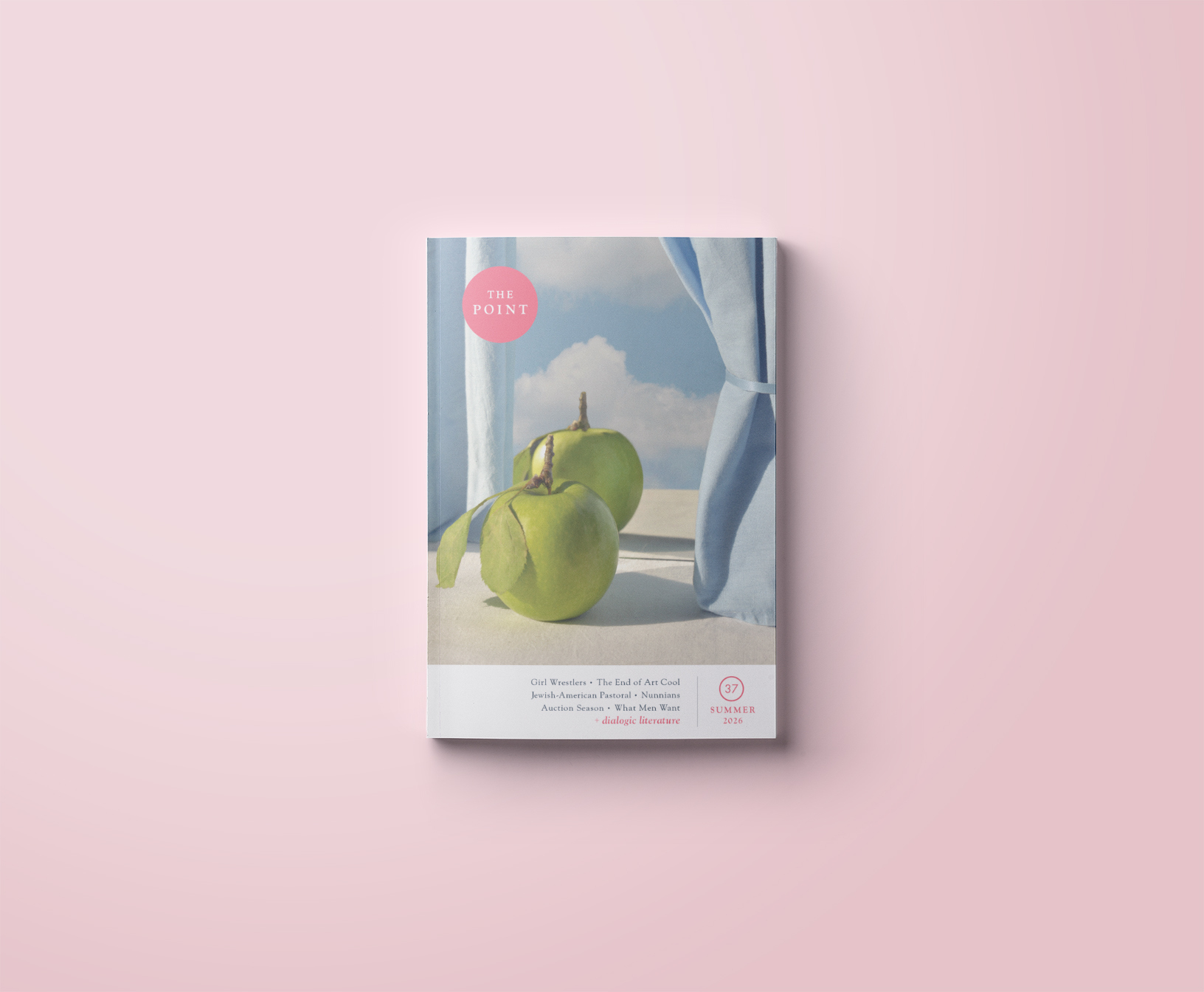
The annotated table of contents below offers a sneak peek at what’s in issue 37. To get the issue delivered straight to your door, subscribe now.
Letter from the Editors
On Radical Preservation
[The Editors]
Our contention is that, if we fail to think through and delimit the role of AI in our lives, we risk undermining the intelligibility of our own guiding cultural concepts, and thus initiating a period in our own society of which it may someday be possible to say that “nothing happened.”
Essays
Girls Wrestling
Going to the mat in Ohio
[Laura Baudot]
“She’s not wrestling boys, right?” I rushed to reassure them: “No way! They actually just started a girls team.” A day or two before the Oak Harbor tournament, my daughter announced to me that in order to increase her number of matches she would be wrestling boys.
After the Post-Avant-Garde
How to return to art history
[Sean Tatol]
When the art market can get by with flashy and ineffectual figurative paintings that are easy to sell on Instagram, it no longer has any reason to care about what’s going on in artistic subcultures. Indeed, those subcultures no longer have any reason to care about themselves. This isn’t to say, however, that the internet alone made art uncool. Not at all.
Student of Desire
Do men want smart women?
[Adelle Waldman]
The pressing question is not the extent to which Roth typified the conventional thinking of his day and what that means about the society he lived in but whether or not he was right about heterosexual love: Was Roth telling us a hard fact about men that some of us, particularly women who value intellectual connection, don’t want to be true but may well be?
We Were the 99 Percent
The left after Occupy
[Jeffrey Lawrence]
As the global tides have continued to shift rightward, I’ve found myself going back to those initial days of Occupy, looking for clues.
Goodbye, West Orange
Two paths for the American Jew
[David Sugarman]
Do I serve the Zionist cookies, two years into a war I take to be intolerable? Do I throw the cookies in the trash, which the ADL might consider a hate crime? Do I ask my wife, busy doing everything else, who will surely call me an idiot? Do I quietly eat all dozen before anybody sees?
Literature
The Fifth Syllable
[Greg Jackson]
The vehicles were able to achieve velocities significantly higher than the 1.5 m/s at which their maximum speed had been set after a series of safety reviews determined that anything faster posed an unacceptable risk to people and drones alike, given the prevalence and unpredictability of humans, but the 1.8-m/s study footage was still sometimes shown, despite numerous warnings and wrist slaps, by the boys in Facility Management for its priceless Keystone Kops-style comedy.
Q.
Drone porn?
Q.
Everyone’s a critic.
Advanced Fiction
[Elaine Schiff]
SAMUEL: I don’t understand—
STUART: It’s—it’s simple. I / told you
SAMUEL: How can you even—it’s ridiculous, how can you—a grade, creative writing? I mean, a—a—a— / a—a—
STUART: Will you let me finish?
SAMUEL: A bad grade?
Correspondence
A Vital Education
Can the microcollege movement gain ground?
[Franklin Tucker Eccher]
The summit in Viroqua had the air of a family reunion, hobbyist convention or emotional support group—the relief and wonder of finally, after all this time, meeting other people who know exactly what you’re talking about when you mention the time the staff building burned down or the student body voted to take an indefinite vow of silence.
Reviews
Art Auctions
[Jackson Arn]
What is it about lines that gets people going? Gold is supposed to be universally attractive to our species, and gold has nothing on lines. How else to explain the rich cross section of humanity behind the black velvet rope on the fifth floor of the Breuer—college kids, tourists from Hong Kong and Colombia, dog owners, united in the desire to stand and wait?
Silent Language
[Rory O’Connell]
For these critics, at the heart of Septology lies something fundamentally incommunicable. Fosse himself often cites the famous, or perhaps infamous, proposition with which the Austrian philosopher Ludwig Wittgenstein concludes the Tractatus Logico-Philosophicus: “Whereof what one cannot speak, thereof one must remain silent.” It can seem, then, that to try to say something about the essence of Fosse’s work is to go against the wisdom of the author as well as his most sensitive readers—and so perhaps to violate the spirit of the work itself.
Raritan
[Sheena Meng]
I had never heard the word “literature” uttered without the one-two punch of “AP” before it, but the publication served as a window through which I could see everything I didn’t know, but about which I could learn.
If you liked this essay, you’ll love reading The Point in print.