This issue on violence, the second The Point has ever devoted fully to a theme, was conceived in response to a number of questions or confusions. On the one hand, it seemed that violence was all around us: from the foreign wars being beamed to our phones in vivid and horrifying detail; to the weekly drumbeat of assassination attempts and lone-shooter episodes here in America; to the senseless, if often spectacular, violence that is never more than a click away on the internet. Yet even as our atmosphere was becoming suffused with violent news and imagery, the larger meaning of these events—for those of us not directly affected by them—proved elusive. Certain images—Luigi Mangione’s masked face at a Manhattan Starbucks, our current president thrusting his fist into the air on a rally stage in Pennsylvania—continued to haunt us, but not because we were able to connect them with any larger project or consequential impact. How to contextualize these snapshots of “real” events within an everyday experience characterized increasingly by a sense of disembodiment, disorder and drift? Was violence, too, destined to collapse into the endless slop of “content”? Or, if properly attended to, could it still hold the potential to resensitize us to the reality of the shared world we inhabit as finite, moral selves?
Such questions seemed to us too hard and urgent to fit into our usual symposium format, and the pages that follow testify to their vertiginous pull. From our opening essay, by Sam Kriss, on John Hinckley, Jr. and the evolution of killing in the televisual age, to our closing review, by Alex Rollins Berg, on the developments in filmic violence from Thomas Edison’s Electrocuting an Elephant to the Tesla Cybertruck bombing of 2025, many of the authors in this issue grapple with the way that algorithmic culture severs our apprehension of violent events from the narrative structures that once invested them with political and moral meaning. At the same time, in essays by Mary Gaitskill on “demonic” violence, by Lillian Fishman on the domination fantasies we find in pornography, by Peter Mommsen on his journey to accepting the pacifism of his religious community and by Oliver Bateman on violence within his own family—among many others—the issue approaches perennial mysteries about the sources of human violence, including within ourselves. In these cases the problem is not that violence is meaningless but that it threatens to mean too much, transgressing the boundaries we might like to imagine separate the personal from the political, the cultural from the historical, the sexual from the spiritual.
This issue was also completed against the backdrop of a conspicuous rise in domestic political violence, on both the right and the left—including targeted attacks by a pro-life preacher that left a Democratic state legislator and her husband dead and two more in critical condition in Minnesota, and another by a pro-Palestinian activist from Chicago who gunned down two Israeli embassy workers in Washington, D.C. Most memorably, the CEO of UnitedHealthcare, Brian Thompson, was shot and killed in New York City in December, setting off a widely publicized manhunt that led to the arrest of 26-year-old data engineer Luigi Mangione. Sophie Pinkham discusses this act of vigilante justice in relation to the legacy of a group of celebrity assassins from pre-revolutionary Russia, asking what lessons their stories might hold for us about “the nature of political violence, with its ineluctable momentum.” Distinctive as Luigi Mangione’s act might have seemed at the time, however, it was only one in a series of violent acts perpetrated by lone shooters in recent years—many of which seem inspired less by coherent political motives than by what Kriss calls the “diffuse, secularized violence” of the internet—as well as the rise in justifications for more organized forms of political violence, from the George Floyd protests in 2020 to the Capitol riot on January 6, 2021. These latter events are part of the impetus for Geoff Shullenberger to return to a long-running debate between two prominent French intellectuals, Michel Foucault and René Girard, about the relationship between violence and modern institutions. The debate culminates, for Shullenberger, in a question many Americans have surely been asking themselves in recent years: How can a society “keep in check the possibility of its own apocalyptic breakdown into spirals of reciprocal violence”?
●
If the prospect of spirals of reciprocal violence is frightening to some Americans, its terrible reality can be seen playing out on the international stage—both in Eastern Europe, where according to some estimates more than 300,000 Russians and Ukrainians have died since Russian tanks began rolling across the border in February of 2022, and in the Middle East, where the Gaza war that began on October 7, 2023, has caused the deaths of some 2,000 Israelis and more than 60,000 Palestinians. Within this issue, America’s role in both conflicts is examined by David Bromwich in his essay on “the war habit,” while Alia Malek’s report on a Syrian scientist’s attempt to quantify the intergenerational effects of exposure to traumatic violence emphasizes the far-reaching consequences of wars undertaken amid civilian populations—as has been the case in Israel’s ongoing campaign in Gaza. Engaging with the international response to the October 7th attacks and their aftermath, the Israel-based political theorist and activist Jacob Abolafia probes the role of violence in the political imagination of left-wing intellectuals in the West, arguing that a romanticization of revolutionary violence can obscure the need for clarity about the relationship between “effective means … and emancipatory ends.” In our Literature section, Yousri Alghoul writes from Gaza about the surreal—and all too real—experience of living in a situation of unremitting instability and threat, while Jenny Erpenbeck reflects, in a series of vignettes, on living among the artifacts of Germany’s Nazi past and the more mundane destruction of the present. Meanwhile, in our survey, we ask photojournalists working in conflict zones how they see their role as documenters and witnesses.
We had expected to have one more essay in the issue that addressed the Israel-Palestine conflict by way of a longer-term reflection on the role of violence in the history of revolutionary movements in the Middle East. The essay was ultimately pulled due to the writer’s concerns about political retribution by the Trump administration. This was the first time in our sixteen years as a magazine that we have had a writer tell us they were concerned about government censorship or reprisal. While we are certainly not the first to have felt the weight of this threat to intellectual discourse—especially as regards writing and speech about Israel-Palestine—it bears mentioning that the threat has reached even our small magazine of ideas. And that it represents to us a new and disquieting obstacle to our goal of promoting honest, pluralistic and adventurous dialogue in our pages.
With that said, we’ve tried in this issue, as always, to publish as wide a variety of compelling perspectives on our theme as we could find. The point is not that everyone has equally valid or compelling things to say about violence, but that, if we do not try to understand the personal, philosophical and political commitments that inform our fundamental differences in perspective, then it is impossible to have any real argument at all. The point is also not that a “real argument” is always what is necessary to solve our problems. Indeed it can seem perverse, so long as violence is ongoing, to ask for philosophical reflection on violence. In some sense, it surely is. It is a perversity that is coequal with intellectual life itself, which will always seem decadent or ineffectual in view of some more urgent concern or other, and yet remains our only avenue for understanding why something feels urgent to us in the first place, or why it seems less so to others. We might add that no action is thoughtless in the strict sense, though it can certainly be—and often is, especially in the case of violence—a result of what Hannah Arendt called “thoughtlessness,” meaning the refusal or the incapacity or the lack of habitual training to, in the common English idiom she liked so much, “stop and think.”

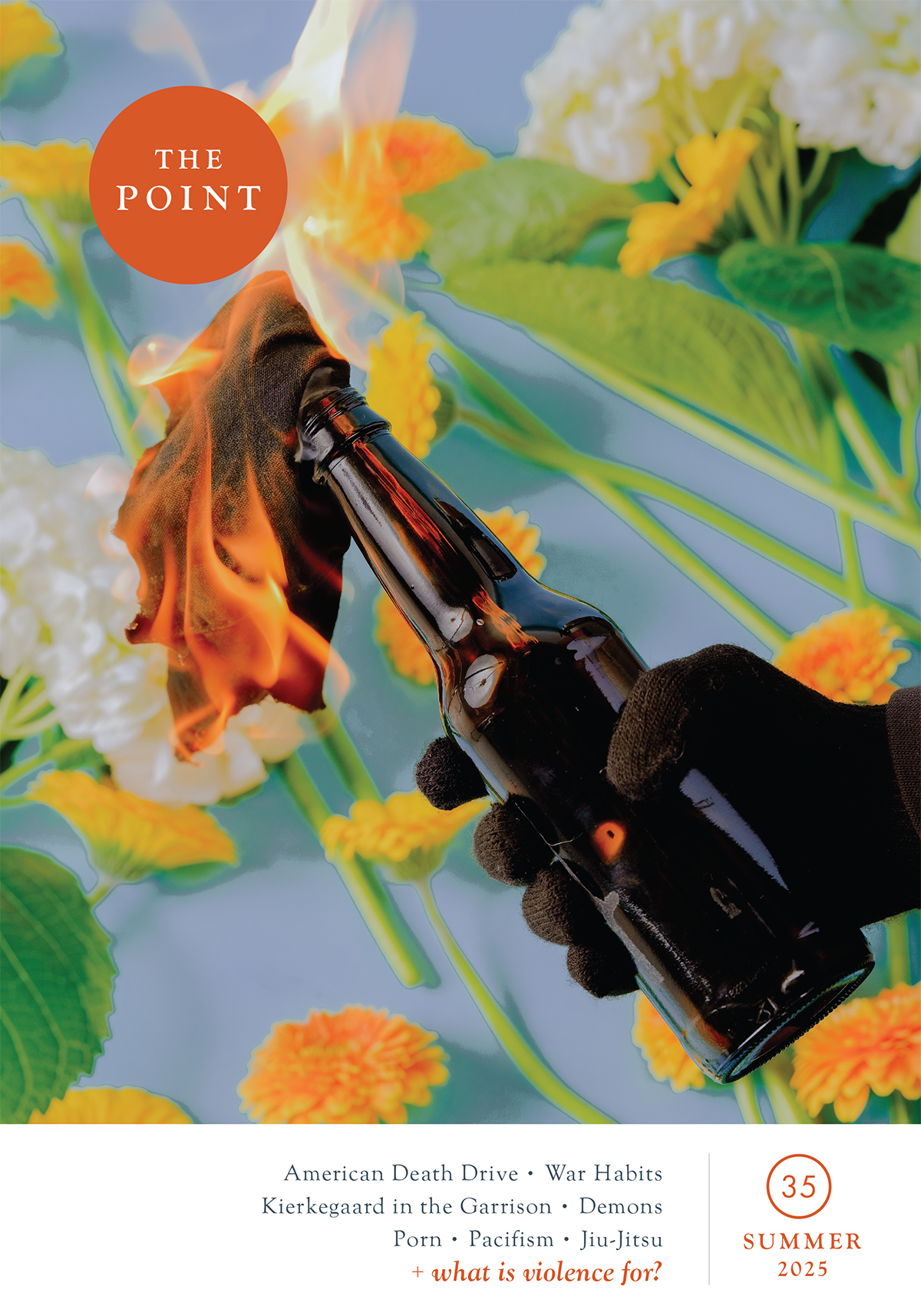
This issue on violence, the second The Point has ever devoted fully to a theme, was conceived in response to a number of questions or confusions. On the one hand, it seemed that violence was all around us: from the foreign wars being beamed to our phones in vivid and horrifying detail; to the weekly drumbeat of assassination attempts and lone-shooter episodes here in America; to the senseless, if often spectacular, violence that is never more than a click away on the internet. Yet even as our atmosphere was becoming suffused with violent news and imagery, the larger meaning of these events—for those of us not directly affected by them—proved elusive. Certain images—Luigi Mangione’s masked face at a Manhattan Starbucks, our current president thrusting his fist into the air on a rally stage in Pennsylvania—continued to haunt us, but not because we were able to connect them with any larger project or consequential impact. How to contextualize these snapshots of “real” events within an everyday experience characterized increasingly by a sense of disembodiment, disorder and drift? Was violence, too, destined to collapse into the endless slop of “content”? Or, if properly attended to, could it still hold the potential to resensitize us to the reality of the shared world we inhabit as finite, moral selves?
Such questions seemed to us too hard and urgent to fit into our usual symposium format, and the pages that follow testify to their vertiginous pull. From our opening essay, by Sam Kriss, on John Hinckley, Jr. and the evolution of killing in the televisual age, to our closing review, by Alex Rollins Berg, on the developments in filmic violence from Thomas Edison’s Electrocuting an Elephant to the Tesla Cybertruck bombing of 2025, many of the authors in this issue grapple with the way that algorithmic culture severs our apprehension of violent events from the narrative structures that once invested them with political and moral meaning. At the same time, in essays by Mary Gaitskill on “demonic” violence, by Lillian Fishman on the domination fantasies we find in pornography, by Peter Mommsen on his journey to accepting the pacifism of his religious community and by Oliver Bateman on violence within his own family—among many others—the issue approaches perennial mysteries about the sources of human violence, including within ourselves. In these cases the problem is not that violence is meaningless but that it threatens to mean too much, transgressing the boundaries we might like to imagine separate the personal from the political, the cultural from the historical, the sexual from the spiritual.
This issue was also completed against the backdrop of a conspicuous rise in domestic political violence, on both the right and the left—including targeted attacks by a pro-life preacher that left a Democratic state legislator and her husband dead and two more in critical condition in Minnesota, and another by a pro-Palestinian activist from Chicago who gunned down two Israeli embassy workers in Washington, D.C. Most memorably, the CEO of UnitedHealthcare, Brian Thompson, was shot and killed in New York City in December, setting off a widely publicized manhunt that led to the arrest of 26-year-old data engineer Luigi Mangione. Sophie Pinkham discusses this act of vigilante justice in relation to the legacy of a group of celebrity assassins from pre-revolutionary Russia, asking what lessons their stories might hold for us about “the nature of political violence, with its ineluctable momentum.” Distinctive as Luigi Mangione’s act might have seemed at the time, however, it was only one in a series of violent acts perpetrated by lone shooters in recent years—many of which seem inspired less by coherent political motives than by what Kriss calls the “diffuse, secularized violence” of the internet—as well as the rise in justifications for more organized forms of political violence, from the George Floyd protests in 2020 to the Capitol riot on January 6, 2021. These latter events are part of the impetus for Geoff Shullenberger to return to a long-running debate between two prominent French intellectuals, Michel Foucault and René Girard, about the relationship between violence and modern institutions. The debate culminates, for Shullenberger, in a question many Americans have surely been asking themselves in recent years: How can a society “keep in check the possibility of its own apocalyptic breakdown into spirals of reciprocal violence”?
●
If the prospect of spirals of reciprocal violence is frightening to some Americans, its terrible reality can be seen playing out on the international stage—both in Eastern Europe, where according to some estimates more than 300,000 Russians and Ukrainians have died since Russian tanks began rolling across the border in February of 2022, and in the Middle East, where the Gaza war that began on October 7, 2023, has caused the deaths of some 2,000 Israelis and more than 60,000 Palestinians. Within this issue, America’s role in both conflicts is examined by David Bromwich in his essay on “the war habit,” while Alia Malek’s report on a Syrian scientist’s attempt to quantify the intergenerational effects of exposure to traumatic violence emphasizes the far-reaching consequences of wars undertaken amid civilian populations—as has been the case in Israel’s ongoing campaign in Gaza. Engaging with the international response to the October 7th attacks and their aftermath, the Israel-based political theorist and activist Jacob Abolafia probes the role of violence in the political imagination of left-wing intellectuals in the West, arguing that a romanticization of revolutionary violence can obscure the need for clarity about the relationship between “effective means … and emancipatory ends.” In our Literature section, Yousri Alghoul writes from Gaza about the surreal—and all too real—experience of living in a situation of unremitting instability and threat, while Jenny Erpenbeck reflects, in a series of vignettes, on living among the artifacts of Germany’s Nazi past and the more mundane destruction of the present. Meanwhile, in our survey, we ask photojournalists working in conflict zones how they see their role as documenters and witnesses.
We had expected to have one more essay in the issue that addressed the Israel-Palestine conflict by way of a longer-term reflection on the role of violence in the history of revolutionary movements in the Middle East. The essay was ultimately pulled due to the writer’s concerns about political retribution by the Trump administration. This was the first time in our sixteen years as a magazine that we have had a writer tell us they were concerned about government censorship or reprisal. While we are certainly not the first to have felt the weight of this threat to intellectual discourse—especially as regards writing and speech about Israel-Palestine—it bears mentioning that the threat has reached even our small magazine of ideas. And that it represents to us a new and disquieting obstacle to our goal of promoting honest, pluralistic and adventurous dialogue in our pages.
With that said, we’ve tried in this issue, as always, to publish as wide a variety of compelling perspectives on our theme as we could find. The point is not that everyone has equally valid or compelling things to say about violence, but that, if we do not try to understand the personal, philosophical and political commitments that inform our fundamental differences in perspective, then it is impossible to have any real argument at all. The point is also not that a “real argument” is always what is necessary to solve our problems. Indeed it can seem perverse, so long as violence is ongoing, to ask for philosophical reflection on violence. In some sense, it surely is. It is a perversity that is coequal with intellectual life itself, which will always seem decadent or ineffectual in view of some more urgent concern or other, and yet remains our only avenue for understanding why something feels urgent to us in the first place, or why it seems less so to others. We might add that no action is thoughtless in the strict sense, though it can certainly be—and often is, especially in the case of violence—a result of what Hannah Arendt called “thoughtlessness,” meaning the refusal or the incapacity or the lack of habitual training to, in the common English idiom she liked so much, “stop and think.”
If you liked this essay, you’ll love reading The Point in print.