Yes, your fantasies aren’t real, but you’re not stupid to have had them.
Doomers in Love
On dating and dignity
[Mana Afsari]
“For most young men, their lives are consumed by thinking about these categories,” he continues, “because real life is degraded for most people, and they can’t exit out of these imagined categories and just meet human beings. Real life is not degraded for me, because I’m relatively good-looking and charming and rich.” He pauses and gives me a smile. “But I can understand it. We’ve outsourced opportunities for normal connection. You go to bars today and it’s literally groups of guys in three and groups of women in three, and none of them talk to each other. That was not how it was fifty years ago. If you’re just a well-meaning young person who is not extraordinary in any way, what are you supposed to do?”
Forum: The left and the good life
Beyond Equality
[Jonny Thakkar]
What I’m about to say is going to seem like a bad joke: the trouble with the left is its egalitarianism.
Perfecting Democracy
[Paul Taylor]
Perfection, however unattainable, is the heavenly mark that galvanizes the self—the fallible, humble, but aspiring self that can, despite itself, come to regard goodness and right as cold and lifeless abstractions.
Live in Society!
[Rosemarie Ho]
Discovering class consciousness is itself a social practice, where people form communities through a constant feedback loop of desire, self-inquiry and action. The Greeks had a word for this. They used to call it politics.
Radical Eudaimonism
[Jensen Suther]
Degrowth communism risks becoming eco-authoritarianism in a Marxist guise. Yet Hegel helps us see that work like Saito’s is premised on a false dichotomy—the choice is not between growth and degrowth but capital growth and rational growth.
Serpents in the Garden
[Marco Roth]
Lonergan’s scene highlights the difficulty of maintaining open-ended intellectual spaces even under what ought to be close-to-ideal conditions. With one misstep, one slip off balance, the invitation to think becomes instead a theater of gesture, a drama of recognition and vengeance playing out in a space that appears to be free but reveals itself to be cryptically or tacitly authoritarian.
The Left Case for Great Books
[Daniel Walden]
When we sit down in a seminar to explore a text and the questions it poses, we are not doing it for an employer or in the service of some idea of social utility, but for ourselves and for one another. Indeed, it is only by divesting ourselves of the trappings of expertise and social hierarchy that a seminar becomes possible at all: we must meet and speak as equals. This includes both the people in the room and the author of the text: all may be criticized, but all must be understood.
Freedom of Intelligence
[Annie Abrams]
In the name of progress, public education is now pressed into the service of agendas that align with corporate profit, workforce readiness, ideological reproduction and demand for quantifiable results. These aims ignore what progressive education at its best can do, and the students who school ostensibly serves.
Clocked Out
[Martin Dolan]
Writing off the average American worker as either a naïve dupe or an embattled burnout is reductive, an easy intellectual out. It skirts the messier question: Even if the contemporary economy is inherently exploitative, does the left have anything constructive to say about finding meaningful work within it anyway?
Make Nothing That Isn’t Beautiful
[John Michael Colón]
Morris dreamed of large-scale works of art that, like the cathedral, would combine the talents of all the greatest artists in all the recognized art forms of our time and stand as testaments to posterity of who we were and what we aspired to achieve. And they would also be microcosms of the society that produced them, whose virtue was to discover and direct the talents of the common people (a good slice of them, anyway) and not waste them in drudgery. For us who follow in the wake of the twentieth-century avant-gardes, Morris’s challenge remains our challenge, his dream our dream.
Dialogue
A Space Apart
A conversation with Paul North on Marx and translation
[Paul North and Anastasia Berg]
“The intellectuals who want to ‘do what Marx did’ are the ones who decide to spend some years reading Marx. We have this great guide—they don’t need to write it again. We’re still in the same epic saga where the analysis takes us.”
Correspondence
Tragic Heritage
The uncertain fate of Soviet art in Ukraine under siege
[Megan Buskey]
All sorts of things that before were considered benign or even part of a shared culture—Russian literature, Russian arts, the Russian language—were now being scrutinized as ideological cover for Putin’s war of aggression. “My legli spat 23 Fevryala,” one acquaintance in Kyiv told me, “i my prokynulysya 24 Lyutoho.” “We went to sleep on February 23rd,” she said in Russian, “and woke up on February 24th,” she finished in Ukrainian.
Reviews
Listless Liberalism
[Becca Rothfeld]
What the post-liberals get right—and the reason they are winning—is that the end of history has been sallow, ugly and deflating. Theirs is decidedly not an intellectual objection. It is not even an ethical objection, though it is often trussed up in the trappings of moral outrage. At its core, it is an aesthetic aversion.
The Great Replacement
[Vikrant Dadawala]
None of us—Camus, the peddlers of multicultural ephemera, the internet Nazis or me—is immune to the self-forgetting that follows the transformation of genuine cultural memory into kitsch.
Quitting
[John Phipps]
Every smoker keeps in the front of their mind a worse-off, more seriously addicted, probably sooner-dying smoker who they use to legitimate their own habit. For everyone I knew, I was that smoker.

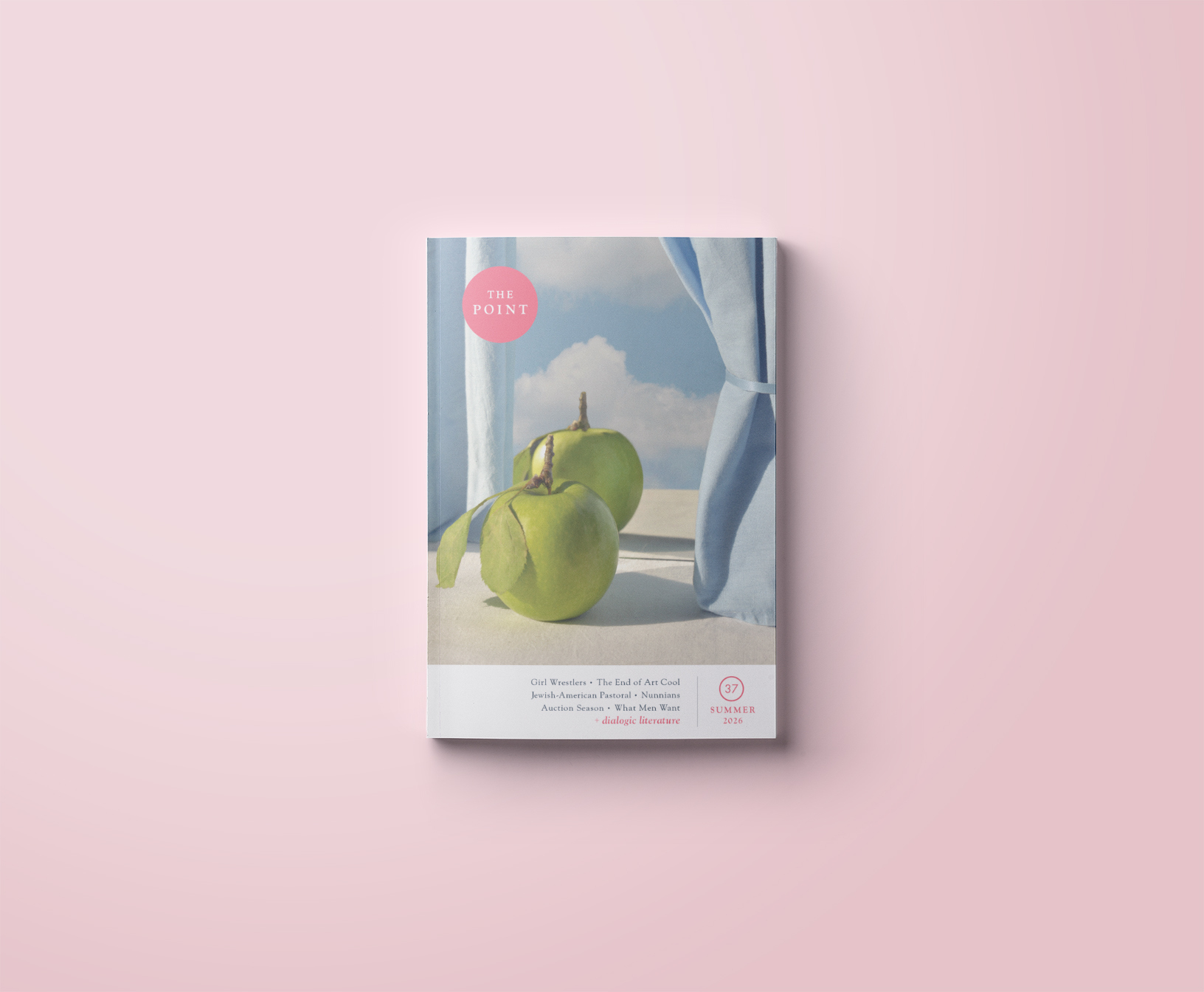
The annotated table of contents below offers a sneak peek at what’s in issue 36. To get the issue delivered straight to your door, subscribe now.
Letter from the Editors
On the Liberal Imagination
[Jon Baskin]
Perhaps the vision offered up in the opening of Abundance—a temperature-controlled apartment, well-stocked fridge and drone technology for package delivery (something already current in select American cities)—is utopian enough for Klein and Thompson’s most likely readership: well-educated progressives who already inhabit some version of this life but would like to be liberated from the guilt they feel at the injustice and scarcity on which they know it is built. Surely, though, there must be something more to the “good life” than this.
Essays
Right and Left
A bad year in Washington
[Noelle Bodick]
Another fed worker tells me he spends his days pacing the marble corridors of his office like an absolute madman. The Lana del Rey lyric “I don’t wanna do this anymore” plays on loops in his head in Lana’s exact fey, languid voice. “Everyone is depressed under Trump. Everyone has ED,” a government lifer—male, late forties—reports, matter of fact. A probationary worker who studied history in school laughs manically when I ask if 2025 has felt “historic.” “It has not felt historic. It has felt chaotic.”
The Art of Nostalgia
Wes Anderson’s history films
[Andrew Eckholm]
Yes, your fantasies aren’t real, but you’re not stupid to have had them.
Doomers in Love
On dating and dignity
[Mana Afsari]
“For most young men, their lives are consumed by thinking about these categories,” he continues, “because real life is degraded for most people, and they can’t exit out of these imagined categories and just meet human beings. Real life is not degraded for me, because I’m relatively good-looking and charming and rich.” He pauses and gives me a smile. “But I can understand it. We’ve outsourced opportunities for normal connection. You go to bars today and it’s literally groups of guys in three and groups of women in three, and none of them talk to each other. That was not how it was fifty years ago. If you’re just a well-meaning young person who is not extraordinary in any way, what are you supposed to do?”
Forum: The left and the good life
Beyond Equality
[Jonny Thakkar]
What I’m about to say is going to seem like a bad joke: the trouble with the left is its egalitarianism.
Perfecting Democracy
[Paul Taylor]
Perfection, however unattainable, is the heavenly mark that galvanizes the self—the fallible, humble, but aspiring self that can, despite itself, come to regard goodness and right as cold and lifeless abstractions.
Live in Society!
[Rosemarie Ho]
Discovering class consciousness is itself a social practice, where people form communities through a constant feedback loop of desire, self-inquiry and action. The Greeks had a word for this. They used to call it politics.
Radical Eudaimonism
[Jensen Suther]
Degrowth communism risks becoming eco-authoritarianism in a Marxist guise. Yet Hegel helps us see that work like Saito’s is premised on a false dichotomy—the choice is not between growth and degrowth but capital growth and rational growth.
Serpents in the Garden
[Marco Roth]
Lonergan’s scene highlights the difficulty of maintaining open-ended intellectual spaces even under what ought to be close-to-ideal conditions. With one misstep, one slip off balance, the invitation to think becomes instead a theater of gesture, a drama of recognition and vengeance playing out in a space that appears to be free but reveals itself to be cryptically or tacitly authoritarian.
The Left Case for Great Books
[Daniel Walden]
When we sit down in a seminar to explore a text and the questions it poses, we are not doing it for an employer or in the service of some idea of social utility, but for ourselves and for one another. Indeed, it is only by divesting ourselves of the trappings of expertise and social hierarchy that a seminar becomes possible at all: we must meet and speak as equals. This includes both the people in the room and the author of the text: all may be criticized, but all must be understood.
Freedom of Intelligence
[Annie Abrams]
In the name of progress, public education is now pressed into the service of agendas that align with corporate profit, workforce readiness, ideological reproduction and demand for quantifiable results. These aims ignore what progressive education at its best can do, and the students who school ostensibly serves.
Clocked Out
[Martin Dolan]
Writing off the average American worker as either a naïve dupe or an embattled burnout is reductive, an easy intellectual out. It skirts the messier question: Even if the contemporary economy is inherently exploitative, does the left have anything constructive to say about finding meaningful work within it anyway?
Make Nothing That Isn’t Beautiful
[John Michael Colón]
Morris dreamed of large-scale works of art that, like the cathedral, would combine the talents of all the greatest artists in all the recognized art forms of our time and stand as testaments to posterity of who we were and what we aspired to achieve. And they would also be microcosms of the society that produced them, whose virtue was to discover and direct the talents of the common people (a good slice of them, anyway) and not waste them in drudgery. For us who follow in the wake of the twentieth-century avant-gardes, Morris’s challenge remains our challenge, his dream our dream.
Dialogue
A Space Apart
A conversation with Paul North on Marx and translation
[Paul North and Anastasia Berg]
“The intellectuals who want to ‘do what Marx did’ are the ones who decide to spend some years reading Marx. We have this great guide—they don’t need to write it again. We’re still in the same epic saga where the analysis takes us.”
Correspondence
Tragic Heritage
The uncertain fate of Soviet art in Ukraine under siege
[Megan Buskey]
All sorts of things that before were considered benign or even part of a shared culture—Russian literature, Russian arts, the Russian language—were now being scrutinized as ideological cover for Putin’s war of aggression. “My legli spat 23 Fevryala,” one acquaintance in Kyiv told me, “i my prokynulysya 24 Lyutoho.” “We went to sleep on February 23rd,” she said in Russian, “and woke up on February 24th,” she finished in Ukrainian.
Reviews
Listless Liberalism
[Becca Rothfeld]
What the post-liberals get right—and the reason they are winning—is that the end of history has been sallow, ugly and deflating. Theirs is decidedly not an intellectual objection. It is not even an ethical objection, though it is often trussed up in the trappings of moral outrage. At its core, it is an aesthetic aversion.
The Great Replacement
[Vikrant Dadawala]
None of us—Camus, the peddlers of multicultural ephemera, the internet Nazis or me—is immune to the self-forgetting that follows the transformation of genuine cultural memory into kitsch.
Quitting
[John Phipps]
Every smoker keeps in the front of their mind a worse-off, more seriously addicted, probably sooner-dying smoker who they use to legitimate their own habit. For everyone I knew, I was that smoker.
If you liked this essay, you’ll love reading The Point in print.