No great American novel has ever emerged from the nation’s capital, Christopher Hitchens once observed. London had Dickens—Paris, Zola and Flaubert. And Washington, D.C.? A city cut out for genre fiction: dutiful historical reconstruction, or else cheap political thrillers, sold at airports with raised gold lettering. Evidently, the town’s bureaucratic processes and brutalist office architecture just cannot deliver an exhilarating prose style. Nor can the self-serious men and women, with their big egos and small ambitions, attract literary sympathies.
If literature is no place to turn, perhaps there exists some great work of art? It was 2025, and I had to escape a May Day protest on the Mall (grown men in FUCK TRUMP wifebeaters, a crimson Handmaid’s Tale girl zapped back from a fascist-lite era). So far 2025 had been no 1963, 1982 or even 2017. CSPAN-watching geriatrics waving cardboard signs on bridges felt at times like the only symbolic act fending off the wacko, dark-web authoritarianism radiating from Pennsylvania Avenue. When May Day turned to more “mayday, mayday!,” rather than going to the Lincoln Memorial Reflecting Pool to drown myself, I ended up in front of a painting in the American Wing of the nearby National Gallery.
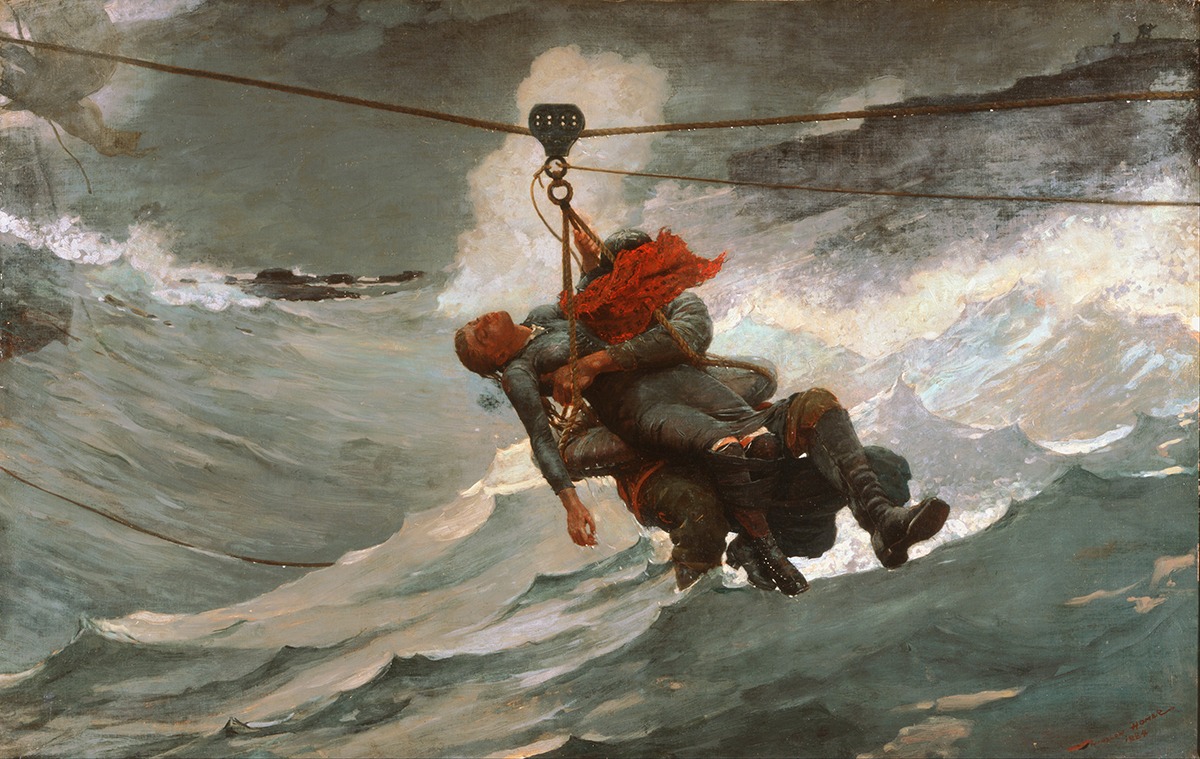
Right and Left (1909) by Winslow Homer might be altogether disqualified from Great Washington Painting. For one, the work is not set on the banks of the Potomac but off the shore of Prouts Neck, Maine. Surely the craggy presidential faces in the Portrait Gallery or Gordon Parks’s solemn American Gothic (1942) would make for more obvious contenders. But the painting’s perfect, suggestive title, paired with the melancholic mood of the hunting scene, relaxed all critical judgment that afternoon, as I reached for something, anything, to explain a strange city in strange times.
Over gray waters, a pair of goldeneye ducks are tossed mid-flight like clown juggling pins. Distant waves carry the sportsman who has just fired on them. As if rendered by a Persian miniaturist, the diminutive scale of the shooter makes clear human motives are entirely incidental to the painting. The real drama, and damage, is in the foreground—the freakish, jack-o’-lantern yellow eye of the bird on the left, the terrible head-first plummet on the right. Both birds’ bodies are a cohesion of awkward, unnatural angles. The animals are alive and dead. The waves crest and fall. There is nothing romantic about the state of suspension: the setting sun, low and feeble, is a single orange stroke Homer has made over the indefinite horizon, like a pencil scratch on a doorframe marking the growth of a child.
In late January of last year, a quiet panic began rippling through the capital when the little figure skaters’ plane went down in the Potomac. This was around the time the government was purging tens of thousands of jobs that do things like keep planes in the sky. Countless entries follow in the region’s diary of a bad year. Authorities abducted a local Maryland man from an IKEA parking lot, to then erroneously deport him to a Salvadoran mega-prison. Gold-chained tech barons snapped up mansions in Massachusetts Avenue Heights as the welcome mat was laid out in the White House. A gunman mowed down embassy sweethearts in the streets; seventy-ton M1 Abrams tanks squeaked through a militarized birthday carnival. The clangor of dissent played out on pots and pans as the National Guard rolled into town. M4 semiautomatic rifles circled two-year-olds’ birthday parties in Capitol Hill’s Lincoln Park. Meanwhile, immigration authorities began quietly patrolling the District alongside the police, making more than triple the number of arrests in a month than in the first half of the year. Come fall, the president spent the longest government shutdown in U.S. history gussying up the White House, with such understated measures as razing a wing. The year rounded out with two shot National Guard members and a hydra-headed call for five hundred more on the ground: Christmases lost protecting deserted streets in camo and Santa hats.
In a city being pulverized and remade seemingly daily, where even as recent of history as the Black Lives Matter plaza is jackhammered to oblivion, the sense of dread and unknown can bully one into a state of mental submission, or else frantic, desperate attempts to make sense of the nonsense—“rational delirium,” I underline in a hip novel I can’t finish. One of these disposable origami thoughts comes to me in the museum. It is futile surely as any other attempt to say something intelligent about such deeply stupid times. But there it is: like Homer’s bewildering birds, the targets in Washington have also been two. They have also been twinned. In this city, maybe no one has been thumped harder than undocumented workers from Central and South America, on the one hand, and federal public servants, on the other. Their red-alert existential terror—though quite incomparable in kind—might even be held within a single frame. Both perform types of labor deeply distasteful, or perhaps incomprehensible, to the administration: manual labor and public-serving work.
What I mean to say is, hardworking bricklayers and line cooks are being criminalized as hardened gangsters. Dedicated civil servants, meanwhile, are roasted as do-nothings, forced to correspond with HR black holes and polygraph machines. D.C. flags may have sold out across the city in protest of the paramilitary takeover, but Trump’s nostalgia for tough-on-crime 1970s New York increasingly feels like the sideshow. The real story of this past year, the story that will have the longer historical afterlife, is a quieter one. It is one of draining the intrinsic value from labor yoked to repetitive, inglorious and truly vital tasks: the maintenance of the civic home, on the one hand, and the literal home, on the other. (If you want to call these real, productive forms of labor feminized versus a masculine world of bullshit finance capital or big tech, I, for one, won’t object.)
In this bleak picture of 2025 Washington, both civil servants and undocumented workers were said to be living off ill-gotten gains. Both were targeted at the places of their work. Both, like the pair of mid-flight sea birds, found themselves in kinds of godless existential suspense. And both, I would argue in a more grandiose mood, if I could summon it, were subject to an elitist attack on the American work ethic. A work ethic that arrived in the rugged hills of New England with… the Puritans!
Leaving the museum, I retraced the perimeter of the protest on the National Mall, where it turned out I might have misunderstood the Calvinist commitments of the Handmaid girl whose outdated display had driven me away. Now sitting cross-legged, ringed by the roots of an American elm and the rim of her red dress, eyes closed, bodice pooling around her waist: She was topless? Stamp-sized leaves overlaid her nipples and inked across her chest in lipstick were the words “Non Violent Vibes.” (Two words, not one.)
The Puritans had their maypoles of Merry Mount and were, in reality, a band of certified neurotics (Max Weber’s description was always too somber). But even at this lefty protest, the Protestant work ethic—its seriousness, self-discipline, prudishness—appeared to be in somewhat dramatic retreat.
I supposed. Who the hell knew what was going on anymore. I was pregnant and needed to go home and lie down.
●
Against the odds, I would later pull down my faded copy of Weber’s The Protestant Ethic and the Spirit of Capitalism, putting aside my preferred reading (that is, a pastel-toned Natural Hospital Birth, Best of Both Worlds). I hadn’t consulted Weber since graduate school, and then, in grad-school fashion, only glancingly. All my margin notes were clearly from college. My handwriting is architectural and neat, illustrated with arrows and exclamation points. It was the early Obama years, and I believed in an orderly world of ideas begetting more ideas, like generations of the Bible.
Weber, I recalled, also had a fanatically tidy sense of historical change. Blame the seventeenth-century Puritans, he says, for the nervous, fanatical, work-obsessed personality of the United States, in which industry as an ideal was raised above leisure. The Puritans believed God had called everyone to a particular vocation to work for a common good and His glory, punting religion out of the monastic cell and into the world of work. A monk’s life of contemplation and prayer—no more! (“Egoistic lovelessness that withdraws from one’s duties in the world,” I had !’d). The rest about a Protestant ethic ushering in a “spirit of capitalism” sounded like ahistorical mumbo-jumbo as ever. But there was something else key in the text: a counterintuitive psychological insight. The sixteenth- and seventeenth-century stringent work habits allowed for new forms of passionate distraction. Through work, the Puritans could stave off the anxiety of predestination—God’s selection of a few “elect” souls to save, while condemning the majority to hell. Busy yourself and banish tormenting doubts of whether you were among the damned or the saved!
Around Washington, the flat, SSRI-pilled Zoomers wear shirts that read like floating signifiers or non sequiturs. A girl brandishes SOLD OUT across her sweatshirt in Capitol Hill. (She sold out? Her shirt is sold out?) MAIN CHARACTER traipses toward the zoo in Northwest. (Surely the pandas are the protagonists?) LET’S GO FOR A WALK crosses Penn Quarter, alone, as if the invitation has gone declined. I haven’t seen a slogan fit for the moment of deep unease in a city in which 20 percent of the workforce is federal, tens of thousands have left or been fired since February, and where the unemployment rate has been leading the nation for months. Why not say what we mean? CANNED, FURLOUGHED or PROBATIONARY. DAMNED. SAVED.
In every other respect, the people of this city speak in a direct manner, so rarely a note of the ironical or bohemian. Washington can feel like inhabiting a LinkedIn hologram: transactional, oppressively chipper, neutered. At the tasteful, wood-paneled bistro, a young woman in athleisure sits alone reading Gung Ho! Increase Productivity, Profits, and Your Own Prosperity over a shrimp salad and pale coffee. (The endearing maître d’ who used to inhale drags of Arthur Schlesinger, Jr. behind the counter seems to have evacuated his post.) Steel yourself: the first question out of a new acquaintance’s month really might be “What d’you do?”
But there is a less cynical read, I’ve learned, of the town’s professional prying and preening. People often do interesting work! They take pride in it! An ex-fed who studied women’s health spent the month of February deleting the past three and a half years of her research because of its purported “gender bias.” She kept referencing these 85 internal guidance documents, poof, up in smoke, like they were the Library of Alexandria, and I kept wondering if it was all a sideways manner of talking about the more immediate loss of her job, income, health coverage. But eventually it clicked for me that she felt as any artist or craftsman might—that she had coined herself into her labor. Now that it had vanished, who was she?
Another fed worker tells me he spends his days pacing the marble corridors of his office like an absolute madman. The Lana del Rey lyric “I don’t wanna do this anymore” plays on loops in his head in Lana’s exact fey, languid voice. “Everyone is depressed under Trump. Everyone has ED,” a government lifer—male, late forties—reports, matter of fact. A probationary worker who studied history in school laughs manically when I ask if 2025 has felt “historic.” “It has not felt historic. It has felt chaotic.” (By autumn, the pace of chaos had transformed into a feeling of collective fatigue as federal employees scrutinized shutdown headlines and grim-reaper memes like fortune-cookie messages.)
Laments are often operatic, duly so, but from people whose professional life and manner are the definition of restraint. A physician running miraculous clinical trials described to me a Looney Tunes world this past winter: a futile Road Runner-Coyote chase sequence, until the latest cuts made by the DOGE kid stuffed in the utility closet inevitably get reversed. Another fed worker is witnessing his unit transform into a “tabloid operation,” he says, “a craven institution stewarding the demise of the nation.” He continues: “What do you do stuck in a job with career-preservationists in charge who bend 93 different ways a day?”
Accommodation certainly is one way to ascend Mount Purgatory to Trumpian-gold Paradise. “Ride the tiger,” a longtime government worker says. Rid the ranks of the effete, tepid Democrats from Yale and Harvard—why not? Here come the burly Republicans knocking down doors! There are all sorts of ways to accommodate an ideological rearrangement. A mother of three wears a summer dress to the office with a neckline best left to the red carpet—a wardrobe malfunction or deft move ahead of a front-office meeting later that day? What is the point of fighting the government from the inside?
The question as to whether to hightail it out of Sodom and Gomorrah seems to depend on how entrenched one is, which, practically speaking, means if you have kids. After Elon’s “Fork in the Road,” a childless lawyer told me he planned to see the Badlands this winter, the glacier forests, to be gored by a bison, before the National Parks are sold off. But the DMV maintains a tighter grip on parents’ lives, and wallets. A “displaced federal worker,” a single mother, texted a D.C. moms’ WhatsApp group this summer, desperate to find someone to fill her child’s Pre-K 4 spot. The maternelle is trying to hold 50 percent of the annual tuition, even as she is moving out of state and, jobless, doesn’t have cash to put up for a school her kid isn’t attending.
On a Northwest playground, another parent tells me his ex is resigning from the National Endowment for the Arts, where she used to distribute grant money to poets. Her program’s funds have been canceled in favor of the National Garden of American Heroes, Trump’s statue garden of realist horror. A probationary worker who moved here from across the country texts me the end of a John Berryman “Dream Song”: “I can’t think what to do, or be, / or what will happen to Henry.”
●
What to do after the Fork, after the firing? What to be? F. Scott Fitzgerald said there were no second acts in American life. But Fitzgerald, old sport, didn’t know about $70,000 master’s programs! A sacked international researcher is applying to a program at Georgetown. She is 55 years old. I hear of another terminated midlife peacekeeper getting accredited to be a “life coach.” A 26-year-old who worked on Ukraine refuses to consider more school with the imploding Department of Education. Laid off, she nannies for a three-year-old while applying for entry-level jobs in fields she never had a passing thought of before. On the Metro, she bumped into an ex-colleague, who greeted her excitedly: “I didn’t know you had a kid!”
For other idealistic young nonprofit workers and public servants, all paths seem to lead to bullshit corporate jobs. (As a January 2025 email sent to one of the nation’s largest workforces chirped: “The way to greater American prosperity is encouraging people to move from lower productivity jobs in the public sector to higher productivity jobs in the private sector.”) A young lawyer leading a case against a gang of septuagenarian law-firm partners says he cannot go back to being a muzzled associate at a firm. A few months later, I hear he is, in fact, a muzzled associate at a firm. Another attorney somehow finds it difficult to get revved up about defending jet-ski patents in-house—how is that a vocational calling? It’s no wonder that some continue to cling to public work that has undeniable social value and likely provides some shred of personal meaning. But will there be any place for these individuals in an evolving non-labor economy that pries apart value and work?
Inside and outside of Washington, there is a vast real-time scrambling of what even constitutes work today in the United States. Non-labor—crypto, meme coins, equity, real estate, AMD and Nvidia stock portfolios—is redefined as what real jobs and real money deal in. Perform hard, backbreaking labor, or else work on the behalf of some common good, and you are a loser, in Trumpian parlance. If the seventeenth-century Puritans raised industry as an ideal above leisure in search of a “calling,” then the inverse is true among adrift millennials and Zoomers. Their currency in the non-labor economy is “fuck-you money,” as a prep-school friend fondly calls her small Silicon Valley fortune. Fuck-you money buys outfits that broadcast how “expensive-looking” you are and “business” Substack coverage probing if 37 is too early for your first facelift. The prevalent, if often utterly dishonest, 2010s slumming-it of hipsters-turned-dirtbag-left—the trust funder who “couldn’t make rent”—indeed appears to be an artifact today.
A counterculture, in this economy?
●
Fuck-you money feels fitting as the U.S. becomes a state-sanctioned fuck-you nation. In Washington, there are some 95,000 immigrants, more than a quarter thought to be undocumented. Often they serve as the city’s workforce, subbing in for seemingly every form of social reproduction: nannies from Nicaragua and house cleaners from Guatemala, station chefs from Mexico, Brazilian roofers working under the 109-degree June heat dome. The Puritans chose emigration abroad as a substitute for revolution at home, which chimes with a story of southern exodus to the United States. Puritanism, most simply put, was the exile from the Church of England to form a “community of saints.” True enough, friends’ Facebook contacts were reporting self-deporting on their own terms, with their worldly possessions in tow. But more often undocumented workers have moved in the opposite direction, clinging to the lives they have built in the city and to their communities, if not, strictly speaking, communities of saints.
An employee in an immigration law firm tells me business has been brisk since January, like the morgue in plague times. Clients are spending tens of thousands of dollars on what are essentially lotto tickets for the chance of pursuing asylum claims, visas or other forms of legal status. That the clients often have no shot of obtaining said documents does not concern the non-attorney boss or his thousands of Instagram followers, whom he addresses with the intensity of a revivalist minister. “Yes, you are going to be deported,” begins a TikTok video that could have been produced by Homeland Security, or Jonathan Edwards. (…Unless you get a consultation today!)
A Brazilian client was recently pulled over in his long-haul commercial truck. The driver passed the English-language test, no problem (see “Enforcing Commonsense Rules of the Road for America’s Truck Drivers,” issued by the president in April), but the officer then demanded the driver put his employer on the line. The driver’s boss—and he has known and worked for this guy for years—goes, “Sorry, I don’t know who this man is”—a lie that lands the driver in an ICE detention facility.
In front of a government building downtown, I overhear a security guard point to a Latino guard’s arm tattoos. “Gotta call ICE,” he says, laughing.
Anxieties in the city first peaked when ICE was rumored to be conducting raids on restaurants and then playgrounds and bilingual elementary schools last spring. A friend whose apartment overlooks the Forest Hills playground in Northwest takes a photo after reports of unmarked trucks fly around caretakers’ WhatsApp groups. The playground is empty after nap time. It turns out the officers were rounding up someone in a nearby apartment building, unrelated to immigration, but the effect of unmarked trucks was all the same.
My friend is herself riding out the final days of a graduate-student visa, on the verge of marrying her boyfriend of a year if she doesn’t find a job. At night, she has been watching Beleza Fatal (“Scars of Beauty”) on HBO. This is where Kristi Noem finds her. For each day overstayed as an “illegal alien,” the targeted ad insists, she owes the U.S. nearly a thousand dollars. No chance for mindless escapism even in a telenovela.
An elder nanny sidles up at the library to tell me about more ICE sightings. Arrests of nannies at Turtle Park, now Macomb. “They called the parents to come get the child,” she says of yet another raid I cannot confirm. When I ask her where she is hearing these reports—that I think they really might in fact be false—she just points to her phone, to the WhatsApp-group rumor mills, like it is an investigative report published by the Washington Post. It doesn’t matter that she is a citizen, she says. “They don’t care who you are, what your status is. And they go right to us,” she says, pointing to her skin and pursing her lips. Other nannies in the area are forgoing Venmo or check payments. Cash only. “Soviet practices=best practices in this climate!” a Russian-American mom texts me.
No one can even pretend anymore that Americans will take over all these jobs, particularly in the realm of construction or farming, giving the lie to an “American-made” future. An artist acquaintance has been photographing housing construction sites to imagine what it would look like for the power tools and saws to go silent in an industry where undocumented workers constitute more than 20 percent of the workforce. In a film she is making, she interviews a worker who says in Portuguese: “That guy that makes the hole, that breaks things, gets on the roof, lays down brick—they [Americans] don’t want to do that.” He adds, lightly: “So that is why they have us.” I hear of another young woman’s Bolsonarista father in São Paulo finally turning on the Bolsonaro of the North: “Who will do the work?”
The tariffs on trade suppose we want our goods “American-made,” returning the old glory back to the American working-class and blue-collar jobs. But by treating undocumented laborers in the appalling manner we are, it sends the message, rather loudly, that the work done by these individuals does not confer one ounce of dignity or worth. In fact, it disqualifies one from living even a quiet life on the margins. Who wants to be the understudy to the guy who worked so hard he was rewarded with being disappeared to a country he doesn’t even come from?
Another South American living near Rock Creek Park tells me he woke up recently in the middle of the night to the cry of a rabbit shrieking, pursued by a fox, an owl, some kind of predator. It was the most chilling sound he had ever heard. “I feel like that,” he says, “like a chased animal.”
●
In the days after the dud May Day protest, the image of the Puritan-turned-forest-nymph kept turning over in my head. Surely the two weren’t the same woman. Fanciful to have imagined so. But, then again, why not an austere Puritan and exhibitionist both? Weber at his most censorious rails against the Protestant restriction of a person to one specialized task, the “calling,” which abandoned the “Faustian multidimensionality” of the individual. One person, in short, need not do one thing, be one thing. I do not mean, then, to rhapsodize about the clattering tedium of keyboards or the sweat of manual labor. There is nothing defensible in what is effectively a wage-slave immigrant caste. Nor is there anything very thrilling about jobs that, however vital, can also be grindingly dull in their daily rhythms.
But forms of labor that conserve, fix, make and care for others once had a place in the mythos of America, not to mention on the mantle of the Old Left. Not today when abundance Democrats and luxury socialists alike consign the good life to the dreamed-up kingdom of techno-utopianism: less work, more streaming!—thank you, AI and UBI! Their message fits too easily with that of tech elites and an administration that is systematically dismantling AI regulations (“onerous and excessive”). A friend—left-leaning but making too much money to leave her pointless job in San Francisco—texts me Substacks with titles like “Why the French Don’t Obsess Over Purpose” about a “softer kind of ambition, where work is not your worth…” A few months later, my phone pings with a New York Times headline: “For Gen Z-ers, Work Is Now More Depressing Than Unemployment.”
There is no doubt that modern capitalism thwarts the need for joy in work. But the solution was not to abandon working altogether, as seems to be the objective of both the zoned-out Zoomers and the “burnt-out” millennials grinding toward their ultimate telos: FIRE (“Financial Independence, Retire Early,” a cult encouraging stepping away from work at the wizened age of, say, 32). An older tradition once existed that tried to reattach daily life and labor to art—to discover an “instinct for workmanship” (Veblen). It asked how we can expand the forms of work that bestow on a person dignity and purpose—caretaking, devotion to a craft, writing the next great Washington novel—rather than finding more empty time for consumption.
Today, life in its foamy nothingness can believe it has reached the peak of human flourishing. But without labor that maintains and preserves and fixes and grows, the next iteration of the American good life might come to feel as unreal and adrift as floating on the open seas, shooting at sea birds, their bodies landing with a thud unheard over the rolling surf.

No great American novel has ever emerged from the nation’s capital, Christopher Hitchens once observed. London had Dickens—Paris, Zola and Flaubert. And Washington, D.C.? A city cut out for genre fiction: dutiful historical reconstruction, or else cheap political thrillers, sold at airports with raised gold lettering. Evidently, the town’s bureaucratic processes and brutalist office architecture just cannot deliver an exhilarating prose style. Nor can the self-serious men and women, with their big egos and small ambitions, attract literary sympathies.
If literature is no place to turn, perhaps there exists some great work of art? It was 2025, and I had to escape a May Day protest on the Mall (grown men in FUCK TRUMP wifebeaters, a crimson Handmaid’s Tale girl zapped back from a fascist-lite era). So far 2025 had been no 1963, 1982 or even 2017. CSPAN-watching geriatrics waving cardboard signs on bridges felt at times like the only symbolic act fending off the wacko, dark-web authoritarianism radiating from Pennsylvania Avenue. When May Day turned to more “mayday, mayday!,” rather than going to the Lincoln Memorial Reflecting Pool to drown myself, I ended up in front of a painting in the American Wing of the nearby National Gallery.
Right and Left (1909) by Winslow Homer might be altogether disqualified from Great Washington Painting. For one, the work is not set on the banks of the Potomac but off the shore of Prouts Neck, Maine. Surely the craggy presidential faces in the Portrait Gallery or Gordon Parks’s solemn American Gothic (1942) would make for more obvious contenders. But the painting’s perfect, suggestive title, paired with the melancholic mood of the hunting scene, relaxed all critical judgment that afternoon, as I reached for something, anything, to explain a strange city in strange times.
Over gray waters, a pair of goldeneye ducks are tossed mid-flight like clown juggling pins. Distant waves carry the sportsman who has just fired on them. As if rendered by a Persian miniaturist, the diminutive scale of the shooter makes clear human motives are entirely incidental to the painting. The real drama, and damage, is in the foreground—the freakish, jack-o’-lantern yellow eye of the bird on the left, the terrible head-first plummet on the right. Both birds’ bodies are a cohesion of awkward, unnatural angles. The animals are alive and dead. The waves crest and fall. There is nothing romantic about the state of suspension: the setting sun, low and feeble, is a single orange stroke Homer has made over the indefinite horizon, like a pencil scratch on a doorframe marking the growth of a child.
In late January of last year, a quiet panic began rippling through the capital when the little figure skaters’ plane went down in the Potomac. This was around the time the government was purging tens of thousands of jobs that do things like keep planes in the sky. Countless entries follow in the region’s diary of a bad year. Authorities abducted a local Maryland man from an IKEA parking lot, to then erroneously deport him to a Salvadoran mega-prison. Gold-chained tech barons snapped up mansions in Massachusetts Avenue Heights as the welcome mat was laid out in the White House. A gunman mowed down embassy sweethearts in the streets; seventy-ton M1 Abrams tanks squeaked through a militarized birthday carnival. The clangor of dissent played out on pots and pans as the National Guard rolled into town. M4 semiautomatic rifles circled two-year-olds’ birthday parties in Capitol Hill’s Lincoln Park. Meanwhile, immigration authorities began quietly patrolling the District alongside the police, making more than triple the number of arrests in a month than in the first half of the year. Come fall, the president spent the longest government shutdown in U.S. history gussying up the White House, with such understated measures as razing a wing. The year rounded out with two shot National Guard members and a hydra-headed call for five hundred more on the ground: Christmases lost protecting deserted streets in camo and Santa hats.
In a city being pulverized and remade seemingly daily, where even as recent of history as the Black Lives Matter plaza is jackhammered to oblivion, the sense of dread and unknown can bully one into a state of mental submission, or else frantic, desperate attempts to make sense of the nonsense—“rational delirium,” I underline in a hip novel I can’t finish. One of these disposable origami thoughts comes to me in the museum. It is futile surely as any other attempt to say something intelligent about such deeply stupid times. But there it is: like Homer’s bewildering birds, the targets in Washington have also been two. They have also been twinned. In this city, maybe no one has been thumped harder than undocumented workers from Central and South America, on the one hand, and federal public servants, on the other. Their red-alert existential terror—though quite incomparable in kind—might even be held within a single frame. Both perform types of labor deeply distasteful, or perhaps incomprehensible, to the administration: manual labor and public-serving work.
What I mean to say is, hardworking bricklayers and line cooks are being criminalized as hardened gangsters. Dedicated civil servants, meanwhile, are roasted as do-nothings, forced to correspond with HR black holes and polygraph machines. D.C. flags may have sold out across the city in protest of the paramilitary takeover, but Trump’s nostalgia for tough-on-crime 1970s New York increasingly feels like the sideshow. The real story of this past year, the story that will have the longer historical afterlife, is a quieter one. It is one of draining the intrinsic value from labor yoked to repetitive, inglorious and truly vital tasks: the maintenance of the civic home, on the one hand, and the literal home, on the other. (If you want to call these real, productive forms of labor feminized versus a masculine world of bullshit finance capital or big tech, I, for one, won’t object.)
In this bleak picture of 2025 Washington, both civil servants and undocumented workers were said to be living off ill-gotten gains. Both were targeted at the places of their work. Both, like the pair of mid-flight sea birds, found themselves in kinds of godless existential suspense. And both, I would argue in a more grandiose mood, if I could summon it, were subject to an elitist attack on the American work ethic. A work ethic that arrived in the rugged hills of New England with… the Puritans!
Leaving the museum, I retraced the perimeter of the protest on the National Mall, where it turned out I might have misunderstood the Calvinist commitments of the Handmaid girl whose outdated display had driven me away. Now sitting cross-legged, ringed by the roots of an American elm and the rim of her red dress, eyes closed, bodice pooling around her waist: She was topless? Stamp-sized leaves overlaid her nipples and inked across her chest in lipstick were the words “Non Violent Vibes.” (Two words, not one.)
The Puritans had their maypoles of Merry Mount and were, in reality, a band of certified neurotics (Max Weber’s description was always too somber). But even at this lefty protest, the Protestant work ethic—its seriousness, self-discipline, prudishness—appeared to be in somewhat dramatic retreat.
I supposed. Who the hell knew what was going on anymore. I was pregnant and needed to go home and lie down.
●
Against the odds, I would later pull down my faded copy of Weber’s The Protestant Ethic and the Spirit of Capitalism, putting aside my preferred reading (that is, a pastel-toned Natural Hospital Birth, Best of Both Worlds). I hadn’t consulted Weber since graduate school, and then, in grad-school fashion, only glancingly. All my margin notes were clearly from college. My handwriting is architectural and neat, illustrated with arrows and exclamation points. It was the early Obama years, and I believed in an orderly world of ideas begetting more ideas, like generations of the Bible.
Weber, I recalled, also had a fanatically tidy sense of historical change. Blame the seventeenth-century Puritans, he says, for the nervous, fanatical, work-obsessed personality of the United States, in which industry as an ideal was raised above leisure. The Puritans believed God had called everyone to a particular vocation to work for a common good and His glory, punting religion out of the monastic cell and into the world of work. A monk’s life of contemplation and prayer—no more! (“Egoistic lovelessness that withdraws from one’s duties in the world,” I had !’d). The rest about a Protestant ethic ushering in a “spirit of capitalism” sounded like ahistorical mumbo-jumbo as ever. But there was something else key in the text: a counterintuitive psychological insight. The sixteenth- and seventeenth-century stringent work habits allowed for new forms of passionate distraction. Through work, the Puritans could stave off the anxiety of predestination—God’s selection of a few “elect” souls to save, while condemning the majority to hell. Busy yourself and banish tormenting doubts of whether you were among the damned or the saved!
Around Washington, the flat, SSRI-pilled Zoomers wear shirts that read like floating signifiers or non sequiturs. A girl brandishes SOLD OUT across her sweatshirt in Capitol Hill. (She sold out? Her shirt is sold out?) MAIN CHARACTER traipses toward the zoo in Northwest. (Surely the pandas are the protagonists?) LET’S GO FOR A WALK crosses Penn Quarter, alone, as if the invitation has gone declined. I haven’t seen a slogan fit for the moment of deep unease in a city in which 20 percent of the workforce is federal, tens of thousands have left or been fired since February, and where the unemployment rate has been leading the nation for months. Why not say what we mean? CANNED, FURLOUGHED or PROBATIONARY. DAMNED. SAVED.
In every other respect, the people of this city speak in a direct manner, so rarely a note of the ironical or bohemian. Washington can feel like inhabiting a LinkedIn hologram: transactional, oppressively chipper, neutered. At the tasteful, wood-paneled bistro, a young woman in athleisure sits alone reading Gung Ho! Increase Productivity, Profits, and Your Own Prosperity over a shrimp salad and pale coffee. (The endearing maître d’ who used to inhale drags of Arthur Schlesinger, Jr. behind the counter seems to have evacuated his post.) Steel yourself: the first question out of a new acquaintance’s month really might be “What d’you do?”
But there is a less cynical read, I’ve learned, of the town’s professional prying and preening. People often do interesting work! They take pride in it! An ex-fed who studied women’s health spent the month of February deleting the past three and a half years of her research because of its purported “gender bias.” She kept referencing these 85 internal guidance documents, poof, up in smoke, like they were the Library of Alexandria, and I kept wondering if it was all a sideways manner of talking about the more immediate loss of her job, income, health coverage. But eventually it clicked for me that she felt as any artist or craftsman might—that she had coined herself into her labor. Now that it had vanished, who was she?
Another fed worker tells me he spends his days pacing the marble corridors of his office like an absolute madman. The Lana del Rey lyric “I don’t wanna do this anymore” plays on loops in his head in Lana’s exact fey, languid voice. “Everyone is depressed under Trump. Everyone has ED,” a government lifer—male, late forties—reports, matter of fact. A probationary worker who studied history in school laughs manically when I ask if 2025 has felt “historic.” “It has not felt historic. It has felt chaotic.” (By autumn, the pace of chaos had transformed into a feeling of collective fatigue as federal employees scrutinized shutdown headlines and grim-reaper memes like fortune-cookie messages.)
Laments are often operatic, duly so, but from people whose professional life and manner are the definition of restraint. A physician running miraculous clinical trials described to me a Looney Tunes world this past winter: a futile Road Runner-Coyote chase sequence, until the latest cuts made by the DOGE kid stuffed in the utility closet inevitably get reversed. Another fed worker is witnessing his unit transform into a “tabloid operation,” he says, “a craven institution stewarding the demise of the nation.” He continues: “What do you do stuck in a job with career-preservationists in charge who bend 93 different ways a day?”
Accommodation certainly is one way to ascend Mount Purgatory to Trumpian-gold Paradise. “Ride the tiger,” a longtime government worker says. Rid the ranks of the effete, tepid Democrats from Yale and Harvard—why not? Here come the burly Republicans knocking down doors! There are all sorts of ways to accommodate an ideological rearrangement. A mother of three wears a summer dress to the office with a neckline best left to the red carpet—a wardrobe malfunction or deft move ahead of a front-office meeting later that day? What is the point of fighting the government from the inside?
The question as to whether to hightail it out of Sodom and Gomorrah seems to depend on how entrenched one is, which, practically speaking, means if you have kids. After Elon’s “Fork in the Road,” a childless lawyer told me he planned to see the Badlands this winter, the glacier forests, to be gored by a bison, before the National Parks are sold off. But the DMV maintains a tighter grip on parents’ lives, and wallets. A “displaced federal worker,” a single mother, texted a D.C. moms’ WhatsApp group this summer, desperate to find someone to fill her child’s Pre-K 4 spot. The maternelle is trying to hold 50 percent of the annual tuition, even as she is moving out of state and, jobless, doesn’t have cash to put up for a school her kid isn’t attending.
On a Northwest playground, another parent tells me his ex is resigning from the National Endowment for the Arts, where she used to distribute grant money to poets. Her program’s funds have been canceled in favor of the National Garden of American Heroes, Trump’s statue garden of realist horror. A probationary worker who moved here from across the country texts me the end of a John Berryman “Dream Song”: “I can’t think what to do, or be, / or what will happen to Henry.”
●
What to do after the Fork, after the firing? What to be? F. Scott Fitzgerald said there were no second acts in American life. But Fitzgerald, old sport, didn’t know about $70,000 master’s programs! A sacked international researcher is applying to a program at Georgetown. She is 55 years old. I hear of another terminated midlife peacekeeper getting accredited to be a “life coach.” A 26-year-old who worked on Ukraine refuses to consider more school with the imploding Department of Education. Laid off, she nannies for a three-year-old while applying for entry-level jobs in fields she never had a passing thought of before. On the Metro, she bumped into an ex-colleague, who greeted her excitedly: “I didn’t know you had a kid!”
For other idealistic young nonprofit workers and public servants, all paths seem to lead to bullshit corporate jobs. (As a January 2025 email sent to one of the nation’s largest workforces chirped: “The way to greater American prosperity is encouraging people to move from lower productivity jobs in the public sector to higher productivity jobs in the private sector.”) A young lawyer leading a case against a gang of septuagenarian law-firm partners says he cannot go back to being a muzzled associate at a firm. A few months later, I hear he is, in fact, a muzzled associate at a firm. Another attorney somehow finds it difficult to get revved up about defending jet-ski patents in-house—how is that a vocational calling? It’s no wonder that some continue to cling to public work that has undeniable social value and likely provides some shred of personal meaning. But will there be any place for these individuals in an evolving non-labor economy that pries apart value and work?
Inside and outside of Washington, there is a vast real-time scrambling of what even constitutes work today in the United States. Non-labor—crypto, meme coins, equity, real estate, AMD and Nvidia stock portfolios—is redefined as what real jobs and real money deal in. Perform hard, backbreaking labor, or else work on the behalf of some common good, and you are a loser, in Trumpian parlance. If the seventeenth-century Puritans raised industry as an ideal above leisure in search of a “calling,” then the inverse is true among adrift millennials and Zoomers. Their currency in the non-labor economy is “fuck-you money,” as a prep-school friend fondly calls her small Silicon Valley fortune. Fuck-you money buys outfits that broadcast how “expensive-looking” you are and “business” Substack coverage probing if 37 is too early for your first facelift. The prevalent, if often utterly dishonest, 2010s slumming-it of hipsters-turned-dirtbag-left—the trust funder who “couldn’t make rent”—indeed appears to be an artifact today.
A counterculture, in this economy?
●
Fuck-you money feels fitting as the U.S. becomes a state-sanctioned fuck-you nation. In Washington, there are some 95,000 immigrants, more than a quarter thought to be undocumented. Often they serve as the city’s workforce, subbing in for seemingly every form of social reproduction: nannies from Nicaragua and house cleaners from Guatemala, station chefs from Mexico, Brazilian roofers working under the 109-degree June heat dome. The Puritans chose emigration abroad as a substitute for revolution at home, which chimes with a story of southern exodus to the United States. Puritanism, most simply put, was the exile from the Church of England to form a “community of saints.” True enough, friends’ Facebook contacts were reporting self-deporting on their own terms, with their worldly possessions in tow. But more often undocumented workers have moved in the opposite direction, clinging to the lives they have built in the city and to their communities, if not, strictly speaking, communities of saints.
An employee in an immigration law firm tells me business has been brisk since January, like the morgue in plague times. Clients are spending tens of thousands of dollars on what are essentially lotto tickets for the chance of pursuing asylum claims, visas or other forms of legal status. That the clients often have no shot of obtaining said documents does not concern the non-attorney boss or his thousands of Instagram followers, whom he addresses with the intensity of a revivalist minister. “Yes, you are going to be deported,” begins a TikTok video that could have been produced by Homeland Security, or Jonathan Edwards. (…Unless you get a consultation today!)
A Brazilian client was recently pulled over in his long-haul commercial truck. The driver passed the English-language test, no problem (see “Enforcing Commonsense Rules of the Road for America’s Truck Drivers,” issued by the president in April), but the officer then demanded the driver put his employer on the line. The driver’s boss—and he has known and worked for this guy for years—goes, “Sorry, I don’t know who this man is”—a lie that lands the driver in an ICE detention facility.
In front of a government building downtown, I overhear a security guard point to a Latino guard’s arm tattoos. “Gotta call ICE,” he says, laughing.
Anxieties in the city first peaked when ICE was rumored to be conducting raids on restaurants and then playgrounds and bilingual elementary schools last spring. A friend whose apartment overlooks the Forest Hills playground in Northwest takes a photo after reports of unmarked trucks fly around caretakers’ WhatsApp groups. The playground is empty after nap time. It turns out the officers were rounding up someone in a nearby apartment building, unrelated to immigration, but the effect of unmarked trucks was all the same.
My friend is herself riding out the final days of a graduate-student visa, on the verge of marrying her boyfriend of a year if she doesn’t find a job. At night, she has been watching Beleza Fatal (“Scars of Beauty”) on HBO. This is where Kristi Noem finds her. For each day overstayed as an “illegal alien,” the targeted ad insists, she owes the U.S. nearly a thousand dollars. No chance for mindless escapism even in a telenovela.
An elder nanny sidles up at the library to tell me about more ICE sightings. Arrests of nannies at Turtle Park, now Macomb. “They called the parents to come get the child,” she says of yet another raid I cannot confirm. When I ask her where she is hearing these reports—that I think they really might in fact be false—she just points to her phone, to the WhatsApp-group rumor mills, like it is an investigative report published by the Washington Post. It doesn’t matter that she is a citizen, she says. “They don’t care who you are, what your status is. And they go right to us,” she says, pointing to her skin and pursing her lips. Other nannies in the area are forgoing Venmo or check payments. Cash only. “Soviet practices=best practices in this climate!” a Russian-American mom texts me.
No one can even pretend anymore that Americans will take over all these jobs, particularly in the realm of construction or farming, giving the lie to an “American-made” future. An artist acquaintance has been photographing housing construction sites to imagine what it would look like for the power tools and saws to go silent in an industry where undocumented workers constitute more than 20 percent of the workforce. In a film she is making, she interviews a worker who says in Portuguese: “That guy that makes the hole, that breaks things, gets on the roof, lays down brick—they [Americans] don’t want to do that.” He adds, lightly: “So that is why they have us.” I hear of another young woman’s Bolsonarista father in São Paulo finally turning on the Bolsonaro of the North: “Who will do the work?”
The tariffs on trade suppose we want our goods “American-made,” returning the old glory back to the American working-class and blue-collar jobs. But by treating undocumented laborers in the appalling manner we are, it sends the message, rather loudly, that the work done by these individuals does not confer one ounce of dignity or worth. In fact, it disqualifies one from living even a quiet life on the margins. Who wants to be the understudy to the guy who worked so hard he was rewarded with being disappeared to a country he doesn’t even come from?
Another South American living near Rock Creek Park tells me he woke up recently in the middle of the night to the cry of a rabbit shrieking, pursued by a fox, an owl, some kind of predator. It was the most chilling sound he had ever heard. “I feel like that,” he says, “like a chased animal.”
●
In the days after the dud May Day protest, the image of the Puritan-turned-forest-nymph kept turning over in my head. Surely the two weren’t the same woman. Fanciful to have imagined so. But, then again, why not an austere Puritan and exhibitionist both? Weber at his most censorious rails against the Protestant restriction of a person to one specialized task, the “calling,” which abandoned the “Faustian multidimensionality” of the individual. One person, in short, need not do one thing, be one thing. I do not mean, then, to rhapsodize about the clattering tedium of keyboards or the sweat of manual labor. There is nothing defensible in what is effectively a wage-slave immigrant caste. Nor is there anything very thrilling about jobs that, however vital, can also be grindingly dull in their daily rhythms.
But forms of labor that conserve, fix, make and care for others once had a place in the mythos of America, not to mention on the mantle of the Old Left. Not today when abundance Democrats and luxury socialists alike consign the good life to the dreamed-up kingdom of techno-utopianism: less work, more streaming!—thank you, AI and UBI! Their message fits too easily with that of tech elites and an administration that is systematically dismantling AI regulations (“onerous and excessive”). A friend—left-leaning but making too much money to leave her pointless job in San Francisco—texts me Substacks with titles like “Why the French Don’t Obsess Over Purpose” about a “softer kind of ambition, where work is not your worth…” A few months later, my phone pings with a New York Times headline: “For Gen Z-ers, Work Is Now More Depressing Than Unemployment.”
There is no doubt that modern capitalism thwarts the need for joy in work. But the solution was not to abandon working altogether, as seems to be the objective of both the zoned-out Zoomers and the “burnt-out” millennials grinding toward their ultimate telos: FIRE (“Financial Independence, Retire Early,” a cult encouraging stepping away from work at the wizened age of, say, 32). An older tradition once existed that tried to reattach daily life and labor to art—to discover an “instinct for workmanship” (Veblen). It asked how we can expand the forms of work that bestow on a person dignity and purpose—caretaking, devotion to a craft, writing the next great Washington novel—rather than finding more empty time for consumption.
Today, life in its foamy nothingness can believe it has reached the peak of human flourishing. But without labor that maintains and preserves and fixes and grows, the next iteration of the American good life might come to feel as unreal and adrift as floating on the open seas, shooting at sea birds, their bodies landing with a thud unheard over the rolling surf.
If you liked this essay, you’ll love reading The Point in print.