In April 2019, I boarded a marshrutka, a humble mass-transit minivan ubiquitous in the former Soviet Union, and watched the massive prefab apartment blocks on the outskirts of Kyiv give way to the hard, dry grass of the steppe. The trip to the village of Kmytiv from the capital was about an hour and half; my fellow passengers and I silently took in a vintage Matthew McConaughey caper being broadcast on a flat-screen TV mounted above the first row of seats. This was before COVID, when Ukrainians held fast to their skepticism of ventilation, so the van grew warm with our breathing. When we arrived at Kmytiv, the driver made eye contact with me in the rearview mirror and nodded toward the door. I was the only one standing on the pavement as the van sped away, gravel flying its wake.
I’d gone to Kmytiv to visit Yevheniia Moliar, an art historian and activist I’d met in Kyiv earlier that year. Zhenya, as she is known informally, was one of the doyennes of Kyiv’s contemporary art scene and well-known for advocating for the preservation of Soviet-era art, particularly mosaics. Her preservation work had piqued my interest because it involved championing Soviet Ukrainian cultural heritage at a time when it was attracting growing disfavor. Back then, the country’s identity was still being reshaped by the dramatic events of 2013 and 2014, when Russia had seized Crimea and invaded Ukraine’s east under the guise of a separatist movement following massive public protests and the ouster of the sitting Ukrainian president, Viktor Yanukovych.
The bloodshed unleashed an unprecedented wave of rancor toward Russia and the Soviet Union. In 2015, the pro-Western government that replaced Yanukovych’s introduced a set of laws on “decommunization,” which were in part designed to rid Ukrainian public space of art and symbols that celebrated the Soviet period. While changing toponyms with the political seasons had long been a feature of life in the region (think Leningrad turning back into St. Petersburg) and plenty of Ukrainian Lenins had been dismantled since 1991, the ambitions of decommunization were on an altogether different level. In its crosshairs were not only the approximately 1,300 Lenin statues still standing in Ukraine, but any place name or monumental art form that referenced Soviet officials or symbols, such as the hammer and sickle. In the words of the then-head of the Ukrainian Institute of National Memory, decommunization was intended to “overcome the communist, totalitarian heritage, eliminate it from history, [and] make sure it does not recreate itself to influence the present.” Nevertheless, despite the widespread antipathy toward Russia, five years after the introduction of decommunization, only a third of Ukrainians supported the banning of communist symbols. A third opposed it, while the remainder, perhaps just as significantly, didn’t care or couldn’t say.
Moliar emerged as one of the most compelling critical voices of the practice. Born in 1981 and raised in Kyiv, she was old enough to remember Soviet times but young enough to have entered adulthood under a totally different set of rules. In 2015, Moliar and a group of colleagues had formed a loose collective called DE NE DE—“here and there” in Ukrainian—that sought to preserve Ukraine’s “obscure and non-obvious cultural heritage” from the zeitgeist forces of the day: decommunization, deconstruction, decolonization. Like much of Kyiv’s bohemian art scene, the collective had a DIY ethos. It attracted leading members of the Ukrainian millennial avant-garde—artists Nikita Kadan and Zhanna Kadyrova and documentary filmmaker Oleksiy Radynski among them. Together, they orchestrated a set of daring programs: an art residency at a derelict cinema, an exhibit juxtaposing Soviet-era ecological planning in Kyiv with the capital’s urban development under neoliberalism, and a series of expeditions playfully named after a common essay exercise assigned to Ukrainian schoolchildren (“Love and Know Your Native Land”), where participants traveled to outlying Ukrainian towns and villages to experience local cultural sites, with obligatory stops at the market, history museum and village discotheque. While researching one of these trips, DE NE DE stumbled on a large, remarkable art museum operating under the radar in the nondescript village of Kmytiv. That discovery would compel Moliar to undertake arguably her most ambitious project: to bring a museum originally dedicated to glorifying socialist realist art into conversation with an independent, post-Soviet Ukraine.
The Kmytiv Museum of Soviet Art opened its doors in 1985. The museum was the brainchild of a Red Army veteran who dreamed of bringing art “closer to the masses” in his beloved Ukraine—to expand their “ideological and aesthetic education” and introduce them to the “world of beauty” he’d encountered while teaching in cosmopolitan Leningrad. The veteran, Yosyp Bukhanchuk, was an earnest believer in Soviet socialism, and the collection he developed—which eventually boasted three thousand works from across the USSR—reflected both his devotion to the cause and the art of the day. The Soviets had initially favored modes like suprematism and futurism for their ability to shatter ordinary modes of perception; by the 1930s, however, socialist realism—which celebrated the struggles of Soviet workers and their bright future under communism—had won out. Bukhanchuk’s collection was mostly drawn from the last decades of the tradition but contained glimpses of the sometimes-brilliant outsider tradition that simmered on the edges of official Soviet culture.
Bukhanchuk died in 1990 but lived long enough to witness the museum’s heyday, when it attracted thousands of visitors annually. One year after his death, the Soviet Union collapsed, upending all the assumptions upon which the Kmytiv Museum was founded—that socialist realism would continue to exert force over the culture; that the political system that undergirded the socialist-realist imaginary would continue to exist.
In the wake of the collapse, Kmytiv’s deluge of visitors slowed to a trickle. With the state’s coffers virtually empty, the museum struggled to cover routine maintenance. Leaks sprouted in its roof and holes in its walls. The neglect was not just financial but political in origin. Ukraine had been a sovereign nation only once before, for a fleeting period during World War I, and the establishment of an independent Ukrainian state in 1991 was initially met with the euphoria of new beginnings. What was an independent Ukraine to do with a museum devoted to an artistic style that now evoked a mix of nostalgia, indifference, embarrassment and disgust? As if to discourage visitors from asking that question too readily, the museum directors moved the most ideologically explicit works—posters extolling the triumphs of communism and busts of revolutionary heroes—to a storage room in the basement and dropped “Soviet” from the institution’s name. It was rechristened the Yosyp Bukhanchuk Kmytiv Museum of Fine Arts.
Moliar and her colleagues had other ideas. The ethos of DE NE DE was not to turn away from the uncomfortable legacy of Soviet art but to document it, study it and create a place for it in contemporary Ukraine’s cultural self-understanding. Moliar’s experience at Kmytiv would show them that this was easier said than done. When Russia launched its full-scale invasion of Ukraine in 2022, the task of contextualizing Ukraine’s Soviet past became more complicated than she ever imagined. Amid the abject injustice and cruelty of the war, which has claimed hundreds of thousands of lives, support for the erasure of Soviet and Russian symbols in public life has soared among Ukrainians. The questions surrounding this small museum can be extended to the country at large: What value does Soviet heritage have in Ukraine now?
●
When I started traveling to Ukraine in the early 2000s, I was a naïve college student eager to find adventure by plumbing my roots. My grasp of Ukrainian, my mother’s native language, was flimsy and my understanding of post-Soviet culture faint. I found Ukraine’s visual geography—the faded “Glory to the Worker” slogans that languished on building facades, the residential neighborhoods comprised of orderly grids of dilapidated panelki, the hulking monumental statutes of Soviet political and cultural figures—at first off-putting, then endearing and eventually beautiful. Politics were legible in these structures, and while I couldn’t interpret their messages at first, I could sense in them the terror and awe of the Soviet state.
In my twenties, I began to research my Ukrainian family’s experience during and after World War II, spurred in part by my curiosity about the circumstances that led my mother to be born in a gulag exile settlement in Siberia, thousands of miles from my grandparents’ native village in Ukraine. I discovered that my family’s experience had been violent, tragic and utterly typical. It also refused to resolve into a neat moral account—members of my family had collaborated with occupying authorities and fought against them, had been victims of horrible violence and perpetrated horrible violence. I wanted to know how Ukrainians of my generation were making their own ways through these complicated inheritances, in part because I was struggling to do so myself.
As I spent more time in Ukraine, I started to appreciate the range of ways Ukrainians remembered the Soviet past. Some I knew despised the Soviet system. Others remembered it as the flawed but well-meaning structure that had shaped the meaning of their lives and whose egalitarian ideals they had pursued with goodwill and dignity. How could Ukrainian society recognize these divergent attitudes toward the recent past? What was to be done with the physical evidence—the grab bag of architecture, art and public space markers—that so powerfully articulated these mixed feelings?
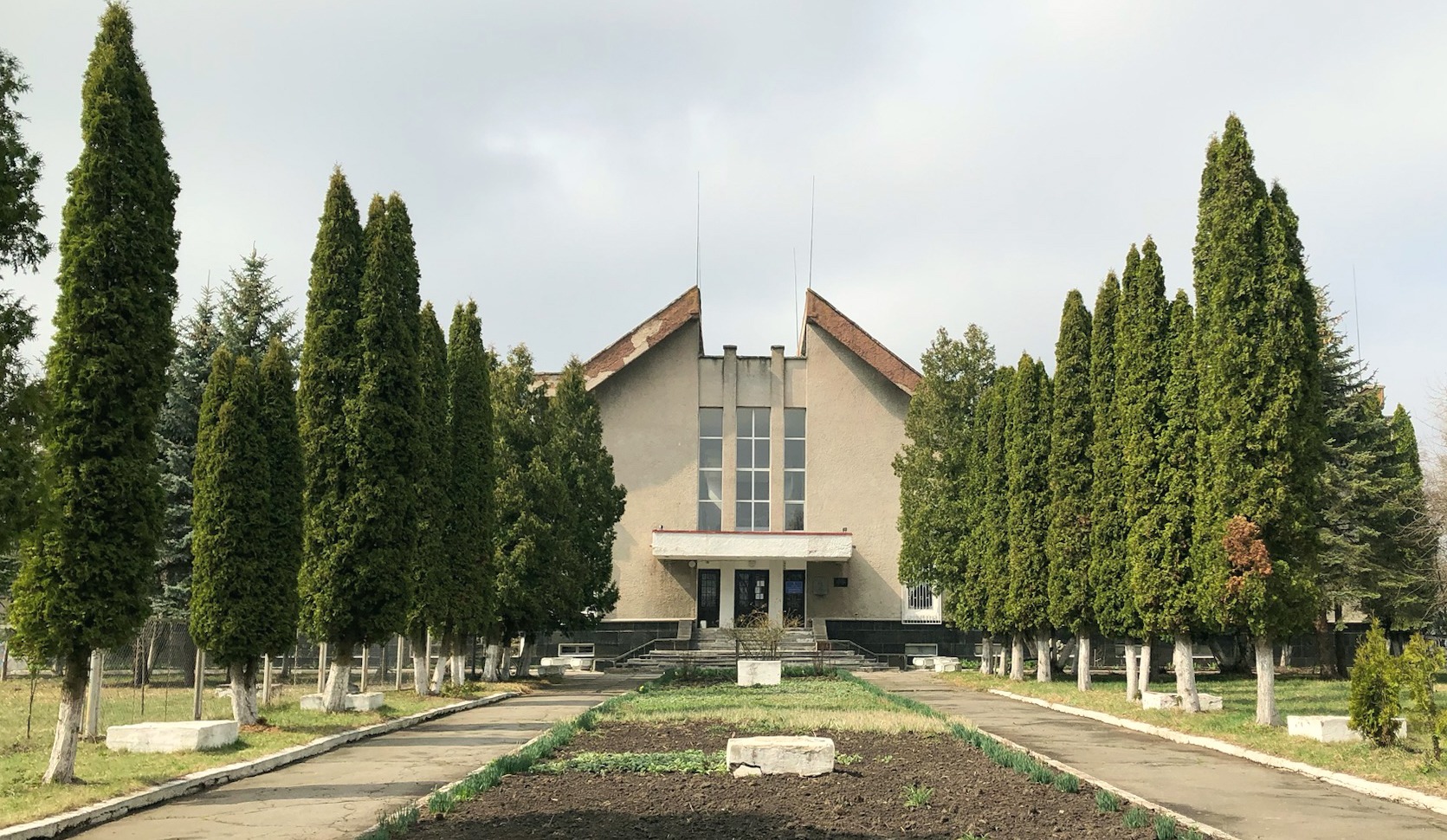
I’d gone to visit Kmytiv that spring day in 2019 in the hopes of finding out. After walking up a grand, poplar-lined lane to the museum’s entrance, I found Moliar typing in an office on the first floor. She invited me to tour the galleries with her and a few of the museum staff. The museum was an imposing brutalist structure, with a distinctive roof that resembled angular waves and abundant windows designed to maximize natural light. Sunlight poured in from a series of long thin panes, illuminating the works in a perfectly balanced glow, though the airy interiors were a challenge to heat on the museum’s shoestring budget. “We keep on our coats here,” Moliar said wryly as we walked through the chilly galleries in our puffy winter jackets.
My attention was seized by one of the masterpieces of the collection, a large canvas called Wedding by Ivan-Valentyn Zadorozhny from 1967. The painting depicts a newly married couple seated at a grand table in front of a korovai, a braided Ukrainian bread traditionally shared at weddings. Zadorozhny spent two years on the work, Moliar informed me, and used the attendees of a wedding that had occurred in a small village near Kyiv as models. Each figure—a child in pigtailed braids peering down at her feet, an older man intently watching the proceedings at the table, a fiddle player with a pageboy bob—is portrayed with human specificity. In a country that systematically subordinated the private to the collective, Zadorozhny’s masterful rendering of each individual was a notable achievement as well as a quietly subversive one.
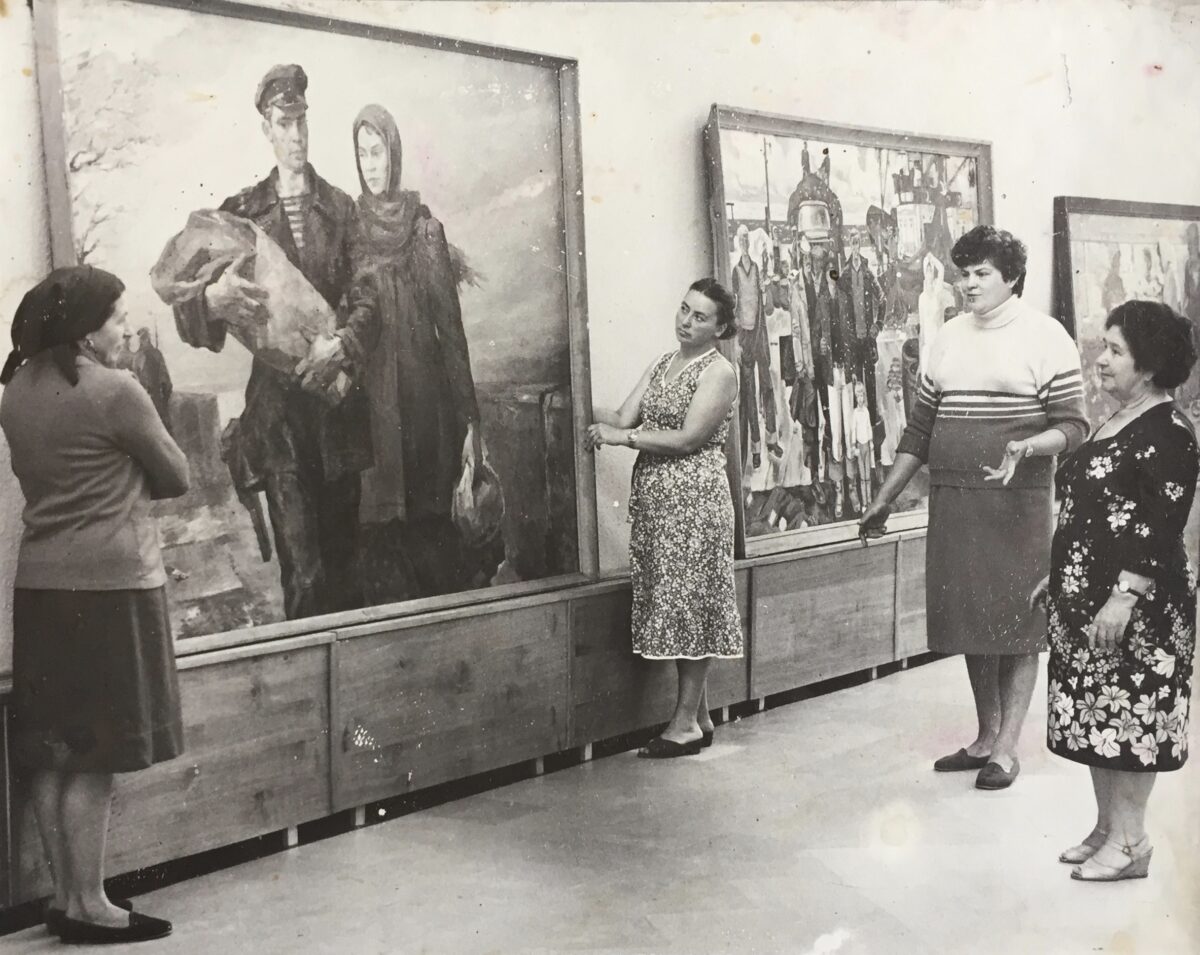
The galleries were also home to more predictable scenes drawn from the Soviet everyday: cheerful women wearing babushki sorting through crafts; a portrait of a female iron welder, her helmet tipped open to reveal classical features reminiscent of Athena; muscular laborers working on a rig in Odesa. There were paintings, drawings, lithographs, glassware, textiles and sculptures. Not everything was exceptional—there was a smattering of forgettable landscapes, an assortment of ceramics and glassware that were nearly indistinguishable from the kitsch hawked by vendors on Kyiv’s famous Andriivskiy Descent. “This is a museum that represents not the best of the best, but really a slice of time,” Moliar emphasized as we cycled through the galleries. Art historians and enthusiasts tend to favor dramatic movements like the Soviet avant-garde, the severely programmed Stalin era or the work of repressed dissidents. The late socialist realism that dominated the Kmytiv collection was more subtle and complex; the conventions of the past still reigned, but depictions of interiority and emotions like bitterness and despair were permissible. Ukrainians lived for decades amid this visual language. To neglect that tradition, Moliar firmly believed, would be to excise part of what made Ukraine what it was.
To me, the museum seemed to hearken back to a more innocent time, when the promise of the Soviet project hadn’t completely curdled. I stopped in front of a painting from 1972 that depicted an ebullient gathering on a town square—an accordion player ringed by lively young Ukrainians all dressed in red (a subtle signal of Party support). Though the subject matter was rote, as if dictated by telegram by the Ministry of Culture, the artist’s talent was undeniable. The painting was at once impressionistic and admirably precise: the faces of the figures beckoned with a real-life clarity. One of my aunts had been an enthusiastic Party member, and I could imagine her posing for the painting with her friends as a teenager, the bow in her blonde hair tied perfectly, the faux leather of her short heels gleaming. The painting was testament to the culture that had absorbed the energy and hopefulness of her youth. I could not help but feel affection for what I imagined to be a remnant of her dreams.
Yet the warmth I felt brought with it a familiar ambivalence. I had recognized long ago that it was easy to feel nostalgic about a culture when one can contemplate it safely from a distance, when it no longer poses a threat—the version of history I had been raised on in the comforts of Midwestern suburbs in the aftermath of the Cold War. How much could I really know of the hardships of the Soviet period? It was not me but my grandmother whom the regime had forced to work in coal mines in her twenties, not me but my mother whom the regime had denied the right to receive schooling in her native language. That aunt who had been an enthusiastic Party member? She had volunteered as an engineer at the Chornobyl nuclear power plant in the weeks after one of its reactors suffered a catastrophic meltdown in 1986, only to be diagnosed with cancer a few years later. She recovered but suffered poor health for the rest of her life—and never stopped believing in the value of close ties with Russia. She died a month before the invasion. I moved on to the next painting.
Part of Moliar’s mandate at Kmytiv was to facilitate encounters such as this, where visitors had no choice but to confront thorny questions of aesthetics, history and personal experience all at once: How should ingenuity and talent be evaluated or remembered if achieved in service of a discredited ideology? What enduring truths might largely propagandistic works still be able to convey? How much grace should modern viewers extend to artists (and others) who edified the Soviet system by creating works that glorified it?
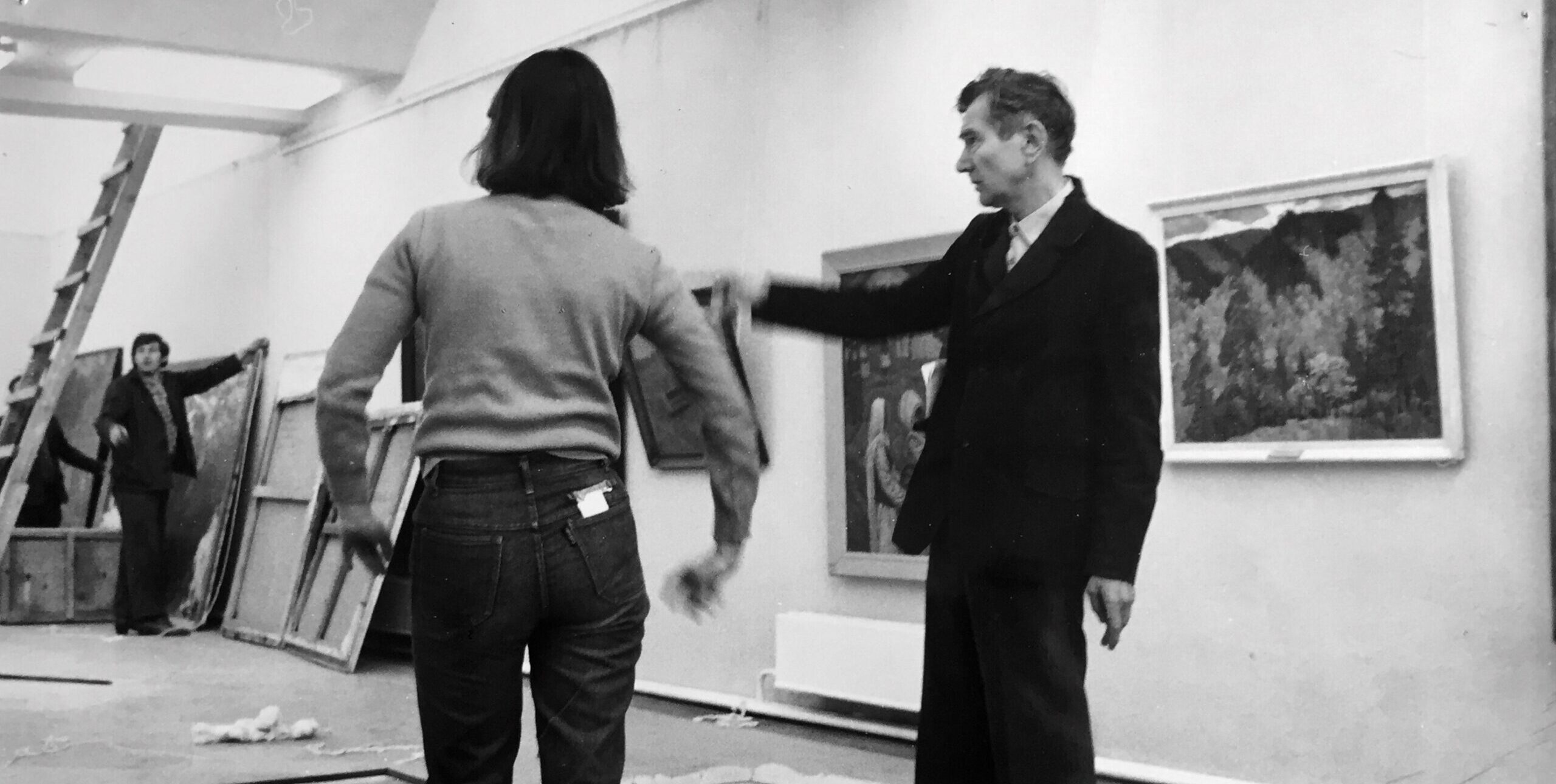
In collaboration with Moliar, another artist who participated in DE NE DE, Nikita Kadan, was curating a series of exhibitions incorporating pieces from Kmytiv’s permanent collection and new works of contemporary art. “What was crucial to us was to oppose this one-dimensional understanding of what Soviet culture was,” Kadan told me, to dispel the notion that the Kmytiv collection was just “huge paintings glorifying the Communist Party.” Some works “had exceptional formal or painterly qualities,” he explained, while others “related more to the indigenous experience of nations in the Soviet state.” For the first of these shows, Kadan put pieces from Kmytiv’s collection into conversation with newer works from Ukraine, Russia and the United States. They staged each exhibit “the Ukrainian way,” Kadan told me—shorthand for resourceful self-organization. They enlisted local female staff, who would arrive after their morning chores around their farms “with their vegetable gardens in their hands,” to help with the manual lifting and hanging of the works. To Kadan, it was important to involve the museum workers in the planning. “They had agency to say that this work is problematic in our opinion, according to our habits, our values. It was all open for debate,” he said.
Almost three decades after Bukhanchuk’s death and the fall of the USSR, Kmytiv was once again becoming a destination. National media featured pieces about the group’s work. On the weekends, the marshrutka was now ferrying hipsters making the trek from the capital to the museum. Kadan had spent one recent Saturday leading a four-hour-long tour of the collection. Afterwards, a DJ spun techno next to the poplars and wildflowers at the museum’s entrance while visitors sat on the steps, smoking cigarettes and swigging beer. The momentum was bracing. It was, like many aspects of cultural life I observed in Ukraine in the late 2010s, questioning, surprising and passionate—the signs of a society that finally had the resources and experience to devote itself to expression after years of wrestling with issues foundational to survival. When Moliar and I parted ways that spring afternoon, I told her I hoped to return to the museum soon.
●
I never made it back. When I saw Moliar about six months later, in October 2019, it was not in Kmytiv but Kyiv, where she was embroiled in a scandal. It had been sparked, as many are in Ukraine, by a debate on Facebook. The museum’s elevated profile had attracted the notice of nationalist members of the city council of Zhytomyr, the regional capital. Some of these authorities were displeased to learn that Moliar and Kadan had used the museum’s original name when they resurrected its defunct Facebook page: the Kmytiv Museum of Soviet Art. (If that seems like a minor offense, you need to keep in mind how seriously Ukrainians take Facebook, and that even the smallest words or symbols that alluded to the Soviet period were scrutinized under decommunization.) Even so, Moliar was surprised by the criticism. Explaining their choice in Ukrayinska Pravda, one of the country’s top news outlets, Moliar, Kadan and Leo Trotsenko, a colleague who was helping implement the Kmytiv project, cited as inspiration the Confucian idea of name rectification, and called it a “symbolic appropriation” in which they used “the name of a no longer existing institution for the project of understanding what an institution was.” Besides, the museum’s local staff had approved the move.
The offended authorities were not convinced. For them, it was simple: the use of the word “Soviet” on the Facebook page—even if not in the museum’s actual name—constituted a “violation of the decommunization law.” They accused the team of being “connoisseurs of the ideology of Marx-Engels-Lenin.” The attacks drew the attention of local conservatives, who found fault with other boundaries the project was testing. “Among ‘contemporary artists,’ views like mine are considered ridiculous and retrograde,” one Zhytomyr newspaper correspondent wrote indignantly after visiting one of the shows Kadan had curated at the Kmytiv museum, which contained contemporary works that featured nudity. “I personally consider most of the exhibits in the exhibition ‘Unheard Bodies’ to be examples of ‘sick’ art, which is completely alien to people with Christian morality and common sense.” The Kmytiv project was becoming entangled in two currents in Ukrainian culture: one, a narrowing conception of what should be considered Ukrainian, which was being enabled by the decommunization laws, and the other, a long-standing social conservatism supported by the country’s older and more religious segments.
Moliar, Kadan and Trotsenko insisted that they were acting within the bounds of the decommunization laws. The laws did not restrict the existence of Soviet artifacts and messages; they restricted the glorification of the Soviet. “Our view is that ‘Soviet’ is primarily a temporal and geographical characteristic,” they wrote in Ukrayinska Pravda. “You can talk about anything Soviet critically, analytically, or with angry condemnation—but that doesn’t stop it from being Soviet … rational analysis of the Soviet project is one of the tools that prevents the historical return of totalitarian regimes. To defeat the Gorgon, one must find a way to see her face.” When we met in Kyiv, Moliar recounted how she and Kadan had worked to ease the anxieties of the museum staff and the director, Yaroslav Khytriy, whose position was now being threatened by the Zhytomyr city council. To counteract the pressure, more than 150 academics and art professionals around the world had signed an open letter supporting their work. The controversy seemed to die down, but only for a few weeks—one day, they noticed that “Soviet” had been expunged from the name of the Facebook page. With a sinking feeling, Moliar inquired and learned that the local police had tired of all the complaints and had told Khytriy to make the change; rattled, the director had caved.
Moliar expressed sympathy for Khytriy, who was, after all, not used to dealing with inquiries from the authorities in his role as the head of a provincial Ukrainian museum. At the same time, she was annoyed. After supervising the change of the Facebook page name, “he went on vacation and turned off his phone and email and everything.” She laughed. As we spoke, he was “still on vacation. Now we have ten days to finish our project and we don’t have any connection to the director of the museum.”
With the team’s grant set to end soon, in December 2019, Moliar was not sure of her future at Kmytiv. She still had many ideas. Bukhanchuk had achieved a lot with his collection, but it had obvious lacunae, most obviously work by artists who were outside of the Soviet mainstream. Moliar and Kadan dreamed of the museum acquiring works that were “Soviet in geography and anti-Soviet in form and content” by artists like the mosaicist Alla Horska and the painter Opanas Zalyvakha. They observed that their critics, who conflated their attention to Soviet artwork with enthusiasm for the Soviet regime, might interpret such a desire as paradoxical. “But to us, it is an example of adequate, holistic, and consistent thought.”
●
On February 24, 2022, the day Russia launched its full-scale invasion of Ukraine, Moliar frantically made plans to seek refuge with her two young daughters at her parents’ dacha on the outskirts of Kyiv. As she and the girls inched their way through a massive traffic jam, she watched as a military helicopter hovered overhead. The scene called to mind one of her favorite works at the Kmytiv museum: the lithograph “Kyiv, 22 June” by the Soviet Ukrainian artist Heorhii Malakov. The print shows a sleepy Kyiv as seen through a large window, its buildings compact and orderly, its trees lush with leaves. As your eyes move up the frame, the tint of the background morphs from evening blue to morning pink until, finally, a swarm of helicopters and military planes comes into focus. Malakov had made the work to capture a new, horrible dawn—the arrival of the Second World War in Kyiv. For Moliar, the memory was like a glitch in the matrix, when the art she had spent her adult life trying to rescue from being forgotten swept thunderously into her present. “Even after all these years, I’ve very often visualized this image with the helicopters,” she told me.
After two weeks, Moliar made the difficult decision to flee the country. She and a friend piled their kids into the car and drove west, destination unknown. First, they went to Budapest. Then Berlin. Along the way were reunions with friends and anguished conversations about what to do, as they checked the news and researched potential safe harbors. By March, she was granted an emergency research fellowship in Rome.
One month later, I flew to Italy to visit Ukrainian family members who had taken a journey much like Moliar’s. While I was there, I met Moliar for coffee. She was hoping to return to Kyiv by September and anxious at the prospect of her stay in Rome being anything more than temporary. At that moment, the priority in her circle was to try to protect as much of Ukraine’s cultural heritage as possible from Russian weaponry, particularly work held by smaller institutions that didn’t have the means to secure their holdings themselves. The Kmytiv museum, which had a large underground storage space to safeguard its collection, was among the better equipped. In Lysychansk, in eastern Ukraine, Moliar’s DE NE DE colleague Leonid Marushchak and another rescuer, Arif Bagirov, narrowly avoided being hit by Russian fire as they gathered artifacts from a museum dedicated to the Ukrainian poet Volodomyr Sosiura. “I told myself, ‘Listen Arif, these are your last days. You might as well live them brightly. Make your death beautiful,’” Bagirov recounted to the Guardian. What if he had died securing Sosiura’s hat, the museum’s most prized but still quite humble possession, the reporter inquired? “That would have been the most beautiful death of all,” he replied.
Moliar was Zooming into meetings to support their efforts while also dealing with the complexities of refugee status. She was also trying to resolve how to contribute to the discussion around decommunization, which since the invasion had been expanded to “derussification.” As Ukrainians accommodated themselves to the previously unfathomable reality of full-scale war with Russia, they started to probe with unprecedented urgency all the ways Russian power had shaped them: their vocabulary, their daily lives, their worldview. These changes were astonishing for me to observe. When I started visiting Ukraine in the early 2000s, Kyiv freely acknowledged and even celebrated Russian culture, including its own contribution to it via the works of native sons like Mikhail Bulgakov. Tolerance was de rigueur even in the traditionally nationalistic west: members of my patriotic family in western Ukraine, where Ukrainian language predominated and symbols of Russian culture were less common, had no qualms speaking Russian. Once almost exclusively Russophone, Kyiv was now effectively split between Russian and Ukrainian speakers and home to cafes that prohibited speaking the “language of the enemy.” Friends reported being filled with sudden anger at the smallest mention of anything Russian, even the common “Moscow” cheese at the supermarket. All sorts of things that before were considered benign or even part of a shared culture—Russian literature, Russian arts, the Russian language—were now being scrutinized as ideological cover for Putin’s war of aggression. “My legli spat 23 Fevryala,” one acquaintance in Kyiv told me, “i my prokynulysya 24 Lyutoho.” “We went to sleep on February 23rd,” she said in Russian, “and woke up on February 24th,” she finished in Ukrainian.
“A lot of people feel some satisfaction” in trying to purify Ukraine of Russian influence, Moliar noted. “I call it magical thinking.” They “really want to think that if they can fell an iron idol, they can fell the real Russian army.” The impulse was understandable, but Moliar didn’t think it should go unquestioned. She was troubled by reports that the Ukrainian Institute of National Memory had just deemed as an appropriate target for dismantling an iconic, soaring titanium arch in central Kyiv symbolizing Ukrainian-Russian friendship, and on which Ukrainian activists had earlier painted a poignant crack. “It’s a really horrible situation when in one part of Ukraine, the Russians have destroyed everything, but in another part of Ukraine, Ukrainians are destroying their heritage. It’s a really difficult heritage. It’s a very tragic heritage. But it’s ours.”
●
More than two years passed before I saw Moliar again, and this time in yet another country: Germany. She had been living in Berlin for more than a year, having been invited to complete a Ph.D. on cultural heritage after her fellowship in Rome ended. Moliar had found a stable place and purpose in Berlin, but the war’s toll still coursed through her life. She watched with admiration as her colleague Marushchak continued to evacuate art from frontline areas at the risk of great danger. “I’ve suffered a lot because I can’t be there,” she said. “Especially when I see how some of the monuments are destroyed, I’m always thinking, oh, if I were there, I would be gathering the fragments.”
Russian bombardments are the main cause of this destruction, having damaged more than five hundred recognized cultural sites across the country as of January 2026, according to UNESCO. But derussification campaigns have also changed Ukraine’s material heritage; streets have been renamed and public artworks and other aspects of the built environment are being removed at a pace that many consider alarming. In the fall of 2024, more than 150 Ukrainian and international intellectuals signed an open letter appealing to UNESCO to intervene in the “spurious, high-handed dismantling” Ukrainian officials envisioned for Odesa, a famously diverse melting pot, which included plans to remove commemorations to local Soviet-era luminaries like Ilf and Petrov, Ivan Bunin and Isaac Babel. “‘Soviet’ is not perceived as part of the Ukrainian past anymore, but only as the Russian present,” Moliar told me. When Ukrainian authorities took down statues commemorating World War II, she said, they were essentially siding with Russian propaganda that messaged that the Soviet victory over fascism was Russia’s alone. The authorities were also denying the Ukrainian public the opportunity to contemplate the dark sides of its participation in the Red Army, where war crimes and other malfeasance were common (not that Ukrainians are particularly eager to take on this kind of reckoning). “For Ukrainians, it may be easiest to give away this part of this story and just forget,” she said. But then Ukraine would be bowdlerizing its history, compromising one of the central promises of its existence as a liberal democratic state.
Moliar’s Ph.D. project was originally going to be on interventions made by contemporary artists to preserve Soviet-era cultural heritage. She came to the difficult realization, however, that “there is no possibility of [this kind of] preservation anymore”—particularly at a time when all the energy in society was flowing toward negotiating how much of the Soviet era should be removed from the public sphere. Moliar reconceived her dissertation. It would now be what she termed a “requiem” for what DE NE DE had done at the Kmytiv museum amid decommunization.
It may turn out to be a requiem for the museum itself. Like cultural institutions across Ukraine, the museum is struggling. In the first months of the invasion, and in the name of wartime cost cutting, a motion was filed to bring it under the jurisdiction of Zhytomyr’s department of local history museums—a decision that, by reducing the museum’s autonomy, made it more difficult to raise funds independently. Meanwhile, the museum is in desperate need of repairs. Without adequate resources, it will become even more vulnerable to those who would happily board up the run-down landmark and redistribute its works to different institutions, erasing the collection’s value as a panoramic view of Soviet art in its last decades.
As if to dramatize the institution’s fragility, in July, a large explosion, later traced to locals developing illegal explosives, rocked Kmytiv and the surrounding area, shattering many of the museum’s distinctive windows. In what has become a Ukrainian tradition, the museum staff cleaned up the best they could and continued their work.
Peace or no peace, Crimea or no Crimea, the widespread carnage and injustice of the war has guaranteed that Ukrainians will harbor fierce animosity toward anything Russia represents for a very long time. “This hatred towards [Ukrainian Soviet] heritage in society is growing and growing,” Moliar said. “There is no possibility to discuss it because of absence of the two points of view now in Ukraine.” While her colleagues at DE NE DE continue their work, both in and outside of Ukraine, they must also metabolize the ongoing trauma of the war, which for them, as for all Ukrainians, is deeply personal. Three artists who participated in DE NE DE have died serving in the Ukrainian Armed Forces: ecological activist Anton Smirnov, queer performance artist Artur Snitkus and anarchist Davyd Chychkan.
In the summer of 2024, after more than two years away, Moliar returned to Ukraine. It was the fulfillment of a deep yearning. “All these years I was living with the idea of returning to Kyiv,” she told me. Moliar had been anxious to go home and see what had become of her native city. At first glance, it seemed like nothing had changed. But then she began to take note of the differences: the curfews, the disrupted educational system, the emptiness of the streets. A rift, often unspoken, had opened between those who had stayed in Ukraine and those who now lived abroad, she observed. One day, she said, “I recognized that everything had changed, that all my friends had changed, and my parents and everything, and it’s absolutely another city.” The changes, she realized, also extended to her. “Somehow, I felt my connection had become weaker.”
Lives, homes, culture: Russia’s toll in Ukraine mounts by the day. But the war has eroded something else too: a sense of belonging.
●
One December day in Berlin I rode the U-Bahn to the city’s western edge. My destination was the Spandau Citadel, a Renaissance-era military fortress that once housed chemical-weapons labs under the Nazis but is now a venue for cultural events. The citadel was the site of a recent installation that Moliar and Kadan, who has remained in Kyiv during the war, had helped to shepherd into existence: a reconstruction of a sculpture by the little-known Ukrainian artist Fedir Tetyanych. Kadan had long been a fan of Tetyanych, whom he describes as “one of the biggest hidden treasures of Ukrainian art history.”
Even for the former Soviet Union, which has a rich tradition of oddball artists, Tetyanych stood out as eccentric. A member of the prestigious Union of Artists of the USSR, he started in his thirties to elaborate on ecological and cosmist ideas—seeing humanity as being part of a mutually interconnected infinity—that would define his oeuvre. He staged colorful, impromptu performances on the streets of Kyiv, most frequently Andriivskiy Descent, where he proclaimed his ideas to uncertain crowds while wearing a costume that mixed regalia with trash. (He was known for donning a crown made of the box in which the city’s trademark dessert, Kyivsky Tort, was sold.) “I count my entire life as one single performance,” he wrote.
In the 1970s, Tetyanych started a series of sculptures that combined his interests in science, art, ecology and technological advancement. Called “biotechnospheres,” the spherical sculptures were life-size utilitarian objects, designed to be both artworks and shelters, which people could use in times of crisis. The biggest was in the city of Popasna, in eastern Ukraine, where Tetyanych built a biotechnosphere in the early 1980s inside the railway depot.
Much of Tetyanych’s work, including all his biotechnospheres, was destroyed amid the collapse of the Soviet patronage system; by the time he died in 2007, he had resorted to selling potatoes at the local market for income. During DE NE DE’s excursions across Ukraine in the 2010s, Kadan, Moliar and other members of the collective started visiting Popasna to seek out traces of his work. On one trip, they met two of the workers who had assisted Tetyanych while he was in the city. “They told us, ‘Oh, that weird bearded man from Kyiv? We know him. We helped him with his biotechnosphere. And at the beginning of the 1990s, we simply cut it up and sold it,’” Moliar recalled. In the lean post-Soviet years, the scrap metal was deemed more valuable than the art.
DE NE DE decided to try to rebuild the biotechnosphere and install it once again in Popasna. Using scant historical photos and archival sketches as guides, Kadan collaborated on the design with Tetyanych’s son and Bogdana Kosmina, an artist and architect from Kyiv. They had planned to start the reconstruction in March 2022 but never got started. Popasna came under attack that very month. By May the Russians had assumed control of the city, which was so badly damaged and depopulated that the occupying authorities formally abolished Popasna’s status as a municipality, effectively wiping it off the map.
Two years later, the project was revived in exile in Germany. I asked Kadan how he felt about the biotechnosphere being displayed for the first time not in Ukraine but abroad. He observed diplomatically that Germany was a fruitful setting for the project, given its tradition of utopian architecture and ecologically engaged art. At the same time, he allowed, his face slightly clouding, it was like “Ukraine lost it twice.”
When I stepped off the U-Bahn at the citadel, the air was chilly and clear. When I reached the building’s courtyard, the reconstructed biotechnosphere loomed before me. A tiled sphere of ore, it sat on four wheeled legs installed over a set of railroad tracks, a nod to the depot where it was originally built. Four round panels were affixed around the midpoint of the sphere, with one of them bearing the relief of an infinity-like symbol that had significance in Tetyanych’s metaphysics.
A video played on a loop in an indoor gallery. In it, the biotechnosphere appeared to speak directly to the viewer. The robotic voice suggested that the structure could be used functionally to provide housing for refugees or shelter in times of disaster. But the most useful service the biotechnosphere provided, the voice posited, might be metaphysical: “I stand now as a symbol of resilience and hope. My recreation in essence proves that the dream of a better future lives on, even after destruction.” As archival images of the original structure in Popasna were superimposed over video footage of its reconstruction, the voice added: “The town that birthed me now lies in ruins. But ideas don’t die so easily.”

In April 2019, I boarded a marshrutka, a humble mass-transit minivan ubiquitous in the former Soviet Union, and watched the massive prefab apartment blocks on the outskirts of Kyiv give way to the hard, dry grass of the steppe. The trip to the village of Kmytiv from the capital was about an hour and half; my fellow passengers and I silently took in a vintage Matthew McConaughey caper being broadcast on a flat-screen TV mounted above the first row of seats. This was before COVID, when Ukrainians held fast to their skepticism of ventilation, so the van grew warm with our breathing. When we arrived at Kmytiv, the driver made eye contact with me in the rearview mirror and nodded toward the door. I was the only one standing on the pavement as the van sped away, gravel flying its wake.
I’d gone to Kmytiv to visit Yevheniia Moliar, an art historian and activist I’d met in Kyiv earlier that year. Zhenya, as she is known informally, was one of the doyennes of Kyiv’s contemporary art scene and well-known for advocating for the preservation of Soviet-era art, particularly mosaics. Her preservation work had piqued my interest because it involved championing Soviet Ukrainian cultural heritage at a time when it was attracting growing disfavor. Back then, the country’s identity was still being reshaped by the dramatic events of 2013 and 2014, when Russia had seized Crimea and invaded Ukraine’s east under the guise of a separatist movement following massive public protests and the ouster of the sitting Ukrainian president, Viktor Yanukovych.
The bloodshed unleashed an unprecedented wave of rancor toward Russia and the Soviet Union. In 2015, the pro-Western government that replaced Yanukovych’s introduced a set of laws on “decommunization,” which were in part designed to rid Ukrainian public space of art and symbols that celebrated the Soviet period. While changing toponyms with the political seasons had long been a feature of life in the region (think Leningrad turning back into St. Petersburg) and plenty of Ukrainian Lenins had been dismantled since 1991, the ambitions of decommunization were on an altogether different level. In its crosshairs were not only the approximately 1,300 Lenin statues still standing in Ukraine, but any place name or monumental art form that referenced Soviet officials or symbols, such as the hammer and sickle. In the words of the then-head of the Ukrainian Institute of National Memory, decommunization was intended to “overcome the communist, totalitarian heritage, eliminate it from history, [and] make sure it does not recreate itself to influence the present.” Nevertheless, despite the widespread antipathy toward Russia, five years after the introduction of decommunization, only a third of Ukrainians supported the banning of communist symbols. A third opposed it, while the remainder, perhaps just as significantly, didn’t care or couldn’t say.
Moliar emerged as one of the most compelling critical voices of the practice. Born in 1981 and raised in Kyiv, she was old enough to remember Soviet times but young enough to have entered adulthood under a totally different set of rules. In 2015, Moliar and a group of colleagues had formed a loose collective called DE NE DE—“here and there” in Ukrainian—that sought to preserve Ukraine’s “obscure and non-obvious cultural heritage” from the zeitgeist forces of the day: decommunization, deconstruction, decolonization. Like much of Kyiv’s bohemian art scene, the collective had a DIY ethos. It attracted leading members of the Ukrainian millennial avant-garde—artists Nikita Kadan and Zhanna Kadyrova and documentary filmmaker Oleksiy Radynski among them. Together, they orchestrated a set of daring programs: an art residency at a derelict cinema, an exhibit juxtaposing Soviet-era ecological planning in Kyiv with the capital’s urban development under neoliberalism, and a series of expeditions playfully named after a common essay exercise assigned to Ukrainian schoolchildren (“Love and Know Your Native Land”), where participants traveled to outlying Ukrainian towns and villages to experience local cultural sites, with obligatory stops at the market, history museum and village discotheque. While researching one of these trips, DE NE DE stumbled on a large, remarkable art museum operating under the radar in the nondescript village of Kmytiv. That discovery would compel Moliar to undertake arguably her most ambitious project: to bring a museum originally dedicated to glorifying socialist realist art into conversation with an independent, post-Soviet Ukraine.
The Kmytiv Museum of Soviet Art opened its doors in 1985. The museum was the brainchild of a Red Army veteran who dreamed of bringing art “closer to the masses” in his beloved Ukraine—to expand their “ideological and aesthetic education” and introduce them to the “world of beauty” he’d encountered while teaching in cosmopolitan Leningrad. The veteran, Yosyp Bukhanchuk, was an earnest believer in Soviet socialism, and the collection he developed—which eventually boasted three thousand works from across the USSR—reflected both his devotion to the cause and the art of the day. The Soviets had initially favored modes like suprematism and futurism for their ability to shatter ordinary modes of perception; by the 1930s, however, socialist realism—which celebrated the struggles of Soviet workers and their bright future under communism—had won out. Bukhanchuk’s collection was mostly drawn from the last decades of the tradition but contained glimpses of the sometimes-brilliant outsider tradition that simmered on the edges of official Soviet culture.
Bukhanchuk died in 1990 but lived long enough to witness the museum’s heyday, when it attracted thousands of visitors annually. One year after his death, the Soviet Union collapsed, upending all the assumptions upon which the Kmytiv Museum was founded—that socialist realism would continue to exert force over the culture; that the political system that undergirded the socialist-realist imaginary would continue to exist.
In the wake of the collapse, Kmytiv’s deluge of visitors slowed to a trickle. With the state’s coffers virtually empty, the museum struggled to cover routine maintenance. Leaks sprouted in its roof and holes in its walls. The neglect was not just financial but political in origin. Ukraine had been a sovereign nation only once before, for a fleeting period during World War I, and the establishment of an independent Ukrainian state in 1991 was initially met with the euphoria of new beginnings. What was an independent Ukraine to do with a museum devoted to an artistic style that now evoked a mix of nostalgia, indifference, embarrassment and disgust? As if to discourage visitors from asking that question too readily, the museum directors moved the most ideologically explicit works—posters extolling the triumphs of communism and busts of revolutionary heroes—to a storage room in the basement and dropped “Soviet” from the institution’s name. It was rechristened the Yosyp Bukhanchuk Kmytiv Museum of Fine Arts.
Moliar and her colleagues had other ideas. The ethos of DE NE DE was not to turn away from the uncomfortable legacy of Soviet art but to document it, study it and create a place for it in contemporary Ukraine’s cultural self-understanding. Moliar’s experience at Kmytiv would show them that this was easier said than done. When Russia launched its full-scale invasion of Ukraine in 2022, the task of contextualizing Ukraine’s Soviet past became more complicated than she ever imagined. Amid the abject injustice and cruelty of the war, which has claimed hundreds of thousands of lives, support for the erasure of Soviet and Russian symbols in public life has soared among Ukrainians. The questions surrounding this small museum can be extended to the country at large: What value does Soviet heritage have in Ukraine now?
●
When I started traveling to Ukraine in the early 2000s, I was a naïve college student eager to find adventure by plumbing my roots. My grasp of Ukrainian, my mother’s native language, was flimsy and my understanding of post-Soviet culture faint. I found Ukraine’s visual geography—the faded “Glory to the Worker” slogans that languished on building facades, the residential neighborhoods comprised of orderly grids of dilapidated panelki, the hulking monumental statutes of Soviet political and cultural figures—at first off-putting, then endearing and eventually beautiful. Politics were legible in these structures, and while I couldn’t interpret their messages at first, I could sense in them the terror and awe of the Soviet state.
In my twenties, I began to research my Ukrainian family’s experience during and after World War II, spurred in part by my curiosity about the circumstances that led my mother to be born in a gulag exile settlement in Siberia, thousands of miles from my grandparents’ native village in Ukraine. I discovered that my family’s experience had been violent, tragic and utterly typical. It also refused to resolve into a neat moral account—members of my family had collaborated with occupying authorities and fought against them, had been victims of horrible violence and perpetrated horrible violence. I wanted to know how Ukrainians of my generation were making their own ways through these complicated inheritances, in part because I was struggling to do so myself.
As I spent more time in Ukraine, I started to appreciate the range of ways Ukrainians remembered the Soviet past. Some I knew despised the Soviet system. Others remembered it as the flawed but well-meaning structure that had shaped the meaning of their lives and whose egalitarian ideals they had pursued with goodwill and dignity. How could Ukrainian society recognize these divergent attitudes toward the recent past? What was to be done with the physical evidence—the grab bag of architecture, art and public space markers—that so powerfully articulated these mixed feelings?
I’d gone to visit Kmytiv that spring day in 2019 in the hopes of finding out. After walking up a grand, poplar-lined lane to the museum’s entrance, I found Moliar typing in an office on the first floor. She invited me to tour the galleries with her and a few of the museum staff. The museum was an imposing brutalist structure, with a distinctive roof that resembled angular waves and abundant windows designed to maximize natural light. Sunlight poured in from a series of long thin panes, illuminating the works in a perfectly balanced glow, though the airy interiors were a challenge to heat on the museum’s shoestring budget. “We keep on our coats here,” Moliar said wryly as we walked through the chilly galleries in our puffy winter jackets.
My attention was seized by one of the masterpieces of the collection, a large canvas called Wedding by Ivan-Valentyn Zadorozhny from 1967. The painting depicts a newly married couple seated at a grand table in front of a korovai, a braided Ukrainian bread traditionally shared at weddings. Zadorozhny spent two years on the work, Moliar informed me, and used the attendees of a wedding that had occurred in a small village near Kyiv as models. Each figure—a child in pigtailed braids peering down at her feet, an older man intently watching the proceedings at the table, a fiddle player with a pageboy bob—is portrayed with human specificity. In a country that systematically subordinated the private to the collective, Zadorozhny’s masterful rendering of each individual was a notable achievement as well as a quietly subversive one.
The galleries were also home to more predictable scenes drawn from the Soviet everyday: cheerful women wearing babushki sorting through crafts; a portrait of a female iron welder, her helmet tipped open to reveal classical features reminiscent of Athena; muscular laborers working on a rig in Odesa. There were paintings, drawings, lithographs, glassware, textiles and sculptures. Not everything was exceptional—there was a smattering of forgettable landscapes, an assortment of ceramics and glassware that were nearly indistinguishable from the kitsch hawked by vendors on Kyiv’s famous Andriivskiy Descent. “This is a museum that represents not the best of the best, but really a slice of time,” Moliar emphasized as we cycled through the galleries. Art historians and enthusiasts tend to favor dramatic movements like the Soviet avant-garde, the severely programmed Stalin era or the work of repressed dissidents. The late socialist realism that dominated the Kmytiv collection was more subtle and complex; the conventions of the past still reigned, but depictions of interiority and emotions like bitterness and despair were permissible. Ukrainians lived for decades amid this visual language. To neglect that tradition, Moliar firmly believed, would be to excise part of what made Ukraine what it was.
To me, the museum seemed to hearken back to a more innocent time, when the promise of the Soviet project hadn’t completely curdled. I stopped in front of a painting from 1972 that depicted an ebullient gathering on a town square—an accordion player ringed by lively young Ukrainians all dressed in red (a subtle signal of Party support). Though the subject matter was rote, as if dictated by telegram by the Ministry of Culture, the artist’s talent was undeniable. The painting was at once impressionistic and admirably precise: the faces of the figures beckoned with a real-life clarity. One of my aunts had been an enthusiastic Party member, and I could imagine her posing for the painting with her friends as a teenager, the bow in her blonde hair tied perfectly, the faux leather of her short heels gleaming. The painting was testament to the culture that had absorbed the energy and hopefulness of her youth. I could not help but feel affection for what I imagined to be a remnant of her dreams.
Yet the warmth I felt brought with it a familiar ambivalence. I had recognized long ago that it was easy to feel nostalgic about a culture when one can contemplate it safely from a distance, when it no longer poses a threat—the version of history I had been raised on in the comforts of Midwestern suburbs in the aftermath of the Cold War. How much could I really know of the hardships of the Soviet period? It was not me but my grandmother whom the regime had forced to work in coal mines in her twenties, not me but my mother whom the regime had denied the right to receive schooling in her native language. That aunt who had been an enthusiastic Party member? She had volunteered as an engineer at the Chornobyl nuclear power plant in the weeks after one of its reactors suffered a catastrophic meltdown in 1986, only to be diagnosed with cancer a few years later. She recovered but suffered poor health for the rest of her life—and never stopped believing in the value of close ties with Russia. She died a month before the invasion. I moved on to the next painting.
Part of Moliar’s mandate at Kmytiv was to facilitate encounters such as this, where visitors had no choice but to confront thorny questions of aesthetics, history and personal experience all at once: How should ingenuity and talent be evaluated or remembered if achieved in service of a discredited ideology? What enduring truths might largely propagandistic works still be able to convey? How much grace should modern viewers extend to artists (and others) who edified the Soviet system by creating works that glorified it?
In collaboration with Moliar, another artist who participated in DE NE DE, Nikita Kadan, was curating a series of exhibitions incorporating pieces from Kmytiv’s permanent collection and new works of contemporary art. “What was crucial to us was to oppose this one-dimensional understanding of what Soviet culture was,” Kadan told me, to dispel the notion that the Kmytiv collection was just “huge paintings glorifying the Communist Party.” Some works “had exceptional formal or painterly qualities,” he explained, while others “related more to the indigenous experience of nations in the Soviet state.” For the first of these shows, Kadan put pieces from Kmytiv’s collection into conversation with newer works from Ukraine, Russia and the United States. They staged each exhibit “the Ukrainian way,” Kadan told me—shorthand for resourceful self-organization. They enlisted local female staff, who would arrive after their morning chores around their farms “with their vegetable gardens in their hands,” to help with the manual lifting and hanging of the works. To Kadan, it was important to involve the museum workers in the planning. “They had agency to say that this work is problematic in our opinion, according to our habits, our values. It was all open for debate,” he said.
Almost three decades after Bukhanchuk’s death and the fall of the USSR, Kmytiv was once again becoming a destination. National media featured pieces about the group’s work. On the weekends, the marshrutka was now ferrying hipsters making the trek from the capital to the museum. Kadan had spent one recent Saturday leading a four-hour-long tour of the collection. Afterwards, a DJ spun techno next to the poplars and wildflowers at the museum’s entrance while visitors sat on the steps, smoking cigarettes and swigging beer. The momentum was bracing. It was, like many aspects of cultural life I observed in Ukraine in the late 2010s, questioning, surprising and passionate—the signs of a society that finally had the resources and experience to devote itself to expression after years of wrestling with issues foundational to survival. When Moliar and I parted ways that spring afternoon, I told her I hoped to return to the museum soon.
●
I never made it back. When I saw Moliar about six months later, in October 2019, it was not in Kmytiv but Kyiv, where she was embroiled in a scandal. It had been sparked, as many are in Ukraine, by a debate on Facebook. The museum’s elevated profile had attracted the notice of nationalist members of the city council of Zhytomyr, the regional capital. Some of these authorities were displeased to learn that Moliar and Kadan had used the museum’s original name when they resurrected its defunct Facebook page: the Kmytiv Museum of Soviet Art. (If that seems like a minor offense, you need to keep in mind how seriously Ukrainians take Facebook, and that even the smallest words or symbols that alluded to the Soviet period were scrutinized under decommunization.) Even so, Moliar was surprised by the criticism. Explaining their choice in Ukrayinska Pravda, one of the country’s top news outlets, Moliar, Kadan and Leo Trotsenko, a colleague who was helping implement the Kmytiv project, cited as inspiration the Confucian idea of name rectification, and called it a “symbolic appropriation” in which they used “the name of a no longer existing institution for the project of understanding what an institution was.” Besides, the museum’s local staff had approved the move.
The offended authorities were not convinced. For them, it was simple: the use of the word “Soviet” on the Facebook page—even if not in the museum’s actual name—constituted a “violation of the decommunization law.” They accused the team of being “connoisseurs of the ideology of Marx-Engels-Lenin.” The attacks drew the attention of local conservatives, who found fault with other boundaries the project was testing. “Among ‘contemporary artists,’ views like mine are considered ridiculous and retrograde,” one Zhytomyr newspaper correspondent wrote indignantly after visiting one of the shows Kadan had curated at the Kmytiv museum, which contained contemporary works that featured nudity. “I personally consider most of the exhibits in the exhibition ‘Unheard Bodies’ to be examples of ‘sick’ art, which is completely alien to people with Christian morality and common sense.” The Kmytiv project was becoming entangled in two currents in Ukrainian culture: one, a narrowing conception of what should be considered Ukrainian, which was being enabled by the decommunization laws, and the other, a long-standing social conservatism supported by the country’s older and more religious segments.
Moliar, Kadan and Trotsenko insisted that they were acting within the bounds of the decommunization laws. The laws did not restrict the existence of Soviet artifacts and messages; they restricted the glorification of the Soviet. “Our view is that ‘Soviet’ is primarily a temporal and geographical characteristic,” they wrote in Ukrayinska Pravda. “You can talk about anything Soviet critically, analytically, or with angry condemnation—but that doesn’t stop it from being Soviet … rational analysis of the Soviet project is one of the tools that prevents the historical return of totalitarian regimes. To defeat the Gorgon, one must find a way to see her face.” When we met in Kyiv, Moliar recounted how she and Kadan had worked to ease the anxieties of the museum staff and the director, Yaroslav Khytriy, whose position was now being threatened by the Zhytomyr city council. To counteract the pressure, more than 150 academics and art professionals around the world had signed an open letter supporting their work. The controversy seemed to die down, but only for a few weeks—one day, they noticed that “Soviet” had been expunged from the name of the Facebook page. With a sinking feeling, Moliar inquired and learned that the local police had tired of all the complaints and had told Khytriy to make the change; rattled, the director had caved.
Moliar expressed sympathy for Khytriy, who was, after all, not used to dealing with inquiries from the authorities in his role as the head of a provincial Ukrainian museum. At the same time, she was annoyed. After supervising the change of the Facebook page name, “he went on vacation and turned off his phone and email and everything.” She laughed. As we spoke, he was “still on vacation. Now we have ten days to finish our project and we don’t have any connection to the director of the museum.”
With the team’s grant set to end soon, in December 2019, Moliar was not sure of her future at Kmytiv. She still had many ideas. Bukhanchuk had achieved a lot with his collection, but it had obvious lacunae, most obviously work by artists who were outside of the Soviet mainstream. Moliar and Kadan dreamed of the museum acquiring works that were “Soviet in geography and anti-Soviet in form and content” by artists like the mosaicist Alla Horska and the painter Opanas Zalyvakha. They observed that their critics, who conflated their attention to Soviet artwork with enthusiasm for the Soviet regime, might interpret such a desire as paradoxical. “But to us, it is an example of adequate, holistic, and consistent thought.”
●
On February 24, 2022, the day Russia launched its full-scale invasion of Ukraine, Moliar frantically made plans to seek refuge with her two young daughters at her parents’ dacha on the outskirts of Kyiv. As she and the girls inched their way through a massive traffic jam, she watched as a military helicopter hovered overhead. The scene called to mind one of her favorite works at the Kmytiv museum: the lithograph “Kyiv, 22 June” by the Soviet Ukrainian artist Heorhii Malakov. The print shows a sleepy Kyiv as seen through a large window, its buildings compact and orderly, its trees lush with leaves. As your eyes move up the frame, the tint of the background morphs from evening blue to morning pink until, finally, a swarm of helicopters and military planes comes into focus. Malakov had made the work to capture a new, horrible dawn—the arrival of the Second World War in Kyiv. For Moliar, the memory was like a glitch in the matrix, when the art she had spent her adult life trying to rescue from being forgotten swept thunderously into her present. “Even after all these years, I’ve very often visualized this image with the helicopters,” she told me.
After two weeks, Moliar made the difficult decision to flee the country. She and a friend piled their kids into the car and drove west, destination unknown. First, they went to Budapest. Then Berlin. Along the way were reunions with friends and anguished conversations about what to do, as they checked the news and researched potential safe harbors. By March, she was granted an emergency research fellowship in Rome.
One month later, I flew to Italy to visit Ukrainian family members who had taken a journey much like Moliar’s. While I was there, I met Moliar for coffee. She was hoping to return to Kyiv by September and anxious at the prospect of her stay in Rome being anything more than temporary. At that moment, the priority in her circle was to try to protect as much of Ukraine’s cultural heritage as possible from Russian weaponry, particularly work held by smaller institutions that didn’t have the means to secure their holdings themselves. The Kmytiv museum, which had a large underground storage space to safeguard its collection, was among the better equipped. In Lysychansk, in eastern Ukraine, Moliar’s DE NE DE colleague Leonid Marushchak and another rescuer, Arif Bagirov, narrowly avoided being hit by Russian fire as they gathered artifacts from a museum dedicated to the Ukrainian poet Volodomyr Sosiura. “I told myself, ‘Listen Arif, these are your last days. You might as well live them brightly. Make your death beautiful,’” Bagirov recounted to the Guardian. What if he had died securing Sosiura’s hat, the museum’s most prized but still quite humble possession, the reporter inquired? “That would have been the most beautiful death of all,” he replied.
Moliar was Zooming into meetings to support their efforts while also dealing with the complexities of refugee status. She was also trying to resolve how to contribute to the discussion around decommunization, which since the invasion had been expanded to “derussification.” As Ukrainians accommodated themselves to the previously unfathomable reality of full-scale war with Russia, they started to probe with unprecedented urgency all the ways Russian power had shaped them: their vocabulary, their daily lives, their worldview. These changes were astonishing for me to observe. When I started visiting Ukraine in the early 2000s, Kyiv freely acknowledged and even celebrated Russian culture, including its own contribution to it via the works of native sons like Mikhail Bulgakov. Tolerance was de rigueur even in the traditionally nationalistic west: members of my patriotic family in western Ukraine, where Ukrainian language predominated and symbols of Russian culture were less common, had no qualms speaking Russian. Once almost exclusively Russophone, Kyiv was now effectively split between Russian and Ukrainian speakers and home to cafes that prohibited speaking the “language of the enemy.” Friends reported being filled with sudden anger at the smallest mention of anything Russian, even the common “Moscow” cheese at the supermarket. All sorts of things that before were considered benign or even part of a shared culture—Russian literature, Russian arts, the Russian language—were now being scrutinized as ideological cover for Putin’s war of aggression. “My legli spat 23 Fevryala,” one acquaintance in Kyiv told me, “i my prokynulysya 24 Lyutoho.” “We went to sleep on February 23rd,” she said in Russian, “and woke up on February 24th,” she finished in Ukrainian.
“A lot of people feel some satisfaction” in trying to purify Ukraine of Russian influence, Moliar noted. “I call it magical thinking.” They “really want to think that if they can fell an iron idol, they can fell the real Russian army.” The impulse was understandable, but Moliar didn’t think it should go unquestioned. She was troubled by reports that the Ukrainian Institute of National Memory had just deemed as an appropriate target for dismantling an iconic, soaring titanium arch in central Kyiv symbolizing Ukrainian-Russian friendship, and on which Ukrainian activists had earlier painted a poignant crack. “It’s a really horrible situation when in one part of Ukraine, the Russians have destroyed everything, but in another part of Ukraine, Ukrainians are destroying their heritage. It’s a really difficult heritage. It’s a very tragic heritage. But it’s ours.”
●
More than two years passed before I saw Moliar again, and this time in yet another country: Germany. She had been living in Berlin for more than a year, having been invited to complete a Ph.D. on cultural heritage after her fellowship in Rome ended. Moliar had found a stable place and purpose in Berlin, but the war’s toll still coursed through her life. She watched with admiration as her colleague Marushchak continued to evacuate art from frontline areas at the risk of great danger. “I’ve suffered a lot because I can’t be there,” she said. “Especially when I see how some of the monuments are destroyed, I’m always thinking, oh, if I were there, I would be gathering the fragments.”
Russian bombardments are the main cause of this destruction, having damaged more than five hundred recognized cultural sites across the country as of January 2026, according to UNESCO. But derussification campaigns have also changed Ukraine’s material heritage; streets have been renamed and public artworks and other aspects of the built environment are being removed at a pace that many consider alarming. In the fall of 2024, more than 150 Ukrainian and international intellectuals signed an open letter appealing to UNESCO to intervene in the “spurious, high-handed dismantling” Ukrainian officials envisioned for Odesa, a famously diverse melting pot, which included plans to remove commemorations to local Soviet-era luminaries like Ilf and Petrov, Ivan Bunin and Isaac Babel. “‘Soviet’ is not perceived as part of the Ukrainian past anymore, but only as the Russian present,” Moliar told me. When Ukrainian authorities took down statues commemorating World War II, she said, they were essentially siding with Russian propaganda that messaged that the Soviet victory over fascism was Russia’s alone. The authorities were also denying the Ukrainian public the opportunity to contemplate the dark sides of its participation in the Red Army, where war crimes and other malfeasance were common (not that Ukrainians are particularly eager to take on this kind of reckoning). “For Ukrainians, it may be easiest to give away this part of this story and just forget,” she said. But then Ukraine would be bowdlerizing its history, compromising one of the central promises of its existence as a liberal democratic state.
Moliar’s Ph.D. project was originally going to be on interventions made by contemporary artists to preserve Soviet-era cultural heritage. She came to the difficult realization, however, that “there is no possibility of [this kind of] preservation anymore”—particularly at a time when all the energy in society was flowing toward negotiating how much of the Soviet era should be removed from the public sphere. Moliar reconceived her dissertation. It would now be what she termed a “requiem” for what DE NE DE had done at the Kmytiv museum amid decommunization.
It may turn out to be a requiem for the museum itself. Like cultural institutions across Ukraine, the museum is struggling. In the first months of the invasion, and in the name of wartime cost cutting, a motion was filed to bring it under the jurisdiction of Zhytomyr’s department of local history museums—a decision that, by reducing the museum’s autonomy, made it more difficult to raise funds independently. Meanwhile, the museum is in desperate need of repairs. Without adequate resources, it will become even more vulnerable to those who would happily board up the run-down landmark and redistribute its works to different institutions, erasing the collection’s value as a panoramic view of Soviet art in its last decades.
As if to dramatize the institution’s fragility, in July, a large explosion, later traced to locals developing illegal explosives, rocked Kmytiv and the surrounding area, shattering many of the museum’s distinctive windows. In what has become a Ukrainian tradition, the museum staff cleaned up the best they could and continued their work.
Peace or no peace, Crimea or no Crimea, the widespread carnage and injustice of the war has guaranteed that Ukrainians will harbor fierce animosity toward anything Russia represents for a very long time. “This hatred towards [Ukrainian Soviet] heritage in society is growing and growing,” Moliar said. “There is no possibility to discuss it because of absence of the two points of view now in Ukraine.” While her colleagues at DE NE DE continue their work, both in and outside of Ukraine, they must also metabolize the ongoing trauma of the war, which for them, as for all Ukrainians, is deeply personal. Three artists who participated in DE NE DE have died serving in the Ukrainian Armed Forces: ecological activist Anton Smirnov, queer performance artist Artur Snitkus and anarchist Davyd Chychkan.
In the summer of 2024, after more than two years away, Moliar returned to Ukraine. It was the fulfillment of a deep yearning. “All these years I was living with the idea of returning to Kyiv,” she told me. Moliar had been anxious to go home and see what had become of her native city. At first glance, it seemed like nothing had changed. But then she began to take note of the differences: the curfews, the disrupted educational system, the emptiness of the streets. A rift, often unspoken, had opened between those who had stayed in Ukraine and those who now lived abroad, she observed. One day, she said, “I recognized that everything had changed, that all my friends had changed, and my parents and everything, and it’s absolutely another city.” The changes, she realized, also extended to her. “Somehow, I felt my connection had become weaker.”
Lives, homes, culture: Russia’s toll in Ukraine mounts by the day. But the war has eroded something else too: a sense of belonging.
●
One December day in Berlin I rode the U-Bahn to the city’s western edge. My destination was the Spandau Citadel, a Renaissance-era military fortress that once housed chemical-weapons labs under the Nazis but is now a venue for cultural events. The citadel was the site of a recent installation that Moliar and Kadan, who has remained in Kyiv during the war, had helped to shepherd into existence: a reconstruction of a sculpture by the little-known Ukrainian artist Fedir Tetyanych. Kadan had long been a fan of Tetyanych, whom he describes as “one of the biggest hidden treasures of Ukrainian art history.”
Even for the former Soviet Union, which has a rich tradition of oddball artists, Tetyanych stood out as eccentric. A member of the prestigious Union of Artists of the USSR, he started in his thirties to elaborate on ecological and cosmist ideas—seeing humanity as being part of a mutually interconnected infinity—that would define his oeuvre. He staged colorful, impromptu performances on the streets of Kyiv, most frequently Andriivskiy Descent, where he proclaimed his ideas to uncertain crowds while wearing a costume that mixed regalia with trash. (He was known for donning a crown made of the box in which the city’s trademark dessert, Kyivsky Tort, was sold.) “I count my entire life as one single performance,” he wrote.
In the 1970s, Tetyanych started a series of sculptures that combined his interests in science, art, ecology and technological advancement. Called “biotechnospheres,” the spherical sculptures were life-size utilitarian objects, designed to be both artworks and shelters, which people could use in times of crisis. The biggest was in the city of Popasna, in eastern Ukraine, where Tetyanych built a biotechnosphere in the early 1980s inside the railway depot.
Much of Tetyanych’s work, including all his biotechnospheres, was destroyed amid the collapse of the Soviet patronage system; by the time he died in 2007, he had resorted to selling potatoes at the local market for income. During DE NE DE’s excursions across Ukraine in the 2010s, Kadan, Moliar and other members of the collective started visiting Popasna to seek out traces of his work. On one trip, they met two of the workers who had assisted Tetyanych while he was in the city. “They told us, ‘Oh, that weird bearded man from Kyiv? We know him. We helped him with his biotechnosphere. And at the beginning of the 1990s, we simply cut it up and sold it,’” Moliar recalled. In the lean post-Soviet years, the scrap metal was deemed more valuable than the art.
DE NE DE decided to try to rebuild the biotechnosphere and install it once again in Popasna. Using scant historical photos and archival sketches as guides, Kadan collaborated on the design with Tetyanych’s son and Bogdana Kosmina, an artist and architect from Kyiv. They had planned to start the reconstruction in March 2022 but never got started. Popasna came under attack that very month. By May the Russians had assumed control of the city, which was so badly damaged and depopulated that the occupying authorities formally abolished Popasna’s status as a municipality, effectively wiping it off the map.
Two years later, the project was revived in exile in Germany. I asked Kadan how he felt about the biotechnosphere being displayed for the first time not in Ukraine but abroad. He observed diplomatically that Germany was a fruitful setting for the project, given its tradition of utopian architecture and ecologically engaged art. At the same time, he allowed, his face slightly clouding, it was like “Ukraine lost it twice.”
When I stepped off the U-Bahn at the citadel, the air was chilly and clear. When I reached the building’s courtyard, the reconstructed biotechnosphere loomed before me. A tiled sphere of ore, it sat on four wheeled legs installed over a set of railroad tracks, a nod to the depot where it was originally built. Four round panels were affixed around the midpoint of the sphere, with one of them bearing the relief of an infinity-like symbol that had significance in Tetyanych’s metaphysics.
A video played on a loop in an indoor gallery. In it, the biotechnosphere appeared to speak directly to the viewer. The robotic voice suggested that the structure could be used functionally to provide housing for refugees or shelter in times of disaster. But the most useful service the biotechnosphere provided, the voice posited, might be metaphysical: “I stand now as a symbol of resilience and hope. My recreation in essence proves that the dream of a better future lives on, even after destruction.” As archival images of the original structure in Popasna were superimposed over video footage of its reconstruction, the voice added: “The town that birthed me now lies in ruins. But ideas don’t die so easily.”
If you liked this essay, you’ll love reading The Point in print.