
Dispatches from the present


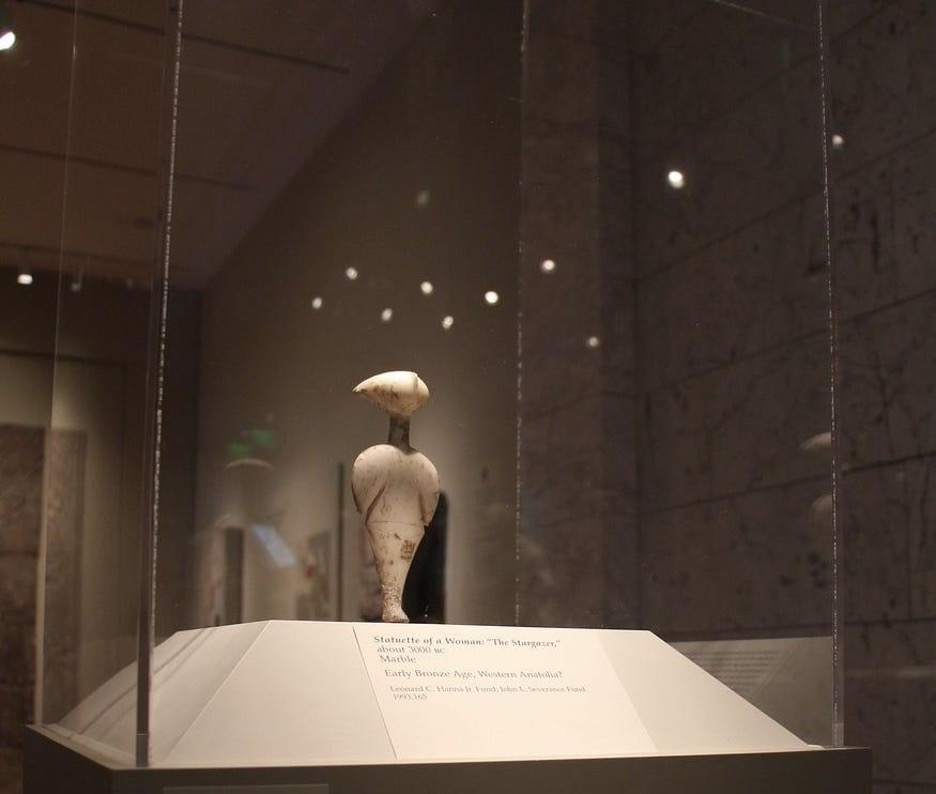
Through the glass in shaded gold—translucent bluish form emerged—delightful flying saucer tilted—on a tiny darkened marble tube—sloping out and each side curved and calmly broadening—then rounding down—to a sharp point—a sense of something standing—looking up with a dignified eyelessness—“cute.”
“I love this little guy” my friend Adam said—as I approached it from a distance—of five millennia and five feet—I was taken out of chronological time—by an alien form—suspended in a lack of understanding—the swelling moment of my life—grew in gentle curiosity—and pure sensation of translucent stone—something so small and out of place—amid the looming gold and color—it surprised me—a futuristic depiction of consciousness—I noticed that it had no spilling flesh.
Adam and I were there to see Lot’s Wife—we had gone to see Lot’s Wife months prior—and years before—but the painting was euphemistically being “restored”—a stretch of years spent trying to put the past back in an image—we went to the museum often—it was generally very good—but today it was full of disappointing objects hurtling toward me—each with a historical velocity.
Adam’s childlike appreciation of this strange little object freed me from the oppression of the other artworks there—“I love this little guy”—he had seen it before—but I hadn’t—or if I had, I didn’t notice—I was too far away and it was too small for me to see clearly—a bowling pin?—some kind of spoon?—no—as I approached—Adam’s voice—“I love this little guy”—met with my eyes—to reveal something resembling a human figure—mysterious smallness—confidently set apart—as soon as I bent my hips above the glass and looked down the categories came—flying saucer head—tilted up on a marble neck—arms at side and standing straight—as hulking, heaving history surrounded me—I was delighted by the triumph of the small.
The shape “stood still, but I could not discern the form thereof; an image was before mine eyes.” That is closer to the truth of it.
●
When I returned to see the sculpture weeks later with a different friend I was again removed from history—my encounter wasn’t the second time—but the first time again—as I watched my friend—“I love this little guy” I said—Adam’s voice traveling through time and space and coming out again in me—“aww, look at it” I said—and then we craned our necks inspectively.
We had walked through the vast—atrium and wide—into a room where giant pieces of the past from other continents hung on walls or swelled up on pedestals.
And everything depended on this tiny body standing straight and looking up.
Mouthless—eyeless—earless—the sculpture couldn’t speak or see or hear—it couldn’t inhabit another’s perspective—or hear another’s voice and speak it—and so the stone revealed to me my personhood—I was made of other people—in a web of inarticulable—I was held in something vast—I couldn’t see.
●
Years later I went back to the museum—at a distance—I watched a family of four—two boisterous squealing young boys—twitching past—parents fiddling with phones then appeared sticklike in the light—two elderly women walked toward it—and paused for three seconds—a young twentysomething couple appeared in my periphery then vanished—an elderly man looked down and hovered his scrunching his face above the glass—as if in pain.
And it happened.
The man was not encountering a chair—and he was not encountering a tree—or a house—he was not encountering something he could use—a category—there was a moment—one of the strangest in my life—where I saw before I knew what I was seeing—and the shape of understanding was withheld—as if somehow inside this strange and muted object which materialized in my vision—there was a future—my future—and this was all very significant… Was it possible for this old man to see what I saw? Was he looking at the same object? Could he see the future?
Some people think looking at art needs information: you learn to distinguish things—and name them—and this increases its pleasure. But this is totally wrong. The initial encounter is full of energy and mystery, created in part by a lack of understanding—coupled with perceptual intensity—and the longer this perceptual intensity lasts—and each new understanding creates layers of non-understanding—the experience seems to expand from within—so that from the outside looking in the first time is over quickly—but from the inside looking out it can last longer than the millennia and distance that the sculpture crossed to get from the Bronze Age to Cleveland.
The cute marble form yielded to inner experience. Art escapes history in heads.
The sculpture’s head is not like any human head I’ve ever seen—somehow—it’s like seeing an orange—or standing in the shadow of a thought—connected to a web of worlds that points beyond it…
It feels weird to call this thing an “artwork”—it was created before the word “artwork” existed—whoever made it had no written language—so someone gave it a name: Statuette of a Woman: “The Stargazer.”
The diminutive “statuette” endears me—but it’s wrong—it’s more like a solar system…—the stone contains all of Stargazer’s eyeless visions—I am made small with it and in it—as I look—I see—the stone comes alive and sees through me—I disappear through looking.
“I love this little guy”—a kind of wondrous swelling…—
I watched the old man bend toward the placard—then hunch away—thick shoes clomping echoes—I snuck up to where he’d just stood—like a spy—
Statuette of a Woman: “The Stargazer”
about 3000 BC
MarbleEarly Bronze Age, Western Anatolia?
Leonard C. Hanna Jr. Fund, John L. Severance Fund
1993.165
●
Months later, in Maryland, I visited the Cleveland Museum of Art website—where the work was transformed from stony eternity into pixels and projections—the stone became numbers—and it was nothing like an orange—or a thought. Art slows time, but digital technology quickens it—I clicked and I wanted to click away—straight on—against a black background—the shape seemed sharper—and flat—less smoothly alien—more obvious…—
I didn’t remember the small gray and brown patches—“burial residue”—I read—concentrated mainly on the neck and the left thigh—tiny abrasions—brown speckles on the translucent marble body—soil, lichen—roping cuts around the ankles—as if the figure’s feet had been bound—and then released.
In person, these details were invisible.
“The Stargazer moniker was given to this diminutive marble sculpture because its upturned head looks toward the heavens”—the website reads—“Details carved into the stone are visible while painted features have been lost to time. We do not know how this object was used, but its enigmatic nature invites speculation.”
Scholarly sources say that it is one of a type—“Cycladic” sculptures—likely “used in rituals”—and many suspect that around 30 percent of these sculptures are forgeries—but no one can prove or disprove it—in 3000 BC—whoever made it could not have imagined the internet—but they could imagine music—a wordless form—I am sure of that—as I continue to encounter words like “Cycladic” and “idol” and “$14,000,000”—I feel the form slip away—into a dark region of forgetting—
In my memory, I close my eyes and I follow her eyeless gaze upward, past the museum ceiling, toward the black sky, punctured with star.