Ancient Egyptians believed that the sun was a golden barge piloted by the god Ra. Each day, he traversed the twelve regions of the daylight sky, casting light upon the banks of the Nile and the sands of the Western Desert; each evening, he descended below the horizon to travel back through the underworld to the region of the dawn. Waiting for him there was Apep, the snake-god of chaos and darkness, who each night ambushed Ra and his ship, hoping to stop the movement of the sun-barge and plunge the world above into an eternal night.
Sources disagree on where exactly Apep was to be found. Some claim he lurked in the tenth region of the night, hoping to strike Ra after he was weakened by his journey through the underworld; others believe he coiled himself around the legendary Mount Bakhu, whose lofty peak holds up the heavens; still others say he lay in wait in the depths of the Nun, the abyssal ocean from which Ra himself sprang on the eve of creation.
Of course, to locate Apep in any particular portion of the underworld was merely a polite fiction, a way to avoid the more terrifying truth: that the serpent was darkness, and darkness was everywhere. Apep had many names and titles, but the truest of them was world-encircler, he who surrounds creation, ever-present, malevolent and infinitely patient.
To imagine a battle between Apep and Ra in any conventional sense, to describe Apep as a serpent at all, was fiction as well. Each night, as Ra piloted through the shadowy realms of the underworld, the battle he fought was not with anything so distinct as a snake. Instead, he battled his fear of the unknown.
●
In 2019, someone started a thread on 4chan asking users to “post disquieting images that just feel ‘off.’” One replied with a picture of a windowless hallway with yellow wallpaper and a drab brown carpet:
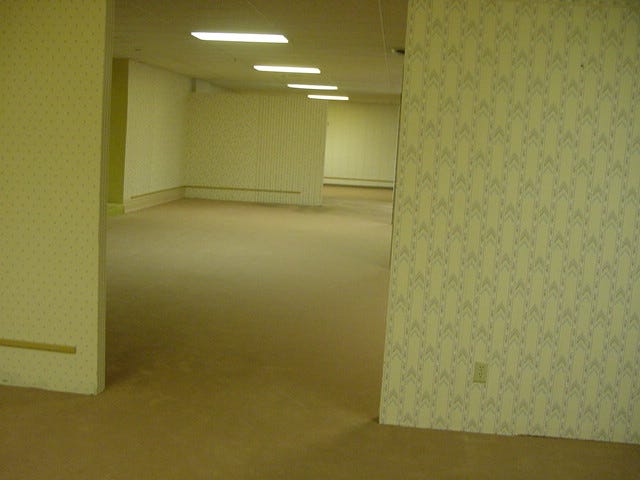
Another user added the following caption:
If you’re not careful and you noclip out of reality in the wrong areas, you’ll end up in the Backrooms, where it’s nothing but the stink of old moist carpet, the madness of mono-yellow, the endless background noise of fluorescent lights at maximum hum-buzz, and approximately six hundred million square miles of randomly segmented empty rooms to be trapped in
God save you if you hear something wandering around nearby, because it sure as hell has heard you
Within days, the post had launched an entire community on Reddit. Users posted their own fictional accounts of being trapped in the Backrooms, elaborating new “levels” below the one first described on 4chan: a concrete parking garage, a public pool, an abandoned hotel, each of them empty, eerie, the contortions of their endless hallways following no obvious logic.
Where the Backrooms really came to life, though, was YouTube. They were the perfect match for the uncanny aesthetic of amateur 3D renders—unnatural lighting, too-smooth surfaces, copy-and-pasted walls and ceilings. The canonical work in this genre, by Kane Parsons—now the 21-year-old director of the movie adaptation Backrooms, which was released in May and has grossed nearly $400 million in box-office sales worldwide—shows a teenager slipping through the ground to land in the labyrinths of the Backrooms. He wanders for hours, discovering no signs of human life other than several mysterious arrows scrawled on the walls, before encountering what the community calls an “entity,” a contorted figure of darkness who pursues and eventually kills him just before he escapes back to earth.
The Backrooms have often been described as drawing on the aesthetics of liminal space. A liminal space is one of transition, and this matches the premise of the Backrooms well enough—endless hallways leading nowhere, a transition without end. But that isn’t what makes the Backrooms distinctive. We might more accurately call them spaces without intention. They borrow from offices, parking garages and malls built in the 1980s and 1990s, large structures constructed to serve a functional need at minimal cost, whose architecture is defined as much by their laziness as their ugliness. If two rooms needed to be connected, the designers simply put a hallway between them, wrapping it around whatever happened to be in the way. They did not think about whether the hallway exhibited symmetry or just proportions, whether it fit into the logic of the larger space or whether it offered the most efficient route from point A to point B. At the extreme, such architecture neglects not only beauty but the idea of order itself.
These spaces, though nominally designed for human use, are in reality deeply hostile to human life. The endless intersections, the bare walls and the worn carpets send a clear message: this place is not for you. It does not care about your desires or your needs. It does not care if you enjoy your journey through these hallways, if you understand the logic of its interminable winding, or even if you reach your destination at all. Such spaces are less the product of human hands than the mindless secretion of an economy growing too rapidly to keep track of its own creations, an incomprehensible collective algorithm, no plans or aspirations, unable to think more than a step or two ahead. Though seemingly functional, their function is conspicuously absent.
This is what lends the Backrooms their uncanny sense of liminality. They evoke the gap not just between origin and destination but between intention and outcome, like a dream where you find yourself in the middle of a task that seems absolutely essential even though you don’t remember how long you’ve been doing it or why. Purgatory not just for the body but for the will. That’s why it’s scary.
Unfortunately, the Backrooms’ fans soon did their best to screw it up. They spent seven years adding to the lore: new levels, new sublevels, entities, creatures, corporations exploring the Backrooms for commercial profit, all of it meticulously detailed on subreddits and online wikis. Everything needed an explanation. One user described a smell of almonds in the Backrooms, likely a reference to the scent of cyanide. But rather than letting the scent remain sourceless and mysterious—as would befit the logic of the Backrooms—the fanbase went on to invent an entire mythology of bottles of almond water scattered around the Backrooms, providing sustenance to travelers, different bottles giving different effects, the whole thing resembling nothing more than a video-game mechanic. The more they elaborated the Backrooms, the smaller they felt.
Parsons’s feature-length adaptation makes the same mistake, attempting to turn the fundamentally bizarre quality of the Backrooms into a tidy, coherent plot. The film begins with Clark (Chiwetel Ejiofor), an unhappy and recently divorced owner of a furniture store, discovering an entrance to the Backrooms in his shop’s basement. During his first visit, he hears a creature—unseen but clearly violent. Undeterred, he returns night after night, eventually enlisting his assistant (Lukita Maxwell) and her boyfriend (Finn Bennett) to provide proof of his discovery. When Clark and his companions go missing, his therapist Mary (Renate Reinsve) investigates, before getting lost in the Backrooms herself.
This first half of Backrooms is a master class in atmospheric dread. Hallways meeting at odd angles, chairs fused together, seagulls suddenly appearing midair only to dash themselves against the walls. Clark’s personality and backstory are largely irrelevant; his primary purpose is to witness these uncanny sights.
By the halfway mark, though, Parsons seems to worry that his audience will grow bored of these montages, and so he abruptly shifts his focus from the Backrooms to the characters within them. Clark, his sanity fraying, attacks Mary and acts out his anger toward his ex-wife. Mary has flashbacks to her schizophrenic mother and her childhood spent indoors. We finally meet the monster prowling the halls; there’s a chase, a fight scene and a reveal of the “true” nature of the Backrooms, which is ultimately quite dull.
Reviewers have struggled to articulate why the second half of Backrooms is so dissatisfying. Several have suggested that a concept launched on an online forum simply doesn’t have the substance to survive the big-screen treatment. As Alison Willmore put it in Vulture, the film is a testament to just “how hard it is to conjure a whole feature out of a vibe.” However, the problem with Backrooms—like much of the online content that inspired it—is less that it relies too much on vibe and more that it fails to understand what makes that vibe interesting in the first place.
The Backrooms are compelling precisely because they evoke a feeling unlike that of the typical horror movie, one that doesn’t rely on jump scares, or gore, or the panicky fright of a monster chase. They conjure a special kind of horror. It is the horror of the unseen and unknown. It is the horror of confronting something so inexplicable as to make a mockery of reason. It is the horror of the sublime.
●
In A Philosophical Enquiry into the Origin of Our Ideas of the Sublime and Beautiful, Edmund Burke defines the sublime precisely in terms of its ability to inspire fear, as “whatever is fitted in any sort to excite the ideas of pain, and danger, that is to say, whatever is in any sort terrible.” Terror, in turn, typically requires a degree of uncertainty, confusion or mystery. “To make anything very terrible,” he writes, “obscurity seems in general to be necessary. When we know the full extent of any danger, when we can accustom our eyes to it, a great deal of the apprehension vanishes.”
For Kant, this failure of comprehension constitutes the essence of the sublime. We experience the sublime when we encounter something that is beyond our ability to grasp intellectually, something that appears “contrapurposive for our power of judgment, incommensurate with our power of exhibition, and as it were violent to our imagination,” and we are confronted with “an abyss in which the imagination is afraid to lose itself.” This arouses in us a feeling of horror—along with a profound pleasure at our very ability to conceive of the inconceivability of the terrifying object.
Kant describes two genres of the sublime—that which arises from considering that which can destroy us (“threatening rocks, thunderclouds piling up in the sky and moving about accompanied by lightning and thunderclaps, volcanoes with all their destructive power”), and that which arises from the contemplation of an object’s staggering scale (think of the sweeping vistas of the Hudson River School, or J.M.W. Turner’s Snow Storm: Hannibal and his Army Crossing the Alps).
The sublime is no ordinary occurrence. It is not enough for something to be large, for example; it must be large “beyond all comparison,” and most of the natural world, even things we might casually call sublime, fails to meet this standard. “Nothing in nature can be given,” Kant writes, “however large we may judge it, that could not, when considered in a different relation, be degraded all the way to the infinitely small.” As he points out, modern science has made such comparisons easier than ever—before the advent of the telescope, it was easier to look at mountains or the sea and believe that they truly were large beyond all comparison. Yet this arguably implies that experiences of the sublime have become rarer and rarer as more of our world is measured and made known.
Where is the sublime today, when we have mapped the oceans and ascended the highest peaks? Where is the sublime when highways crisscross the Alps and retirees take pleasure cruises to the South Pole? Where is the sublime in a world where we level the mountains, clear-cut the forests and poison the sea? Humanity has the power to both comprehend the natural world and destroy it.
I suspect that this hunger for the sublime is what lies behind fans’ obsession with the Backrooms. Reading that original forum post, I had the same feeling of vastness I get from a Turner painting. Not a depiction of nature or the divine, but a nightmare ripped from human imagination itself: large beyond all comparison, able to kill you, terrifying in its incomprehensibility and alienness. This, at least, was something that could not be grasped.
●
Commentators have noted many influences for the Backrooms, from House of Leaves to “The Yellow Wallpaper” to Skinamarink (2022). Its clearest progenitor, however, is the early twentieth-century science fiction writer H.P. Lovecraft, who understood the relationship between horror and the sublime better than any author before or since.
In “The Rats in the Walls,” one of Lovecraft’s earlier stories, a man discovers that the rooms of his ancestral manor are infested by thousands of rats, who each night swarm with squeaks and skittering feet down from the top of the manor to somewhere below. After exploring the basements, he finds steps descending into a vast cavern, sloping down impossibly deep into the earth:
It was a twilit grotto of enormous height, stretching away farther than any eye could see; a subterraneous world of limitless mystery and horrible suggestion. … For yards about the steps extended an insane tangle of human bones, or bones at least as human as those on the steps. Like a foamy sea they stretched … We shall never know what sightless Stygian worlds yawn beyond the little distance we went, for it was decided that such secrets are not good for mankind.
He soon learns that his own forebears are responsible for this endless sea of bones, having spent centuries raising humans like livestock to be eaten in occult rituals. The knowledge of his family’s sins—as overwhelming as the sight of the cavern itself—drives him mad. Acceding to his ancestral lineage, he kills one of his companions and eats his corpse.
Many of Lovecraft’s early stories feature the same device: a discovery of physical vastness to herald the discovery of a similarly vast horror. In “The Music of Erich Zann,” for example, an old man plays the viol toward the drawn curtains of an open window; his downstairs neighbor discovers that the window opens not onto a view of the city but instead an endless black expanse, filled with a mysterious pandemonium the violist is desperately attempting to pacify. In “The Outsider,” a child raised in darkness ascends an impossibly tall tower to find that its peak opens up to another earth, revealing that he has been living below ground—imprisoned there for his hideousness, as he discovers when his attempts to meet others are met with disgust and loathing.
In Lovecraft’s later work, this use of physical space is superseded by a more general concern with fear of the unknown. While Lovecraft’s most famous monster, Cthulhu, is physically large, his true sense of scale comes from what he represents: an unfamiliar order, an alien logic that stands outside the regular working of things and tests the limits of human reason. Exploring the city where they will eventually find him, a group of sailors sees geometry itself beginning to fail. They glimpse “vast angles and stone surfaces—surfaces too great to belong to any thing right or proper for this earth, and impious with horrible images and hieroglyphs … the geometry of the dream-place [they] saw was abnormal, non-Euclidean, and loathsomely redolent of spheres and dimensions apart from ours.” Later, as they flee the island, one disappears without a trace into “an angle of masonry which shouldn’t have been there; an angle which was acute, but behaved as if it were obtuse.”
Most of Lovecraft’s narrators in this period are academics or researchers who try to make sense of bizarre events and fantastical creatures using their familiar tools of scientific inquiry. It is the slow crumbling of their sanity as their efforts fail that give these stories their sense of dread. The fear of incomprehension is most evident in the oft-imitated “Lovecraftian voice,” which is defined by the use and reuse of synonyms for the indescribable, like “unknown,” “nameless,” “immeasurable,” “fathomless” or “unutterable.” (Each of these adjectives appear in a single three-page short story, “Dagon,” along with four uses of “vast.”) Cthulhu, for example, “cannot be described—there is no language for such abysms of shrieking and immemorial lunacy, such eldritch contradictions of all matter, force, and cosmic order.”
Above all, Lovecraft wanted his stories to inspire a very specific feeling in his audience. “Atmosphere, not action, is the great desideratum of weird fiction,” he wrote. “Indeed, all that a wonder story can ever be is a vivid picture of a certain type of human mood.” At times, this meant departing from the traditional emphasis on character and plot in order to focus squarely on the elements of his story that would provide that feeling: the “impossible, improbable, or inconceivable.” As he wrote elsewhere, “The true ‘hero’ of a marvel tale is not any human being, but simply a set of phenomena. Over and above everything else should tower the stark, outrageous monstrousness of the one chosen departure from Nature.” Nothing should distract us from the terrifying strangeness of the story’s central aberration.
The Backrooms are, like Lovecraft’s creations, vast and unfathomable. We don’t know why these hallways exist or what, if anything, is to be gained by exploring them; there is no recognizable logic, no identifiable cause or motivation, just sinister purposelessness, like the spaces that inspired the Backrooms in the first place. As in Lovecraft’s stories, the drama in the film derives—at least initially—from the characters’ failure of comprehension. From the moment Clark discovers the entrance, he is haunted by questions without answers. How can these tunnels be lurking beneath his store? How are they physically possible in the first place? At first, he restricts his movement to only a few of the rooms, drawing out a crude map of how they connect; he was trained as an architect, and you can see his eye for construction. Quickly, though, the inadequacy of this map is revealed, and he realizes to his horror that he has explored only an infinitesimally small part of the Backrooms. He finds musty basements with piles of clothes, tunnels stretching into darkness, something resembling an abandoned public bath where the pools wrap unnaturally around corners and faces bulge out of the white-tiled walls. Always the same misshapen, fused-together quality, a fundamental wrongness in how hallways and rooms meet. And so we begin to glimpse the sublime.
Lovecraft would have understood that this must be the dramatic focus of the movie: the confrontation with the inexplicability of a space too vast to be mapped, too alien to be understood. Early on, the familiar machinery of plot and character might have a place, but at the moment of climax, the focus must be squarely on the feeling of wonder and terror at the central marvel, whose “mere existence should overshadow the character and events.”
Parsons’s earlier Backrooms films on YouTube had generally followed this advice. Most were shot in the fragmentary style of “found footage,” with little in the way of dialogue, exposition or character. The format forced him to keep the emphasis on the Backrooms themselves, whose strangeness would build over the course of a video until some final eeriness, never to be fully explained.
In Backrooms, however, Parsons seems no longer content to dwell in the unknown and unknowable. Armed with a Hollywood script and paid actors, he adopts what he calls a “more intimate, human-driven perspective,” focusing more on the characters, their motivations and conflicts, rather than the mere fact of the Backrooms’ existence. These characters are not especially compelling. (“It’s just the way I’m wired,” Clark tells Mary during one of their therapy sessions, which is basically the extent of Parsons’s insight into his psychology.) They’re also distractions. When Clark lashes out at Mary, we no longer see a man confronting the void; we see a man angry at his ex-wife. When Mary runs from the monster, at the film’s climax, we no longer fear the ungraspable and ineluctable; we fear a particular creature that we can see and from which we can escape. The Backrooms are reduced to mere scenery against which a very conventional story takes place.
Like the ancient Egyptians who chose to imagine Apep as a snake coiled around a mountain or lurking in the ocean, Parsons has attempted to domesticate the Backrooms’ unnerving chaos by giving them a legible form. The true Backrooms, though, like the true realm of night, are boundless and incomprehensible. To imagine a particular form for them, to name that form and define its appearance, is to try to make the unknowable known. And even if that form still inspires a degree of fear, it is nothing compared to the deeper terror of the abyss.

Ancient Egyptians believed that the sun was a golden barge piloted by the god Ra. Each day, he traversed the twelve regions of the daylight sky, casting light upon the banks of the Nile and the sands of the Western Desert; each evening, he descended below the horizon to travel back through the underworld to the region of the dawn. Waiting for him there was Apep, the snake-god of chaos and darkness, who each night ambushed Ra and his ship, hoping to stop the movement of the sun-barge and plunge the world above into an eternal night.
Sources disagree on where exactly Apep was to be found. Some claim he lurked in the tenth region of the night, hoping to strike Ra after he was weakened by his journey through the underworld; others believe he coiled himself around the legendary Mount Bakhu, whose lofty peak holds up the heavens; still others say he lay in wait in the depths of the Nun, the abyssal ocean from which Ra himself sprang on the eve of creation.
Of course, to locate Apep in any particular portion of the underworld was merely a polite fiction, a way to avoid the more terrifying truth: that the serpent was darkness, and darkness was everywhere. Apep had many names and titles, but the truest of them was world-encircler, he who surrounds creation, ever-present, malevolent and infinitely patient.
To imagine a battle between Apep and Ra in any conventional sense, to describe Apep as a serpent at all, was fiction as well. Each night, as Ra piloted through the shadowy realms of the underworld, the battle he fought was not with anything so distinct as a snake. Instead, he battled his fear of the unknown.
●
In 2019, someone started a thread on 4chan asking users to “post disquieting images that just feel ‘off.’” One replied with a picture of a windowless hallway with yellow wallpaper and a drab brown carpet:
Another user added the following caption:
Within days, the post had launched an entire community on Reddit. Users posted their own fictional accounts of being trapped in the Backrooms, elaborating new “levels” below the one first described on 4chan: a concrete parking garage, a public pool, an abandoned hotel, each of them empty, eerie, the contortions of their endless hallways following no obvious logic.
Where the Backrooms really came to life, though, was YouTube. They were the perfect match for the uncanny aesthetic of amateur 3D renders—unnatural lighting, too-smooth surfaces, copy-and-pasted walls and ceilings. The canonical work in this genre, by Kane Parsons—now the 21-year-old director of the movie adaptation Backrooms, which was released in May and has grossed nearly $400 million in box-office sales worldwide—shows a teenager slipping through the ground to land in the labyrinths of the Backrooms. He wanders for hours, discovering no signs of human life other than several mysterious arrows scrawled on the walls, before encountering what the community calls an “entity,” a contorted figure of darkness who pursues and eventually kills him just before he escapes back to earth.
The Backrooms have often been described as drawing on the aesthetics of liminal space. A liminal space is one of transition, and this matches the premise of the Backrooms well enough—endless hallways leading nowhere, a transition without end. But that isn’t what makes the Backrooms distinctive. We might more accurately call them spaces without intention. They borrow from offices, parking garages and malls built in the 1980s and 1990s, large structures constructed to serve a functional need at minimal cost, whose architecture is defined as much by their laziness as their ugliness. If two rooms needed to be connected, the designers simply put a hallway between them, wrapping it around whatever happened to be in the way. They did not think about whether the hallway exhibited symmetry or just proportions, whether it fit into the logic of the larger space or whether it offered the most efficient route from point A to point B. At the extreme, such architecture neglects not only beauty but the idea of order itself.
These spaces, though nominally designed for human use, are in reality deeply hostile to human life. The endless intersections, the bare walls and the worn carpets send a clear message: this place is not for you. It does not care about your desires or your needs. It does not care if you enjoy your journey through these hallways, if you understand the logic of its interminable winding, or even if you reach your destination at all. Such spaces are less the product of human hands than the mindless secretion of an economy growing too rapidly to keep track of its own creations, an incomprehensible collective algorithm, no plans or aspirations, unable to think more than a step or two ahead. Though seemingly functional, their function is conspicuously absent.
This is what lends the Backrooms their uncanny sense of liminality. They evoke the gap not just between origin and destination but between intention and outcome, like a dream where you find yourself in the middle of a task that seems absolutely essential even though you don’t remember how long you’ve been doing it or why. Purgatory not just for the body but for the will. That’s why it’s scary.
Unfortunately, the Backrooms’ fans soon did their best to screw it up. They spent seven years adding to the lore: new levels, new sublevels, entities, creatures, corporations exploring the Backrooms for commercial profit, all of it meticulously detailed on subreddits and online wikis. Everything needed an explanation. One user described a smell of almonds in the Backrooms, likely a reference to the scent of cyanide. But rather than letting the scent remain sourceless and mysterious—as would befit the logic of the Backrooms—the fanbase went on to invent an entire mythology of bottles of almond water scattered around the Backrooms, providing sustenance to travelers, different bottles giving different effects, the whole thing resembling nothing more than a video-game mechanic. The more they elaborated the Backrooms, the smaller they felt.
Parsons’s feature-length adaptation makes the same mistake, attempting to turn the fundamentally bizarre quality of the Backrooms into a tidy, coherent plot. The film begins with Clark (Chiwetel Ejiofor), an unhappy and recently divorced owner of a furniture store, discovering an entrance to the Backrooms in his shop’s basement. During his first visit, he hears a creature—unseen but clearly violent. Undeterred, he returns night after night, eventually enlisting his assistant (Lukita Maxwell) and her boyfriend (Finn Bennett) to provide proof of his discovery. When Clark and his companions go missing, his therapist Mary (Renate Reinsve) investigates, before getting lost in the Backrooms herself.
This first half of Backrooms is a master class in atmospheric dread. Hallways meeting at odd angles, chairs fused together, seagulls suddenly appearing midair only to dash themselves against the walls. Clark’s personality and backstory are largely irrelevant; his primary purpose is to witness these uncanny sights.
By the halfway mark, though, Parsons seems to worry that his audience will grow bored of these montages, and so he abruptly shifts his focus from the Backrooms to the characters within them. Clark, his sanity fraying, attacks Mary and acts out his anger toward his ex-wife. Mary has flashbacks to her schizophrenic mother and her childhood spent indoors. We finally meet the monster prowling the halls; there’s a chase, a fight scene and a reveal of the “true” nature of the Backrooms, which is ultimately quite dull.
Reviewers have struggled to articulate why the second half of Backrooms is so dissatisfying. Several have suggested that a concept launched on an online forum simply doesn’t have the substance to survive the big-screen treatment. As Alison Willmore put it in Vulture, the film is a testament to just “how hard it is to conjure a whole feature out of a vibe.” However, the problem with Backrooms—like much of the online content that inspired it—is less that it relies too much on vibe and more that it fails to understand what makes that vibe interesting in the first place.
The Backrooms are compelling precisely because they evoke a feeling unlike that of the typical horror movie, one that doesn’t rely on jump scares, or gore, or the panicky fright of a monster chase. They conjure a special kind of horror. It is the horror of the unseen and unknown. It is the horror of confronting something so inexplicable as to make a mockery of reason. It is the horror of the sublime.
●
In A Philosophical Enquiry into the Origin of Our Ideas of the Sublime and Beautiful, Edmund Burke defines the sublime precisely in terms of its ability to inspire fear, as “whatever is fitted in any sort to excite the ideas of pain, and danger, that is to say, whatever is in any sort terrible.” Terror, in turn, typically requires a degree of uncertainty, confusion or mystery. “To make anything very terrible,” he writes, “obscurity seems in general to be necessary. When we know the full extent of any danger, when we can accustom our eyes to it, a great deal of the apprehension vanishes.”
For Kant, this failure of comprehension constitutes the essence of the sublime. We experience the sublime when we encounter something that is beyond our ability to grasp intellectually, something that appears “contrapurposive for our power of judgment, incommensurate with our power of exhibition, and as it were violent to our imagination,” and we are confronted with “an abyss in which the imagination is afraid to lose itself.” This arouses in us a feeling of horror—along with a profound pleasure at our very ability to conceive of the inconceivability of the terrifying object.
Kant describes two genres of the sublime—that which arises from considering that which can destroy us (“threatening rocks, thunderclouds piling up in the sky and moving about accompanied by lightning and thunderclaps, volcanoes with all their destructive power”), and that which arises from the contemplation of an object’s staggering scale (think of the sweeping vistas of the Hudson River School, or J.M.W. Turner’s Snow Storm: Hannibal and his Army Crossing the Alps).
The sublime is no ordinary occurrence. It is not enough for something to be large, for example; it must be large “beyond all comparison,” and most of the natural world, even things we might casually call sublime, fails to meet this standard. “Nothing in nature can be given,” Kant writes, “however large we may judge it, that could not, when considered in a different relation, be degraded all the way to the infinitely small.” As he points out, modern science has made such comparisons easier than ever—before the advent of the telescope, it was easier to look at mountains or the sea and believe that they truly were large beyond all comparison. Yet this arguably implies that experiences of the sublime have become rarer and rarer as more of our world is measured and made known.
Where is the sublime today, when we have mapped the oceans and ascended the highest peaks? Where is the sublime when highways crisscross the Alps and retirees take pleasure cruises to the South Pole? Where is the sublime in a world where we level the mountains, clear-cut the forests and poison the sea? Humanity has the power to both comprehend the natural world and destroy it.
I suspect that this hunger for the sublime is what lies behind fans’ obsession with the Backrooms. Reading that original forum post, I had the same feeling of vastness I get from a Turner painting. Not a depiction of nature or the divine, but a nightmare ripped from human imagination itself: large beyond all comparison, able to kill you, terrifying in its incomprehensibility and alienness. This, at least, was something that could not be grasped.
●
Commentators have noted many influences for the Backrooms, from House of Leaves to “The Yellow Wallpaper” to Skinamarink (2022). Its clearest progenitor, however, is the early twentieth-century science fiction writer H.P. Lovecraft, who understood the relationship between horror and the sublime better than any author before or since.
In “The Rats in the Walls,” one of Lovecraft’s earlier stories, a man discovers that the rooms of his ancestral manor are infested by thousands of rats, who each night swarm with squeaks and skittering feet down from the top of the manor to somewhere below. After exploring the basements, he finds steps descending into a vast cavern, sloping down impossibly deep into the earth:
He soon learns that his own forebears are responsible for this endless sea of bones, having spent centuries raising humans like livestock to be eaten in occult rituals. The knowledge of his family’s sins—as overwhelming as the sight of the cavern itself—drives him mad. Acceding to his ancestral lineage, he kills one of his companions and eats his corpse.
Many of Lovecraft’s early stories feature the same device: a discovery of physical vastness to herald the discovery of a similarly vast horror. In “The Music of Erich Zann,” for example, an old man plays the viol toward the drawn curtains of an open window; his downstairs neighbor discovers that the window opens not onto a view of the city but instead an endless black expanse, filled with a mysterious pandemonium the violist is desperately attempting to pacify. In “The Outsider,” a child raised in darkness ascends an impossibly tall tower to find that its peak opens up to another earth, revealing that he has been living below ground—imprisoned there for his hideousness, as he discovers when his attempts to meet others are met with disgust and loathing.
In Lovecraft’s later work, this use of physical space is superseded by a more general concern with fear of the unknown. While Lovecraft’s most famous monster, Cthulhu, is physically large, his true sense of scale comes from what he represents: an unfamiliar order, an alien logic that stands outside the regular working of things and tests the limits of human reason. Exploring the city where they will eventually find him, a group of sailors sees geometry itself beginning to fail. They glimpse “vast angles and stone surfaces—surfaces too great to belong to any thing right or proper for this earth, and impious with horrible images and hieroglyphs … the geometry of the dream-place [they] saw was abnormal, non-Euclidean, and loathsomely redolent of spheres and dimensions apart from ours.” Later, as they flee the island, one disappears without a trace into “an angle of masonry which shouldn’t have been there; an angle which was acute, but behaved as if it were obtuse.”
Most of Lovecraft’s narrators in this period are academics or researchers who try to make sense of bizarre events and fantastical creatures using their familiar tools of scientific inquiry. It is the slow crumbling of their sanity as their efforts fail that give these stories their sense of dread. The fear of incomprehension is most evident in the oft-imitated “Lovecraftian voice,” which is defined by the use and reuse of synonyms for the indescribable, like “unknown,” “nameless,” “immeasurable,” “fathomless” or “unutterable.” (Each of these adjectives appear in a single three-page short story, “Dagon,” along with four uses of “vast.”) Cthulhu, for example, “cannot be described—there is no language for such abysms of shrieking and immemorial lunacy, such eldritch contradictions of all matter, force, and cosmic order.”
Above all, Lovecraft wanted his stories to inspire a very specific feeling in his audience. “Atmosphere, not action, is the great desideratum of weird fiction,” he wrote. “Indeed, all that a wonder story can ever be is a vivid picture of a certain type of human mood.” At times, this meant departing from the traditional emphasis on character and plot in order to focus squarely on the elements of his story that would provide that feeling: the “impossible, improbable, or inconceivable.” As he wrote elsewhere, “The true ‘hero’ of a marvel tale is not any human being, but simply a set of phenomena. Over and above everything else should tower the stark, outrageous monstrousness of the one chosen departure from Nature.” Nothing should distract us from the terrifying strangeness of the story’s central aberration.
The Backrooms are, like Lovecraft’s creations, vast and unfathomable. We don’t know why these hallways exist or what, if anything, is to be gained by exploring them; there is no recognizable logic, no identifiable cause or motivation, just sinister purposelessness, like the spaces that inspired the Backrooms in the first place. As in Lovecraft’s stories, the drama in the film derives—at least initially—from the characters’ failure of comprehension. From the moment Clark discovers the entrance, he is haunted by questions without answers. How can these tunnels be lurking beneath his store? How are they physically possible in the first place? At first, he restricts his movement to only a few of the rooms, drawing out a crude map of how they connect; he was trained as an architect, and you can see his eye for construction. Quickly, though, the inadequacy of this map is revealed, and he realizes to his horror that he has explored only an infinitesimally small part of the Backrooms. He finds musty basements with piles of clothes, tunnels stretching into darkness, something resembling an abandoned public bath where the pools wrap unnaturally around corners and faces bulge out of the white-tiled walls. Always the same misshapen, fused-together quality, a fundamental wrongness in how hallways and rooms meet. And so we begin to glimpse the sublime.
Lovecraft would have understood that this must be the dramatic focus of the movie: the confrontation with the inexplicability of a space too vast to be mapped, too alien to be understood. Early on, the familiar machinery of plot and character might have a place, but at the moment of climax, the focus must be squarely on the feeling of wonder and terror at the central marvel, whose “mere existence should overshadow the character and events.”
Parsons’s earlier Backrooms films on YouTube had generally followed this advice. Most were shot in the fragmentary style of “found footage,” with little in the way of dialogue, exposition or character. The format forced him to keep the emphasis on the Backrooms themselves, whose strangeness would build over the course of a video until some final eeriness, never to be fully explained.
In Backrooms, however, Parsons seems no longer content to dwell in the unknown and unknowable. Armed with a Hollywood script and paid actors, he adopts what he calls a “more intimate, human-driven perspective,” focusing more on the characters, their motivations and conflicts, rather than the mere fact of the Backrooms’ existence. These characters are not especially compelling. (“It’s just the way I’m wired,” Clark tells Mary during one of their therapy sessions, which is basically the extent of Parsons’s insight into his psychology.) They’re also distractions. When Clark lashes out at Mary, we no longer see a man confronting the void; we see a man angry at his ex-wife. When Mary runs from the monster, at the film’s climax, we no longer fear the ungraspable and ineluctable; we fear a particular creature that we can see and from which we can escape. The Backrooms are reduced to mere scenery against which a very conventional story takes place.
Like the ancient Egyptians who chose to imagine Apep as a snake coiled around a mountain or lurking in the ocean, Parsons has attempted to domesticate the Backrooms’ unnerving chaos by giving them a legible form. The true Backrooms, though, like the true realm of night, are boundless and incomprehensible. To imagine a particular form for them, to name that form and define its appearance, is to try to make the unknowable known. And even if that form still inspires a degree of fear, it is nothing compared to the deeper terror of the abyss.
If you liked this essay, you’ll love reading The Point in print.