Every politics has its characteristic aesthetics. This is a truism so widely accepted in the case of fascism that it often tempts otherwise discerning critics to overstate the power of reactionary art. For every Leni Riefenstahl or Knut Hamsun, there is some long-forgotten purveyor of the most banal kitsch—some minor painter of gingerbready village scenes, some carver of half-timbered confections (to say nothing of the nameless mediocrity who directed the alpine romance flicks in which Riefenstahl starred before she took up directing). Still, the frisson that fascism’s best artifacts afford has one merit: it reminds us that fascism looked and felt like something, that it was an ideology with an accompanying sensibility.
The same is rarely said of liberalism, a political formation so pointedly unostentatious that we tend to gaze right through it. There are reams of writing about fascist military parades and socialist-realist murals, yet there is almost nothing comparable about the dull tint at the end of history. Where is liberalism’s “Fascinating Fascism”? Who is its Riefenstahl? At least in its most recent incarnation, it tends to disdain these questions. In its dreams of itself, it is unadorned—a skeletal set of principles and policies without any attendant body. Its heroes are too busy scanning polls and skimming white papers to bother with self-fashioning: in the quintessentially liberal TV series The West Wing, harried wonks pace the halls of the White House in ill-fitting suits and sensible shoes, trying to appear as if they eschewed the distractions of appearance altogether.
Much of this pretense of stylelessness is no more than self-serving delusion, but there are several good reasons for liberalism’s allergy to the aesthetic. For one thing, it is such a heterogeneous philosophy that it repels generalizations. The teeming, humanist liberalism of an Isaiah Berlin has little in common with the professionalized liberalism of a Matthew Yglesias, even at the level of mood or flavor. But to the extent that liberalism has core commitments—or candidates for them—they may prevent it from making any grand aesthetic declarations. The most systematic defender of liberalism in the last century, the Harvard philosopher John Rawls, set the stage for the ensuing fifty years of theory when he rejected perfectionism, the view that the state should impose substantive values on its citizenry. Instead, he argued, each member of a liberal polity must be free to devise and realize her own conception of the good life (in consultation, of course, with her community).
Conservatism, which does not hesitate to impose a single vision on its adherents, is much easier to advertise—and aestheticize. The highly romanticized pictures it recommends are often unappealing, but they are undeniably concrete. Even people who do not want to live in the rosily sanitized universe of a Norman Rockwell painting or a Thomas Kinkade streetscape know exactly what one would look like. A Rawlsian, in contrast, cannot say in advance exactly how any given instance of liberalism will unfold. Though her system has stringent principles—among them, a presumption in favor of material equality—they are consistent with a panoply of cultural formations and styles of life. Justice can look like a small town in New Hampshire, but it can also look like downtown Manhattan. Many different social constellations are consistent with the principles of formal and material equality that the Rawlsian espouses. The plenitude is precisely the point.
True enough—in principle (and famously, Rawls concerned himself only with “ideal theory,” which is to say, only with principle). But in practice, this liberalism, which is so unlike the radically egalitarian sort Rawls envisioned, and which until Trump’s first election in 2016 seemed so wearyingly assured, has a tone and a texture. It has, in short, what a very different sort of liberal once called “manners.” In 1948, the literary critic Lionel Trilling defined these potent ineffables as
a culture’s hum and buzz of implication … which is made up of half-uttered or unuttered or unutterable expressions of value. They are hinted at by small actions, sometimes by the arts of dress or decoration, sometimes by tone, gesture, emphasis, or rhythm, sometimes by the words that are used with a special frequency or a special meaning.
Among the marquee mannerisms of recent liberalism we find chains selling salad bowls, mixed-use developments featuring glassy apartment complexes, the television show Parks and Recreation, the grocery store Trader Joe’s, the word “nuance,” glasses with rectangular frames, group-fitness classes, the profession of consulting, news startups focusing not on criticism or reporting but on commentary, and nonfiction that is a little too good for an airport bookstore but a little too slick and credulously economics-heavy for a literary magazine. The smug yet unconvincing performance of non-aesthetics amounts to aesthetics too.
It is because so many of liberalism’s most prominent defenders fail to recognize this patent fact that they are so mystified by their harshest critics. What so-called post-liberals like Notre Dame professor Patrick Deneen and Vice President J. D. Vance rail against is not their antagonists’ doctrine—not really. Indeed, the post-liberals play so fast and loose with the actual tenets of liberalism that they are scarcely intelligible, so long as they are regarded as participants in a contest of ideas. But it is a mistake to suppose, as so many earnest liberals do, that these details matter. What the post-liberals get right—and the reason they are winning—is that the end of history has been sallow, ugly and deflating. Theirs is decidedly not an intellectual objection. It is not even an ethical objection, though it is often trussed up in the trappings of moral outrage. At its core, it is an aesthetic aversion. The long and short of it is that the post-liberals do not like liberalism’s manners. Would-be proponents of a waning world order can only hope to parry this attack if they confront it on its own terms.
Predictably, they have spent the past year talking desperately past it. While post-liberals gesture at the liberal atmosphere, liberals set out to save their dying ideology by bickering about which housing regulations to change, or which argument in the legal scholarship best supports the notion of the rule of law. Two recent books typify the liberal tendency to fiddle while Rome goes up in flames. Abundance, by the New York Times’s Ezra Klein and the Atlantic’s Derek Thompson, is about making the existing structures of liberalism more efficient; Liberalism: In Defense of Freedom, by Harvard Law School professor Cass Sunstein, taxonomizes liberalism without really championing it. Both books fidget with the mechanics of the liberal machinery—Klein and Thompson with zoning laws and funding structures for scientific research, Sunstein with the minutiae of various arguments in favor of freedom of speech or particular rights—but neither deviates from the bright and conversational tone of a salesman armed with a pitch deck, and neither asks what life under liberalism is actually like.
Both make a number of sensible and convincing points; both are wholly inadequate as attempts to rehabilitate liberalism on the eve of its decimation. Neither addresses—or even acknowledges the importance of addressing—the most serious challenge to the liberal enterprise: the question of whether liberalism can support an ample humanism, of whether it can be beautiful and sweet and sustaining. But liberals ignore these aesthetic matters at their own peril, for the aesthetic is no longer content to ignore their wonkery in exchange.
●
On the one hand, Abundance is an ambitious book. As the leftist lawyer Matt Bruenig writes in Jacobin, it intends to demarcate “the focus of first liberal and then American political life.” It frames itself as no less than “the answer to the question of what the Democratic Party should look like post-Joe Biden.” On the other hand, its big idea shrinks into something quite small under scrutiny.
Klein and Thompson’s central claim is that liberals should supplement redistributive schemes such as Medicare and progressive taxation with what they call “supply-side economics,” a term they hope to wrest back from their Reaganite adversaries. By their lights, it ought to refer to an approach that enlists the state to produce a greater supply of needful goods, generally by deregulating the industries that manufacture them, though sometimes by subsidizing them, and yet other times by managing them directly. Indeed, there is no single method for generating abundance. Sometimes, Klein and Thompson write, we should work toward “removing things that don’t work.” Sometimes, however, we should be “creating entirely new programs that don’t exist but should.” Sometimes, abundance “requires more government. Sometimes it requires less government.” So what do these sundry stratagems have in common? Abundance, Klein and Thompson inform us, “always requires a focus on what the state is trying to achieve and what is in its way.” In other words, abundance requires that government do whatever the government has to do to produce the things that we need—a proposal so vacant it verges on tautology.
Funnily enough, the book that has been so relentlessly billed as the future of liberalism is scarcely about liberalism at all. Really, it is about efficiency—about crafting a governing coalition that can better achieve its goals, whatever they happen to be. One commentator marvels, “abundance has been embraced by post-colonial socialists, techno-futurist capitalists, and Democratic centrists.” But if you have a politics that can be embraced by so many warring camps, you may not have a politics at all. At best, you have a technique (and given that the technique in question is largely a matter of strategic flexibility, you may not even have that).
“A liberalism that builds” is the slogan that Klein and Thompson suggest for their version of supply-side economics. The question I have just raised is: How, exactly, does it build? Another question, no less important and no less obvious, is: A liberalism that builds what? “Turns out people like it when their government gets things done,” Klein and Thompson write stridently at one point. But people tend to care what, exactly, their government is doing. Half the country didn’t like it when Trump dismantled the administrative state, though he did so with impressive speed and bravado. The other half didn’t like the vaccine rollout, though it was so formidable that it figures in Abundance as an exemplar of the book’s guiding approach at work.
Yet Klein and Thompson make no attempt to convince anyone that we should build a specifically liberal abundance, rather than a libertarian or a reactionary one. They simply take it for granted that the airy non-tactics they propose will be directed toward their preferred ends: housing, scientific and medical innovation, green energy and the like. As they clarify in the book’s introductory chapter, they are writing only for readers who already regard these as worthy goals. “We say that we want to save the planet from climate change,” they write. “We say that housing is a human right.” Who is “we”? Whoever it is, the book is pointedly not for anyone it isn’t. Yet the book promises implicitly—and at times explicitly—that it will breathe new life into a moribund political project. How can it hope to do so without winning over new adherents?
The presumption that prevails throughout Abundance is that liberalism has fallen out of favor not because it has failed to justify its aims or vision, not because of the antiseptic tenor of the life it has yielded, not because it is wan and withered, not because it is often outright unjust, but because it isn’t delivering the goods. On this model, conversion or even conversation is a nonstarter, as evidenced by the many states of affairs that Klein and Thompson dismiss as inevitable. They presume, for instance, that the populace cannot be convinced to decrease its meat consumption—“to suggest such a thing is to court political ruin”—even as they imagine a world in which “star pills” have “cured addiction” and slowed “cellular aging.” They’re willing to imagine improbable futuristic advances—“inventions that may seem outlandish today may soon feel essential to our lives,” they assure us—but not a polity with different values and priorities. In this picture, the only thing that can move the needle is sleeker infrastructure.
“If liberals do not want Americans to turn to the false promise of strongmen, they need to offer the fruits of effective government,” Klein and Thompson conclude. But “effective government” is not self-evidently effective; people must be persuaded to see it as such, as the vaccine rollout demonstrates. Abundance is entirely uninterested in the alchemy that alters public opinion. In the end, it is not really a book about politics—convincing constituents, expanding bases, building power—but a book about technology. Its fantasy is that the sheer force of governmental competence can become a substitute for the difficult work of contestation. Its hope is that one day, we will manufacture star pills that can avert cellular aging, cure cancer and recruit our political enemies back onto our side, all in one fell gulp.
●
On the face of it, Sunstein does not seem to suffer from Klein and Thompson’s distaste for persuasion. Liberalism: In Defense of Freedom is peppered with little arguments. We learn, for instance, why we should prefer rule of law over a more ad hoc approach (because rules “increase visibility and accountability,” “reduce the likelihood of bias and arbitrariness,” “minimize the informational and political costs of reaching decisions,” embolden political actors to make unpopular decisions and protect the public from arbitrary officials) and free speech over censorship (because bans on speech induce a chilling effect and because even false speech can be valuable). What we do not learn is why we should be liberal in the first place, in part because Sunstein tends to distance himself from most of the claims he makes. Instead of saying what he thinks, he positions himself as a detached messenger. His writing is riddled with caveats: “many liberals think,” “on another view,” “I do not aim here to choose among these competing understandings,” “reasonable liberals reasonably disagree on such questions.”
To a great extent, then, Liberalism is not quite the defense trumpeted by its subtitle. Much of it is a description dedicated to demonstrating that the tradition it treats is jostling and disunified. Some of its characterizations are unforgivably crude. The book’s first chapter, a list of statements about liberalism initially published in the opinion section of the New York Times in 2023 and later bloated into a lengthier manifesto, is full of coarse generalizations, some of which are plainly false and several of which Sunstein goes on to contradict. “Liberals prize free markets,” he writes, even though he also acknowledges that many liberals (including Rawls) have favored dramatic redistributive programs. “Liberals believe in kindness, humility, and considerateness,” he writes, even though just pages prior he clarified that many liberals are anti-perfectionists who make a point of taking no stance on private virtues. “Liberals have antiliberal, illiberal, and postliberal friends,” he asserts. “Liberals like having friends. They like having friends with disparate views.” Well, some liberals would rather have principles and integrity than “friends” with fascist leanings. With friends like Adrian Vermeule—the post-liberal Harvard Law professor who has professed admiration for Franco and with whom Sunstein has co-authored extensively—who needs enemies?
Elsewhere, however, Liberalism is a reasonably informative primer. Sunstein provides a succinct and lucid overview of the thought of Mill and Hayek, of the advent of the New Deal paradigm and of liberal concepts like opportunity and freedom of speech. If he flits too quickly between history and legal theory to tackle either satisfactorily—and if his book cannot quite decide on its own genre—it is still more illuminating than much of what is written on the topic. At the very least, it captures the conflicted commodiousness of a fractious tradition that many are inclined to flatten into just one of its many guises. Sunstein does not often adjudicate between the various positions he outlines, but he has the virtue of insisting upon the diversity of the liberal project, which encompasses laissez-faire fanatics like Hayek and welfare enthusiasts like Rawls, belletrists like Trilling and decidedly unliterary proceduralists like Klein and Thompson, pessimists like Judith Shklar and utopians like John Stuart Mill, perfectionists who praise pluralism as a positive good and non-perfectionists who commend state neutrality, and many more besides.
Still, that this mild, meandering book was intended to serve as a defense of its subject—especially now that the barbarians formerly at the gate have burst into the White House—is a measure of its impotence. It reads like a dispatch from another era, one in which we could indulge benighted post-liberals with condescending courtesy precisely because liberalism was so fundamentally secure. Sunstein worked in the White House Office of Information and Regulatory Affairs during the Obama administration from 2009 to 2012, and he seems trapped in the affable optimism of that period. Like Thompson and Klein, he cannot really imagine that anyone opposes liberalism, and he writes as if his readers have already opted into it. Even in the passages that come closest to actually commending his ideology of choice, he reverts to feeble description. “A defining feature of liberalism has always been its youth—its energy and fierceness, its delight in human agency, its openness to novelty and surprise, its high spirits.” Is this geriatric account of what liberalism “has always been”—this account that cannot even bring itself to suggest that liberalism still has these qualities—supposed to convince any skeptics? When Sunstein observes that “some contemporary accounts of liberalism … seem a bit tired, passive, backward-looking, even nostalgic,” he seems to be describing himself.
●
There are at least two questions we might ask about the aesthetics of liberalism (or of any political order). The first is which forms it tends to produce; the second is which forms are necessary to sustain it. According to Rawls, the answer to these two questions ought to be the same. Workable political principles, he writes, “should be such that when they are embodied in the basic structure of society men tend to acquire the corresponding sense of justice and develop a desire to act in accordance with its principles.” In other words, the kind of people needed to reproduce liberalism must be the kind of people that liberalism produces. Otherwise, liberalism won’t last.
Thus, even if we card-carrying non-perfectionists are avowedly not in the business of forcing anyone to adopt a particular conception of the good life, we must be in the business of endowing our fellow citizens with a robust appreciation for the seething multiplicity that results when we allow many outlooks to collide. We cannot permit the state to define the true or the good—we cannot point to a Norman Rockwell painting and call it a day, and we wouldn’t want to if we could—but we must nonetheless demonstrate that the true and the good can flourish under liberalism. Most importantly, we must demonstrate that there is something beautiful in the tumult that ensues—a tumult that resembles polytheism as Nietzsche understands it, a chaos in which “dwarfs, fairies, centaurs, satyrs, demons, and devils” consort in a wild melee. In a word, we must show that, in its best and least subdued guises, liberalism enables and instills a taste for the whole of the human mottle, a taste we might call humanism. Parks and Recreation is simply not going to cut it.
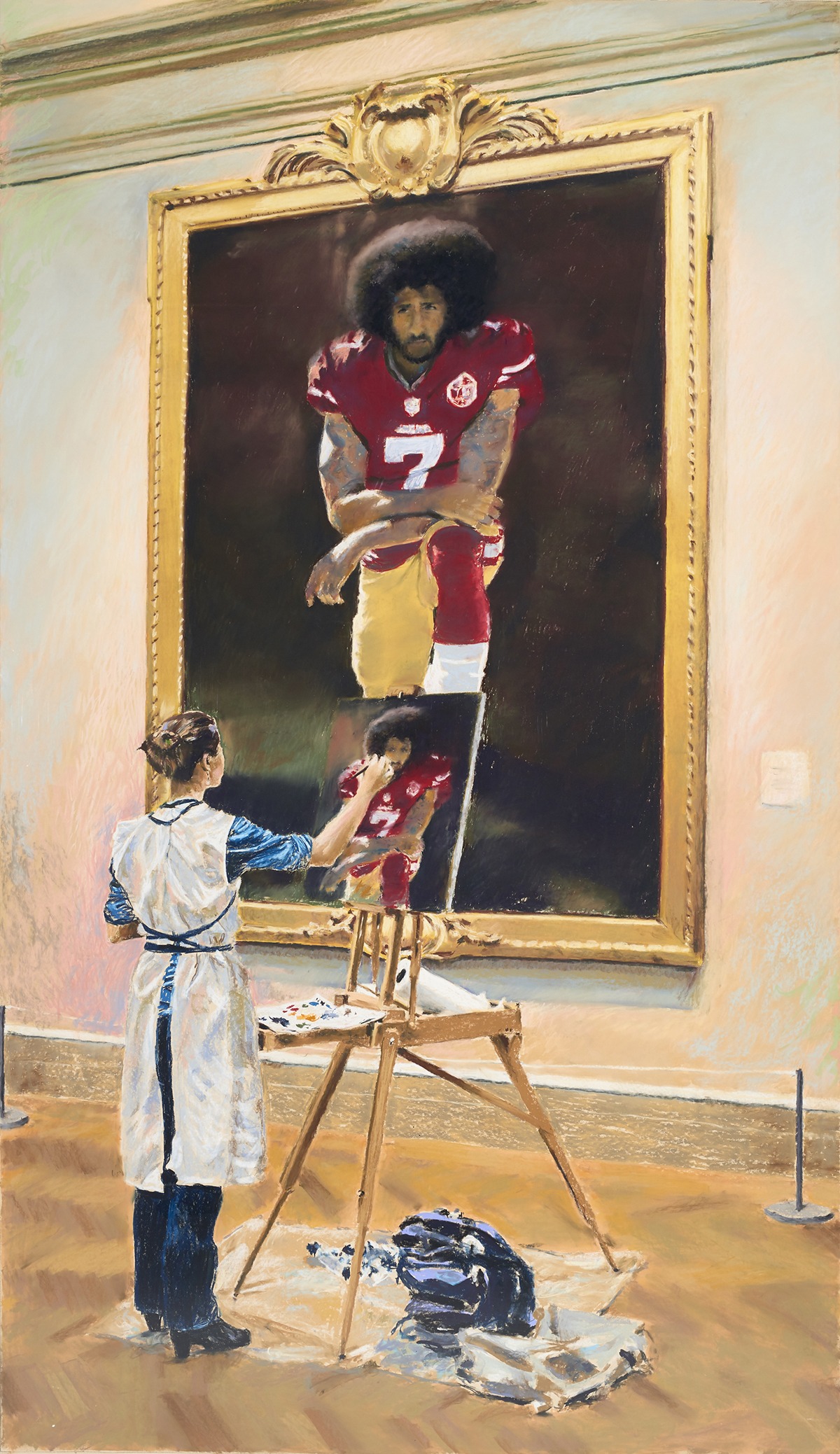
Klein, Thompson and Sunstein make little effort to show that their respective systems allow for, much less foster, a humanistic appetite. For the most part, they relegate the aesthetic to the margins. Sunstein mentions it only briefly, writing that liberals think “the arts broaden the imagination, including the political imagination” and adding that they “admire John Milton, William Blake, Jane Austen, and James Joyce.” But even if liberals could come to a consensus about their tradition’s exemplary artists, which is not likely, Sunstein’s cursory statement does not make any sense of the connection between the liberal order and the liberal palate. Why do liberals admire these artists, if in fact they do? What about the liberal form of life yields this particular canon, if it does? What makes these writers liberal, if in fact they are? How do these writers transform their readers into lovers of social friction, if they do? And perhaps most importantly, how does the quality of existence under the liberal order relate to its characteristic art? About these questions, Sunstein has nothing to say.
Klein and Thompson don’t either, but they do sketch a portrait of the form of life their preferred brand of liberalism is designed to deliver. For a few pages at the beginning of Abundance, they paint a picture of almost novelistic vividness. “A few feet above your head, affixed to the top of the roof, a layer of solar panels blinks in the morning sun,” they write. “You walk to the kitchen to turn on the sink. Water from the ocean pours out of the faucet. It’s fresh and clear, piped from a desalination plant.” You eat meat synthesized in a laboratory and vegetables grown “vertically on tiered shelves inside a tall greenhouse.” And of course, you are dutiful about taking your daily star pills.
Unsurprisingly, this vision is more technological than it is substantive. Klein and Thompson list shiny new amenities yet make almost no mention of the sort of human interaction they facilitate. Aside from a passing mention of some generic “friends,” there is only one character in their fiction, “you.” Do you live with others in a new housing development, and if so, how do you navigate tensions with your neighbors? Are there public spaces that you like to frequent, and if so, do they accommodate everyone? Were there vicious disputes between proponents of abundance and property owners who hoped to preserve single-family housing, and if so, what sort of resentments persist in the resulting polity? Klein and Thompson do not tell us. The realm their character inhabits is one from which clashes and disagreements have been eliminated. The problems from which “you” once suffered in the distant dark ages, before you had ready access to lab-grown meat and star pills, are all problems of convenience.
Not that Klein and Thompson have anything to say about it, but if I had to wager, I’d guess that the art produced in the world of abundance would resemble the popular art of the Obama era, which glorified expertise at the expense of participation. Parks and Rec, which premiered in 2009, lionizes earnest administrators; the Marvel Cinematic Universe, the cinematic scourge that entered onto the scene in 2008, follows an elite crew of superhumans tasked with saving everyone else. The artifact that anticipated these etiolations, The West Wing, has been cited by Klein and other prominent liberal commentators as an influence—and of course, it is about White House staffers who rarely leave the grounds of the president’s mansion and invariably view the public as an irrational body to be placated.
The year The West Wing ended, 2006, it was supplanted by what would become perhaps the quintessential liberal genre: the online TED Talk, in which experts on a brightly lit stage pontificate to an admiring audience off camera. The TED Talk both reflected and modeled the technocratic ideal that triumphed alongside it; in 2016, Wired declared, “We Are Now At Peak TED.” Accordingly, the form has fallen out of favor as the politics of expertise have floundered. Establishment liberals struggle to adapt to the ascendant genre, the podcast, because it is the opposite of the TED Talk: democratized where the TED Talk is asymmetrical, informal where the TED Talk is staged, conversational where the TED Talk is monologic. There is no liberal Joe Rogan because his liberal equivalent would rather soliloquize and tweak a couple of ordinances than enter into an unscripted tête-à-tête for hours.
The problem with the aesthetics and the problem with the politics are, it turns out, one and the same. Both display a hall monitor’s love of rules and regulations; both wish to reduce the gnarl of a person to the simple purity of a plot on a graph. As Trilling put it in a passage about a similarly blinkered worldview, “what is meant negatively is that man cannot be comprehended in a formula; what is meant positively is the sense of complication and possibility, of surprise, intensification, variety, unfoldment, worth.” The sort of art and argument that could make its audience want to be liberal would have to begin by regarding its audience as agents. It would have to enlist them as equals instead of demoting them to the role of pupils; it would have to demonstrate just what form—or, more appropriately to the liberal sensibility, forms—the beautiful abrasions of communal self-determination might take.
One model for this kind of cultural production is the journal in which Trilling first published these lines: the fabled Partisan Review, a literary and political magazine that ran from 1934 until 2003 and that is perhaps the best that American cultural history—and certainly the best that American left-liberalism—has to show for itself. The Review published essays and roundtables alongside fiction from the likes of Kafka and Bellow. Its contributors argued about politics, but they also reviewed all sorts of art, from theater to paintings to novels. Its offerings were smart but never slick; its tone was learned but never condescending; its writers addressed the reader not as if she were a neophyte requiring illumination, but as if she were an interlocutor working out her principles in tandem. Its writers bickered with each other often—indeed, the magazine is bursting with passionate and sometimes bitter disagreement—but they never talked down to each other, much less to their audience. Its writers were proffering the most arduous efforts of their minds, and they were proffering them not in the certainty of rectitude or in the expectation of congratulations but in the hope of correction. The resultant essays were good because they were informed yet curious; the magazine as a whole was good because it was as variegated and crackling as the country itself.
It is difficult to imagine Klein or Sunstein, to say nothing of a Democratic operative, championing the Partisan Review or anything like it. It is difficult to imagine them thinking of fiction—much less dance or film or music—as continuous with their debates over the finer points of policy. And yet the Partisan Review is not only valuable in its own right; its approach also models a worthy political strategy. Good politics, like good art, does not lecture or declaim. It strains; it argues; it is an unending negotiation with the difficult and intransigent adventure of humanity.
Art credit: Eric Yahnker

Every politics has its characteristic aesthetics. This is a truism so widely accepted in the case of fascism that it often tempts otherwise discerning critics to overstate the power of reactionary art. For every Leni Riefenstahl or Knut Hamsun, there is some long-forgotten purveyor of the most banal kitsch—some minor painter of gingerbready village scenes, some carver of half-timbered confections (to say nothing of the nameless mediocrity who directed the alpine romance flicks in which Riefenstahl starred before she took up directing). Still, the frisson that fascism’s best artifacts afford has one merit: it reminds us that fascism looked and felt like something, that it was an ideology with an accompanying sensibility.
The same is rarely said of liberalism, a political formation so pointedly unostentatious that we tend to gaze right through it. There are reams of writing about fascist military parades and socialist-realist murals, yet there is almost nothing comparable about the dull tint at the end of history. Where is liberalism’s “Fascinating Fascism”? Who is its Riefenstahl? At least in its most recent incarnation, it tends to disdain these questions. In its dreams of itself, it is unadorned—a skeletal set of principles and policies without any attendant body. Its heroes are too busy scanning polls and skimming white papers to bother with self-fashioning: in the quintessentially liberal TV series The West Wing, harried wonks pace the halls of the White House in ill-fitting suits and sensible shoes, trying to appear as if they eschewed the distractions of appearance altogether.
Much of this pretense of stylelessness is no more than self-serving delusion, but there are several good reasons for liberalism’s allergy to the aesthetic. For one thing, it is such a heterogeneous philosophy that it repels generalizations. The teeming, humanist liberalism of an Isaiah Berlin has little in common with the professionalized liberalism of a Matthew Yglesias, even at the level of mood or flavor. But to the extent that liberalism has core commitments—or candidates for them—they may prevent it from making any grand aesthetic declarations. The most systematic defender of liberalism in the last century, the Harvard philosopher John Rawls, set the stage for the ensuing fifty years of theory when he rejected perfectionism, the view that the state should impose substantive values on its citizenry. Instead, he argued, each member of a liberal polity must be free to devise and realize her own conception of the good life (in consultation, of course, with her community).
Conservatism, which does not hesitate to impose a single vision on its adherents, is much easier to advertise—and aestheticize. The highly romanticized pictures it recommends are often unappealing, but they are undeniably concrete. Even people who do not want to live in the rosily sanitized universe of a Norman Rockwell painting or a Thomas Kinkade streetscape know exactly what one would look like. A Rawlsian, in contrast, cannot say in advance exactly how any given instance of liberalism will unfold. Though her system has stringent principles—among them, a presumption in favor of material equality—they are consistent with a panoply of cultural formations and styles of life. Justice can look like a small town in New Hampshire, but it can also look like downtown Manhattan. Many different social constellations are consistent with the principles of formal and material equality that the Rawlsian espouses. The plenitude is precisely the point.
True enough—in principle (and famously, Rawls concerned himself only with “ideal theory,” which is to say, only with principle). But in practice, this liberalism, which is so unlike the radically egalitarian sort Rawls envisioned, and which until Trump’s first election in 2016 seemed so wearyingly assured, has a tone and a texture. It has, in short, what a very different sort of liberal once called “manners.” In 1948, the literary critic Lionel Trilling defined these potent ineffables as
Among the marquee mannerisms of recent liberalism we find chains selling salad bowls, mixed-use developments featuring glassy apartment complexes, the television show Parks and Recreation, the grocery store Trader Joe’s, the word “nuance,” glasses with rectangular frames, group-fitness classes, the profession of consulting, news startups focusing not on criticism or reporting but on commentary, and nonfiction that is a little too good for an airport bookstore but a little too slick and credulously economics-heavy for a literary magazine. The smug yet unconvincing performance of non-aesthetics amounts to aesthetics too.
It is because so many of liberalism’s most prominent defenders fail to recognize this patent fact that they are so mystified by their harshest critics. What so-called post-liberals like Notre Dame professor Patrick Deneen and Vice President J. D. Vance rail against is not their antagonists’ doctrine—not really. Indeed, the post-liberals play so fast and loose with the actual tenets of liberalism that they are scarcely intelligible, so long as they are regarded as participants in a contest of ideas. But it is a mistake to suppose, as so many earnest liberals do, that these details matter. What the post-liberals get right—and the reason they are winning—is that the end of history has been sallow, ugly and deflating. Theirs is decidedly not an intellectual objection. It is not even an ethical objection, though it is often trussed up in the trappings of moral outrage. At its core, it is an aesthetic aversion. The long and short of it is that the post-liberals do not like liberalism’s manners. Would-be proponents of a waning world order can only hope to parry this attack if they confront it on its own terms.
Predictably, they have spent the past year talking desperately past it. While post-liberals gesture at the liberal atmosphere, liberals set out to save their dying ideology by bickering about which housing regulations to change, or which argument in the legal scholarship best supports the notion of the rule of law. Two recent books typify the liberal tendency to fiddle while Rome goes up in flames. Abundance, by the New York Times’s Ezra Klein and the Atlantic’s Derek Thompson, is about making the existing structures of liberalism more efficient; Liberalism: In Defense of Freedom, by Harvard Law School professor Cass Sunstein, taxonomizes liberalism without really championing it. Both books fidget with the mechanics of the liberal machinery—Klein and Thompson with zoning laws and funding structures for scientific research, Sunstein with the minutiae of various arguments in favor of freedom of speech or particular rights—but neither deviates from the bright and conversational tone of a salesman armed with a pitch deck, and neither asks what life under liberalism is actually like.
Both make a number of sensible and convincing points; both are wholly inadequate as attempts to rehabilitate liberalism on the eve of its decimation. Neither addresses—or even acknowledges the importance of addressing—the most serious challenge to the liberal enterprise: the question of whether liberalism can support an ample humanism, of whether it can be beautiful and sweet and sustaining. But liberals ignore these aesthetic matters at their own peril, for the aesthetic is no longer content to ignore their wonkery in exchange.
●
On the one hand, Abundance is an ambitious book. As the leftist lawyer Matt Bruenig writes in Jacobin, it intends to demarcate “the focus of first liberal and then American political life.” It frames itself as no less than “the answer to the question of what the Democratic Party should look like post-Joe Biden.” On the other hand, its big idea shrinks into something quite small under scrutiny.
Klein and Thompson’s central claim is that liberals should supplement redistributive schemes such as Medicare and progressive taxation with what they call “supply-side economics,” a term they hope to wrest back from their Reaganite adversaries. By their lights, it ought to refer to an approach that enlists the state to produce a greater supply of needful goods, generally by deregulating the industries that manufacture them, though sometimes by subsidizing them, and yet other times by managing them directly. Indeed, there is no single method for generating abundance. Sometimes, Klein and Thompson write, we should work toward “removing things that don’t work.” Sometimes, however, we should be “creating entirely new programs that don’t exist but should.” Sometimes, abundance “requires more government. Sometimes it requires less government.” So what do these sundry stratagems have in common? Abundance, Klein and Thompson inform us, “always requires a focus on what the state is trying to achieve and what is in its way.” In other words, abundance requires that government do whatever the government has to do to produce the things that we need—a proposal so vacant it verges on tautology.
Funnily enough, the book that has been so relentlessly billed as the future of liberalism is scarcely about liberalism at all. Really, it is about efficiency—about crafting a governing coalition that can better achieve its goals, whatever they happen to be. One commentator marvels, “abundance has been embraced by post-colonial socialists, techno-futurist capitalists, and Democratic centrists.” But if you have a politics that can be embraced by so many warring camps, you may not have a politics at all. At best, you have a technique (and given that the technique in question is largely a matter of strategic flexibility, you may not even have that).
“A liberalism that builds” is the slogan that Klein and Thompson suggest for their version of supply-side economics. The question I have just raised is: How, exactly, does it build? Another question, no less important and no less obvious, is: A liberalism that builds what? “Turns out people like it when their government gets things done,” Klein and Thompson write stridently at one point. But people tend to care what, exactly, their government is doing. Half the country didn’t like it when Trump dismantled the administrative state, though he did so with impressive speed and bravado. The other half didn’t like the vaccine rollout, though it was so formidable that it figures in Abundance as an exemplar of the book’s guiding approach at work.
Yet Klein and Thompson make no attempt to convince anyone that we should build a specifically liberal abundance, rather than a libertarian or a reactionary one. They simply take it for granted that the airy non-tactics they propose will be directed toward their preferred ends: housing, scientific and medical innovation, green energy and the like. As they clarify in the book’s introductory chapter, they are writing only for readers who already regard these as worthy goals. “We say that we want to save the planet from climate change,” they write. “We say that housing is a human right.” Who is “we”? Whoever it is, the book is pointedly not for anyone it isn’t. Yet the book promises implicitly—and at times explicitly—that it will breathe new life into a moribund political project. How can it hope to do so without winning over new adherents?
The presumption that prevails throughout Abundance is that liberalism has fallen out of favor not because it has failed to justify its aims or vision, not because of the antiseptic tenor of the life it has yielded, not because it is wan and withered, not because it is often outright unjust, but because it isn’t delivering the goods. On this model, conversion or even conversation is a nonstarter, as evidenced by the many states of affairs that Klein and Thompson dismiss as inevitable. They presume, for instance, that the populace cannot be convinced to decrease its meat consumption—“to suggest such a thing is to court political ruin”—even as they imagine a world in which “star pills” have “cured addiction” and slowed “cellular aging.” They’re willing to imagine improbable futuristic advances—“inventions that may seem outlandish today may soon feel essential to our lives,” they assure us—but not a polity with different values and priorities. In this picture, the only thing that can move the needle is sleeker infrastructure.
“If liberals do not want Americans to turn to the false promise of strongmen, they need to offer the fruits of effective government,” Klein and Thompson conclude. But “effective government” is not self-evidently effective; people must be persuaded to see it as such, as the vaccine rollout demonstrates. Abundance is entirely uninterested in the alchemy that alters public opinion. In the end, it is not really a book about politics—convincing constituents, expanding bases, building power—but a book about technology. Its fantasy is that the sheer force of governmental competence can become a substitute for the difficult work of contestation. Its hope is that one day, we will manufacture star pills that can avert cellular aging, cure cancer and recruit our political enemies back onto our side, all in one fell gulp.
●
On the face of it, Sunstein does not seem to suffer from Klein and Thompson’s distaste for persuasion. Liberalism: In Defense of Freedom is peppered with little arguments. We learn, for instance, why we should prefer rule of law over a more ad hoc approach (because rules “increase visibility and accountability,” “reduce the likelihood of bias and arbitrariness,” “minimize the informational and political costs of reaching decisions,” embolden political actors to make unpopular decisions and protect the public from arbitrary officials) and free speech over censorship (because bans on speech induce a chilling effect and because even false speech can be valuable). What we do not learn is why we should be liberal in the first place, in part because Sunstein tends to distance himself from most of the claims he makes. Instead of saying what he thinks, he positions himself as a detached messenger. His writing is riddled with caveats: “many liberals think,” “on another view,” “I do not aim here to choose among these competing understandings,” “reasonable liberals reasonably disagree on such questions.”
To a great extent, then, Liberalism is not quite the defense trumpeted by its subtitle. Much of it is a description dedicated to demonstrating that the tradition it treats is jostling and disunified. Some of its characterizations are unforgivably crude. The book’s first chapter, a list of statements about liberalism initially published in the opinion section of the New York Times in 2023 and later bloated into a lengthier manifesto, is full of coarse generalizations, some of which are plainly false and several of which Sunstein goes on to contradict. “Liberals prize free markets,” he writes, even though he also acknowledges that many liberals (including Rawls) have favored dramatic redistributive programs. “Liberals believe in kindness, humility, and considerateness,” he writes, even though just pages prior he clarified that many liberals are anti-perfectionists who make a point of taking no stance on private virtues. “Liberals have antiliberal, illiberal, and postliberal friends,” he asserts. “Liberals like having friends. They like having friends with disparate views.” Well, some liberals would rather have principles and integrity than “friends” with fascist leanings. With friends like Adrian Vermeule—the post-liberal Harvard Law professor who has professed admiration for Franco and with whom Sunstein has co-authored extensively—who needs enemies?
Elsewhere, however, Liberalism is a reasonably informative primer. Sunstein provides a succinct and lucid overview of the thought of Mill and Hayek, of the advent of the New Deal paradigm and of liberal concepts like opportunity and freedom of speech. If he flits too quickly between history and legal theory to tackle either satisfactorily—and if his book cannot quite decide on its own genre—it is still more illuminating than much of what is written on the topic. At the very least, it captures the conflicted commodiousness of a fractious tradition that many are inclined to flatten into just one of its many guises. Sunstein does not often adjudicate between the various positions he outlines, but he has the virtue of insisting upon the diversity of the liberal project, which encompasses laissez-faire fanatics like Hayek and welfare enthusiasts like Rawls, belletrists like Trilling and decidedly unliterary proceduralists like Klein and Thompson, pessimists like Judith Shklar and utopians like John Stuart Mill, perfectionists who praise pluralism as a positive good and non-perfectionists who commend state neutrality, and many more besides.
Still, that this mild, meandering book was intended to serve as a defense of its subject—especially now that the barbarians formerly at the gate have burst into the White House—is a measure of its impotence. It reads like a dispatch from another era, one in which we could indulge benighted post-liberals with condescending courtesy precisely because liberalism was so fundamentally secure. Sunstein worked in the White House Office of Information and Regulatory Affairs during the Obama administration from 2009 to 2012, and he seems trapped in the affable optimism of that period. Like Thompson and Klein, he cannot really imagine that anyone opposes liberalism, and he writes as if his readers have already opted into it. Even in the passages that come closest to actually commending his ideology of choice, he reverts to feeble description. “A defining feature of liberalism has always been its youth—its energy and fierceness, its delight in human agency, its openness to novelty and surprise, its high spirits.” Is this geriatric account of what liberalism “has always been”—this account that cannot even bring itself to suggest that liberalism still has these qualities—supposed to convince any skeptics? When Sunstein observes that “some contemporary accounts of liberalism … seem a bit tired, passive, backward-looking, even nostalgic,” he seems to be describing himself.
●
There are at least two questions we might ask about the aesthetics of liberalism (or of any political order). The first is which forms it tends to produce; the second is which forms are necessary to sustain it. According to Rawls, the answer to these two questions ought to be the same. Workable political principles, he writes, “should be such that when they are embodied in the basic structure of society men tend to acquire the corresponding sense of justice and develop a desire to act in accordance with its principles.” In other words, the kind of people needed to reproduce liberalism must be the kind of people that liberalism produces. Otherwise, liberalism won’t last.
Thus, even if we card-carrying non-perfectionists are avowedly not in the business of forcing anyone to adopt a particular conception of the good life, we must be in the business of endowing our fellow citizens with a robust appreciation for the seething multiplicity that results when we allow many outlooks to collide. We cannot permit the state to define the true or the good—we cannot point to a Norman Rockwell painting and call it a day, and we wouldn’t want to if we could—but we must nonetheless demonstrate that the true and the good can flourish under liberalism. Most importantly, we must demonstrate that there is something beautiful in the tumult that ensues—a tumult that resembles polytheism as Nietzsche understands it, a chaos in which “dwarfs, fairies, centaurs, satyrs, demons, and devils” consort in a wild melee. In a word, we must show that, in its best and least subdued guises, liberalism enables and instills a taste for the whole of the human mottle, a taste we might call humanism. Parks and Recreation is simply not going to cut it.
Klein, Thompson and Sunstein make little effort to show that their respective systems allow for, much less foster, a humanistic appetite. For the most part, they relegate the aesthetic to the margins. Sunstein mentions it only briefly, writing that liberals think “the arts broaden the imagination, including the political imagination” and adding that they “admire John Milton, William Blake, Jane Austen, and James Joyce.” But even if liberals could come to a consensus about their tradition’s exemplary artists, which is not likely, Sunstein’s cursory statement does not make any sense of the connection between the liberal order and the liberal palate. Why do liberals admire these artists, if in fact they do? What about the liberal form of life yields this particular canon, if it does? What makes these writers liberal, if in fact they are? How do these writers transform their readers into lovers of social friction, if they do? And perhaps most importantly, how does the quality of existence under the liberal order relate to its characteristic art? About these questions, Sunstein has nothing to say.
Klein and Thompson don’t either, but they do sketch a portrait of the form of life their preferred brand of liberalism is designed to deliver. For a few pages at the beginning of Abundance, they paint a picture of almost novelistic vividness. “A few feet above your head, affixed to the top of the roof, a layer of solar panels blinks in the morning sun,” they write. “You walk to the kitchen to turn on the sink. Water from the ocean pours out of the faucet. It’s fresh and clear, piped from a desalination plant.” You eat meat synthesized in a laboratory and vegetables grown “vertically on tiered shelves inside a tall greenhouse.” And of course, you are dutiful about taking your daily star pills.
Unsurprisingly, this vision is more technological than it is substantive. Klein and Thompson list shiny new amenities yet make almost no mention of the sort of human interaction they facilitate. Aside from a passing mention of some generic “friends,” there is only one character in their fiction, “you.” Do you live with others in a new housing development, and if so, how do you navigate tensions with your neighbors? Are there public spaces that you like to frequent, and if so, do they accommodate everyone? Were there vicious disputes between proponents of abundance and property owners who hoped to preserve single-family housing, and if so, what sort of resentments persist in the resulting polity? Klein and Thompson do not tell us. The realm their character inhabits is one from which clashes and disagreements have been eliminated. The problems from which “you” once suffered in the distant dark ages, before you had ready access to lab-grown meat and star pills, are all problems of convenience.
Not that Klein and Thompson have anything to say about it, but if I had to wager, I’d guess that the art produced in the world of abundance would resemble the popular art of the Obama era, which glorified expertise at the expense of participation. Parks and Rec, which premiered in 2009, lionizes earnest administrators; the Marvel Cinematic Universe, the cinematic scourge that entered onto the scene in 2008, follows an elite crew of superhumans tasked with saving everyone else. The artifact that anticipated these etiolations, The West Wing, has been cited by Klein and other prominent liberal commentators as an influence—and of course, it is about White House staffers who rarely leave the grounds of the president’s mansion and invariably view the public as an irrational body to be placated.
The year The West Wing ended, 2006, it was supplanted by what would become perhaps the quintessential liberal genre: the online TED Talk, in which experts on a brightly lit stage pontificate to an admiring audience off camera. The TED Talk both reflected and modeled the technocratic ideal that triumphed alongside it; in 2016, Wired declared, “We Are Now At Peak TED.” Accordingly, the form has fallen out of favor as the politics of expertise have floundered. Establishment liberals struggle to adapt to the ascendant genre, the podcast, because it is the opposite of the TED Talk: democratized where the TED Talk is asymmetrical, informal where the TED Talk is staged, conversational where the TED Talk is monologic. There is no liberal Joe Rogan because his liberal equivalent would rather soliloquize and tweak a couple of ordinances than enter into an unscripted tête-à-tête for hours.
The problem with the aesthetics and the problem with the politics are, it turns out, one and the same. Both display a hall monitor’s love of rules and regulations; both wish to reduce the gnarl of a person to the simple purity of a plot on a graph. As Trilling put it in a passage about a similarly blinkered worldview, “what is meant negatively is that man cannot be comprehended in a formula; what is meant positively is the sense of complication and possibility, of surprise, intensification, variety, unfoldment, worth.” The sort of art and argument that could make its audience want to be liberal would have to begin by regarding its audience as agents. It would have to enlist them as equals instead of demoting them to the role of pupils; it would have to demonstrate just what form—or, more appropriately to the liberal sensibility, forms—the beautiful abrasions of communal self-determination might take.
One model for this kind of cultural production is the journal in which Trilling first published these lines: the fabled Partisan Review, a literary and political magazine that ran from 1934 until 2003 and that is perhaps the best that American cultural history—and certainly the best that American left-liberalism—has to show for itself. The Review published essays and roundtables alongside fiction from the likes of Kafka and Bellow. Its contributors argued about politics, but they also reviewed all sorts of art, from theater to paintings to novels. Its offerings were smart but never slick; its tone was learned but never condescending; its writers addressed the reader not as if she were a neophyte requiring illumination, but as if she were an interlocutor working out her principles in tandem. Its writers bickered with each other often—indeed, the magazine is bursting with passionate and sometimes bitter disagreement—but they never talked down to each other, much less to their audience. Its writers were proffering the most arduous efforts of their minds, and they were proffering them not in the certainty of rectitude or in the expectation of congratulations but in the hope of correction. The resultant essays were good because they were informed yet curious; the magazine as a whole was good because it was as variegated and crackling as the country itself.
It is difficult to imagine Klein or Sunstein, to say nothing of a Democratic operative, championing the Partisan Review or anything like it. It is difficult to imagine them thinking of fiction—much less dance or film or music—as continuous with their debates over the finer points of policy. And yet the Partisan Review is not only valuable in its own right; its approach also models a worthy political strategy. Good politics, like good art, does not lecture or declaim. It strains; it argues; it is an unending negotiation with the difficult and intransigent adventure of humanity.
Art credit: Eric Yahnker
If you liked this essay, you’ll love reading The Point in print.